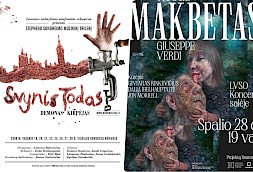
Aušrinė Stundytė
soprano

Works with Vilnius City Opera


In opera
"Elektra“
"Salome“
"Bluebeard's Castle“
"Lady Macbeth of the Mtsensk District“
"The Fiery Angel“
"Madama Butterfly“
"Manon Lescaut“
"Tosca“
"Eugene Onegin“
"The Queen of Spades“
"Don Carlos“
"Un ballo in maschera“
"Otello“
"Pagliacci“
"Die Walküre“
"Fidelio“
"Andrea Chénier“
"Die tote Stadt“
"La Voix humaine“
"Der Rosenkavalier“
"The Enchantress“
"Die Eroberung von Mexico“
"Selma Jezková“
"Tristan und Isolde"
"Laukimas“
"Die Teufel von Loudun"
"Opera About the End of the World"
"Dido and Aeneas"
"The Makropulos Case"
"The Idiot"
"The Gambler"
"Die Frau ohne Schatten"
Theaters
United Kingdom
Germany
France
Austria
Germany
Germany
Germany
Germany
Germany
France
Belgium
The Netherlands
Switzerland
Italy
Italy
Italy
Italy
Spain
Spain
Spain
Brasil
Finland
Poland
Austria
Germany
France
Switzerland
Switzerland
Finland
Austria
Norway
In concerts
A. Berg
R. Strauss
R. Wagner
A. von Zemlinsky
Collaborated with conductors
Antonio Pappano
Alexander Soddy
Mirga Gražinytė-Tyla
Franz Welser-Möst
Gianandrea Noseda
Zubin Metha
Kazushi Ono
Fabio Luisi
Jeffrey Tate
Julia Jones
Julian Kovatchev
Marco Armiliato
Dmitri Jurowski
Markus Stenz
Gabriel Feltz
Collaborated with directors
Krzysztof Warlikowsky
Calixto Bieito
Dmitrij Černiakov
Robert Carsen
Peter Konwitschny
Barry Kosky
Graham Vick
David Alden
Christof Nel
Pierre Audi
Tatjana Gürbaca
Anthony Pilavachi
Romeo Castellucci
Peter Sellers
Katie Mitchell
Awards
XXV International Hans Gabor Belvedere Singing Competition
Second operetta award
Chambre Professionnelle des Directeurs d'Opéra Paris
Special award
„Helikon Opera“ Moscow award
Special award
Musikpreis der RWE-Energie
Award
J. Offenbach award
Award
There are good girls and there are bad. There is Kát’a Kabanová and there is Aušrinė Stundytė who undertook to portray her. The two are hardly comparable, though… Meanwhile Leoš Janáček’s Kát’a Kabanová might be compared to an aggravated version of Žemaitė’s Daughter-in-law, which depicts a young woman torn between her moral conviction, responsibility and genuine feelings. The thorough psychological analysis of this role remains invisible to the audience and is well hidden under Aušrinė’s emotionally tense performance. Mathematics and strategic thinking are among the strengths of this soprano. Just like her special penchant for 20th century music, which is not everyone’s cup of tea. Aušrinė appears in the leading roles at major opera venues like Opera national de Paris, La Fenice Venice, Berlin, Bayreusche, Wiener staatsoper, Salzburg and Aix-en-Provence Festivals. The soloist is capable of embodying the roles that require the kind of devotion and mettle more characteristic of film actors. When at home in Belgium, Aušrinė diverts herself with... making drawings and installations.
Related news
Bohemians Turn 20: Anniversary Season to Culminate in Norma with Asmik Grigorian

Sustainability in opera: how Juozas Statkevičius’s costumes were given new life a decade later

When everything hangs in the balance on stage: the invisible heroines of Dalia Ibelhauptaitė’s productions reveal the secrets behind the scenes

How Bohemians’ advertising took to the streets and changed perceptions of opera