KÁŤA KABANOVÁ
Leoš Janáček
Conductor:
Gintaras Rinkevičius
Director:
Dalia Ibelhauptaitė
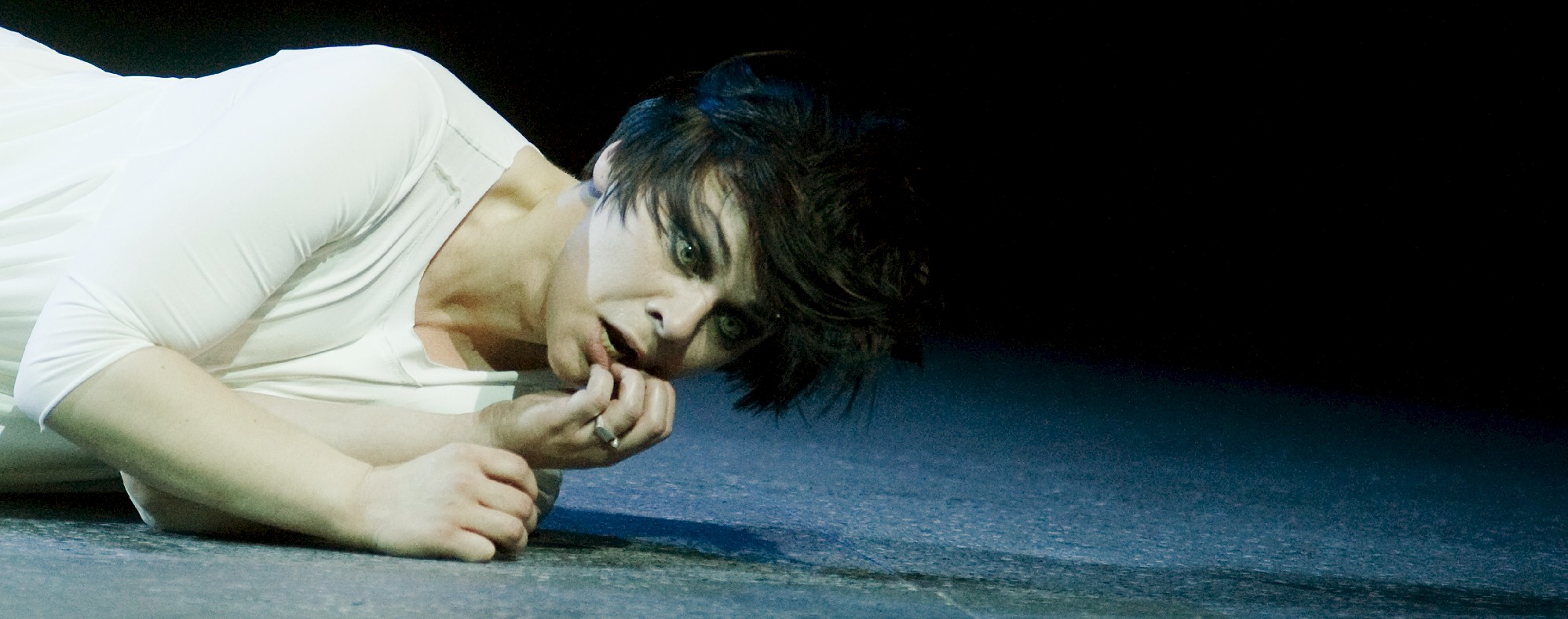
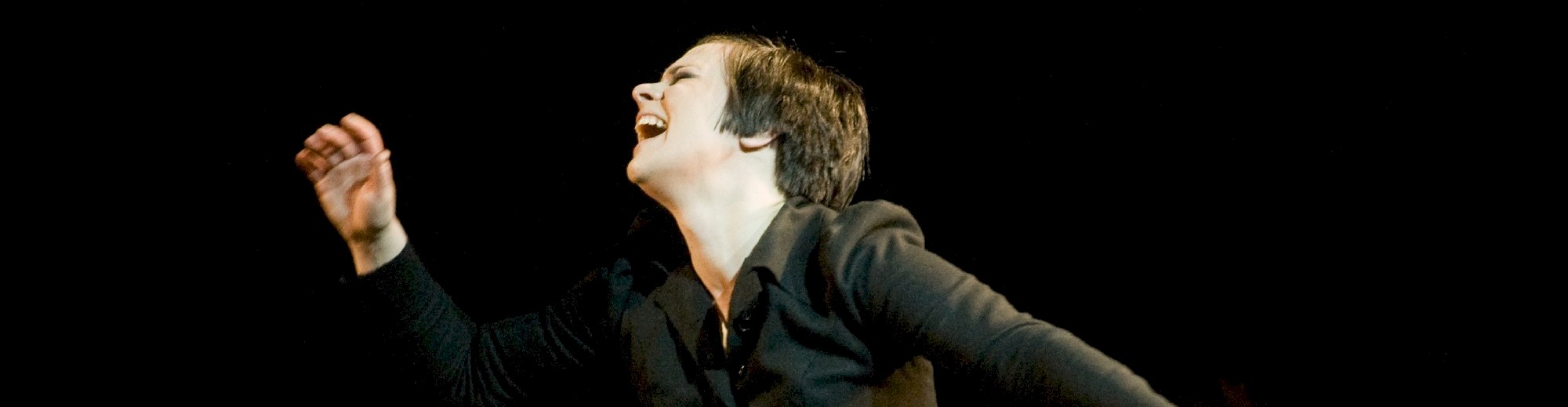
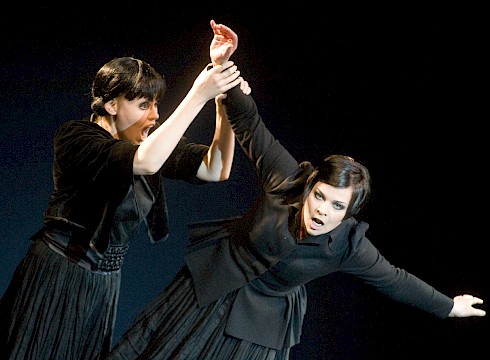
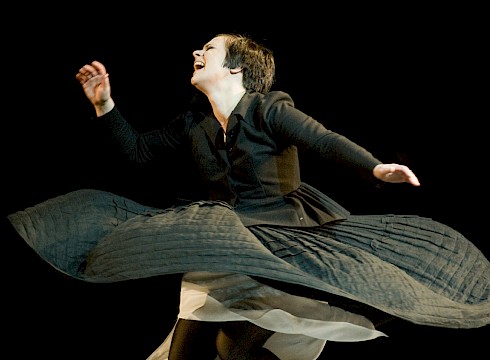
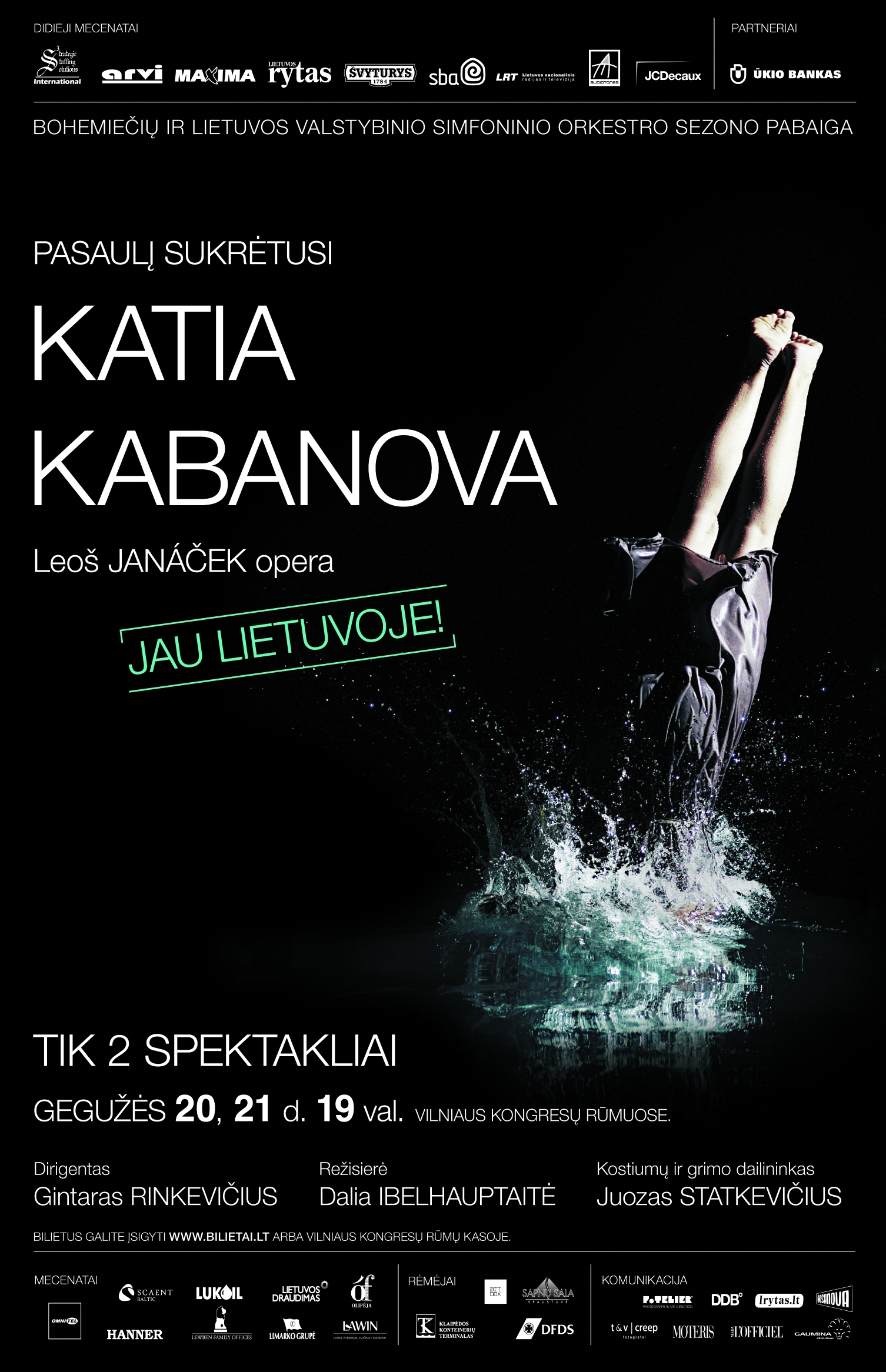
In 2011, VCO started exploring the works of Leoš Janáček – the little known composer who’s operas never before were staged in Lithuania. For the first production, the opera chosen was “Káťa Kabanová” which started the series of “Gourmet Opera”, introducing world famous composers and works not yet familiar in Lithuania. “Less stage sets, more emotion” was the motto of the creators of the show at the time, so they chose to place “Káťa Kabanová” in an abstract dark setting and to allow the opera’s passions to flourish. The main role of Káťa was played by the talented Aušrinė Stundytė who at the time was a complete unknown to the audience in her homeland.
In Lithuania, works of 20th century music geniuses are still largely ignored: “There should be no such gaps in our culture,” states D. Ibelhauptaitė. “It is commonly thought that operas of the 20th century are unappealing, lacking a clear plot and characters and generally unpleasantly sounding. We want to dispel this myth. In truth, these works are highly emotional, convincing, and moving, and positively able to affect any person’s soul and senses.”

Creators


Performers


Glasa
Laura Zigmantaitė
Feklusa
Jūratė Rudžianskaitė
Kuligin
Tomas Tuskenis

Premiere: 2011 May 21
LEOŠ JANÁČEK’S PHENOMENON
A musical eccentric, an individualist who disregarded authority, an exceptionally modern and original creator - this is how Leoš Janáček (1854–1928) is described by his contemporaries and the luminaries of modern music.
He may not be as widely recognized as his countrymen Antonín Dvořák and Bedřich Smetana, but he is no less significant as a unique 20th-century musical figure with much to say to today’s audiences.
Janáček is one of those composers from the last-century who tried to bring their art as close as possible to reality, tying it to everyday life. So it’s no surprise that his works are performed all over the world today and are popular with the public.
*
During his early creative period, Janáček followed in Dvořák’s and Smetana’s traditions, but later forged his own unique musical style. From the last decades of the 19th-century until his death, the composer was profoundly influenced by Moravian and Slovak folk culture - its spirit resonates in his mature compositions.
What sets this composer most distinctly aside from his peers is his imitation of the intonations and rhythms of everyday speech in both vocal and instrumental creativity. The composer even studied how human psychology and temperament affect speech in order to apply these observations in his operas. According to his students, traces of his own manner of expression can be recognized in the vocal lines of some of his opera characters.
Janáček led the Brno Organist School for nearly 40 years; later, he was a Professor at the Brno branch of the Prague Conservatory. He founded the Brno School of Composition. Nevertheless, his students did not become his followers - they neither imitated nor further developed their teacher’s style. Janáček walked his own path, somewhat isolated from the modernist trends of his time, although he was passionate about the creativity of other European composers.
Janáček’s unique music was a tough nut even for his contemporaries. His principal advocate, Václav Talich - the chief conductor of the Czech Philharmonics - used to revise his scores, insisting their orchestration was “unfinished” or “unacceptable.”
It was only in the 1960s that the renowned Australian conductor Charles Mackerras began to resurrect the authentic, unique sound of the composer’s scores.
*
Janáček’s contribution to musical culture is remarkable, considering he drew the world’s attention to his work after turning 60. His greatest creativity blossomed in the last decades of his life - precisely when most of his modern classics were composed. Among these are his late operas Katia Kabanova, The Cunning Little Vixen, The Makropulos Affair, From the House of the Dead, song cycle The Diary of the Disappeared Man, Glagolitic Mass, Sinfonietta, rhapsody Taras Bulba, string quartets, and other chamber works.
Janáček’s late international career was influenced by his uncompromising character - his unwillingness to compromise.
The most famous of his operas, Jenůfa, had to wait twelve years for its premiere at the Prague National Theatre, as its author had openly criticized its principal’s own opera.
In his musical journal Hudební listy, Janáček openly expressed his opinion on the creativity of his contemporaries. He was not afraid of their disfavor and frequently became involved in disputes.
He even fell into conflict with his professors - nearly getting expelled from the Prague Organist School - and earned a reputation as a brash, “difficult” student.
*
Janáček’s creative breakthroughs and crises were intertwined with the dramatic events and passions of his own life. The people he fell in love with and his native places were his greatest sources of inspiration.
The deaths of his two children profoundly marked his life. After the death of his daughter, he fell into deep depression, a state from which he barely recovered. Just a few days before the tragedy, he finished Jenůfa, pouring his own soul’s anguish into it. Subsequently, he fell into a creative crisis - destroying many of his compositions or failing to complete them.
It was only more than a decade after the Jenůfa premiere - when he was 62 - that his inspiration suddenly flowed again in a way he hadn’t experienced before. His life was influenced by fateful women.
Having become somewhat reserved, even suspicious in his maturity, Janáček could be passionate - to the point of obsession - for the women he fell in love with.
COMPOSER’S BIOGRAPHY
1854 - Born in Hukvaldy, Moravia.
1874 - Entered Prague Organist School.
1879 - Studied at Leipzig Conservatory.
1880 - Studied at Vienna Conservatory.
1881 - Established Brno Organist School; married Zdenka Schulzova, his student.
1882 - Birth of his daughter Olga; couple separated for two years afterwards.
1884 - Established the musical journal Hudební listy.
1888 - Birth of his son Vladimir.
1890 - Death of his son.
1903 - Death of his daughter.
1912 - Elected a member of the Czech Academy of Sciences and Arts.
1916 - Unofficially separated from his wife.
1925 - Brno University’s Honorary Doctorate.
1927 - Member of the Prussian Academy of Arts.
1928 - Death from pneumonia in Ostrava; buried in Brno.
IN SEARCH OF A WOMAN
Janáček’s marriage was destined for difficult trials from its earliest years. The composer married Zdenka Schulzová, the daughter of the principal of the Brno Teachers’ College, where he taught, and his own student.
After the birth of their first child, the couple lived separately for a few years, and following the deaths of their son and daughter, their relationship fell into a deep crisis. The composer fell into depression. At this time, he found refuge in a romantic affair - his opera Destiny was inspired by Kamila Urvalkova, whom he met in Luhačovice.
But the major turning point in Janáček’s career came with the appearance of another woman: Gabriela Horvatova, the lead soloist in the Jenůfa premiere in Prague. This further disrupted their marriage - Zdenka even attempted suicide. From then on, the couple lived under the same roof, but separate.
Janáček’s attraction to G. Horvatova was soon overshadowed by a new passion. Again in Luhačovice, at the age of 62, he fell in love with Kamila Stösslova - nearly half his age - the wife of an antiques dealer.
He worshipped this simple, uneducated woman until his last breath, although she neither encouraged nor rebuffed his affections. It was not until 10 years later that Kamila Stösslova finally wrote him a letter, signing it “your Kamila.” During that period, the composer wrote to her daily and sufferingly - when there was no response.
The two exchanged about 730 letters, reflecting the emotional and creative state of L. Janáček during his most productive years. The composer called K. Stösslova the inspiration for his later masterpieces and for many of his stage works.
Unfortunately, Stösslova indirectly contributed to Janáček’s death. The composer fell ill with pneumonia after searching for Kamila’s missing son in the forest near his holiday home in Hukvaldy.
KATIA KABANOVA: THE BLISS OF LOVE AND ITS GRIMACES
Leoš Janáček’s seventh opera Katia Kabanova, with a libretto by Vincenc Červinka, based on the Russian playwright Aleksandr Ostrovsky’s (1823–1886) The Storm, is dedicated to Kamila Stösslova.
This is his darkest opera, although it was composed at the peak of his career. The work profoundly expresses the conflict between passion and moral duties, guilt, and the tragedy stemming from attempts to break free from oppressive moral norms.
Most of Janáček’s operas are sad and deal with the fate of people in hopeless situations - yet they remain profoundly human, touching upon the finest strings of the soul. It is believed that these sad stories unveil the private tragedy of L. Janáček, who was denied a happy marriage.
It’s still a matter of debate what encouraged the composer to bring Ostrovsky’s 1859 The Storm to the opera stage - a tragedy set in a small town by the Volga River, where a married woman, Katia Kabanova, tragically drowns while trying to break free from a restrictive moral code. In Janáček’s time, this act might have been viewed as a desperate, even selfish, step. The Soviet view later regarded it as a form of social protest.
The realistic and somewhat brutal character of the opera’s score underscores its tragedy - yet from 1920, when he began composing it, Janáček openly connected his creative process to his own passionate love for Kamila Stösslova.
“While composing Katia Kabanova, I constantly saw you before me - this is your work,” he wrote to his muse. “When we met in Luhačovice during the war, I first experienced the power of a woman's love for her husband. That’s why I turned to Katia Kabanova. The heroine’s love went in a different direction, but it’s just as boundless. While composing Katia Kabanova, I needed to know what boundless love means.”
Janáček also drew inspiration from Giacomo Puccini’s Madama Butterfly, which he had recently seen in Brno.
Katia Kabanova surpassed all his previous works in its emotional expression and technical mastery. The opera premiered in Brno on November 23, 1921, and in 1926 was performed in Berlin.
Kamila Stösslova saw the opera only a few months before the composer’s death. Shortly afterwards, Janáček visited her and her husband in Písek and inscribed their copy of the score: “The summer sun shone warmly, the flowers drooped toward the earth - it was then I first thought of the ill-fated Katia Kabanova and her great love. (...) I knew a wonderful woman; I was constantly thinking of her. My Katia grew out of her. I hadn’t known greater love than hers. Flowers, bow down to her; birds, keep singing eternal songs of love!”
Today Katia Kabanova is one of the most frequently performed 20th-century operas.
A DIFFERENT “STORM”
Katia Kabanova expresses Janáček’s powerful romantic upheaval - but the context of its story, Aleksandr Ostrovsky’s The Storm, is much broader.
When The Storm was first performed in Russia in 1860, a leading critic called it “a kingdom of darkness” in which Katerina’s resolve to break free stands as a ray of hope. Katia Kabanova is swallowed by the Volga River.
All of Ostrovsky’s works are infused with protest against social injustice, provincialism, and the archaic class structure of Russian society. Today, they are rarely performed. The Storm, his most significant piece, is still a fixture in the international repertoire. The author challenged the moral hypocrisy of a small town - which fell victim to its own judgments - through Katerina’s tragedy.
Janáček did not ignore the social significance of The Storm. Instead, he created a more intimate version of the tragedy by focusing on the relationships among its main characters.
He frequently drew inspiration from Russian literature - reading it in the original - and composed works influenced by Mikhail Lermontov, Vasiliy Zhukovsky, Nikolai Gogol, and Fyodor Dostoevsky. Among his many planned or lost works were an opera based on Leo Tolstoy’s Anna Karenina and The Living Corpse.
Janáček was one of the first opera composers to use prose instead of verse for his librettos. He wrote the librettos for his last three operas himself.
Related news
Bohemians Turn 20: Anniversary Season to Culminate in Norma with Asmik Grigorian

Sustainability in opera: how Juozas Statkevičius’s costumes were given new life a decade later

When everything hangs in the balance on stage: the invisible heroines of Dalia Ibelhauptaitė’s productions reveal the secrets behind the scenes

How Bohemians’ advertising took to the streets and changed perceptions of opera