PAGLIACCI
Ruggero Leoncavallo
Conductor:
Gintaras Rinkevičius
Director:
Dalia Ibelhauptaitė

Where is the boundary between life and stage?
We all have emotions and our own stories, we suffer, we cry, but only when no one sees. On the stage we all become actors. Any place can become a stage - the street, a workplace; however, we always have to put a mask on. Often other people do not care about what is going on inside us. What is more important to them is our masks and how well we can play our parts. In real life this is even much more prominent than in “Pagliacci”.
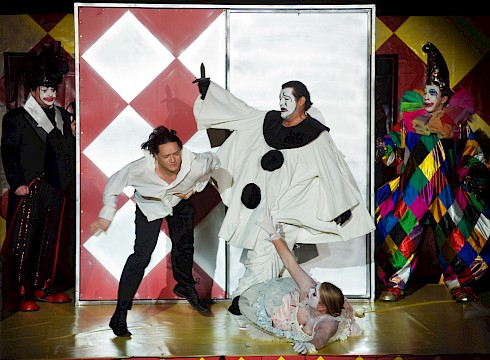
Gintaras Rinkevičius himself, wearing a red tailcoat and a full Pierrot make-up, conducted the Intermezzo facing the audience, thus becoming a member of a traveling circus troupe...
In 2003, “Pagliacci” was a form of exploration, a certain sketch and an attempt to convey the genre of opera in an original way, to scout unusual spaces and to implement unconventional ideas.
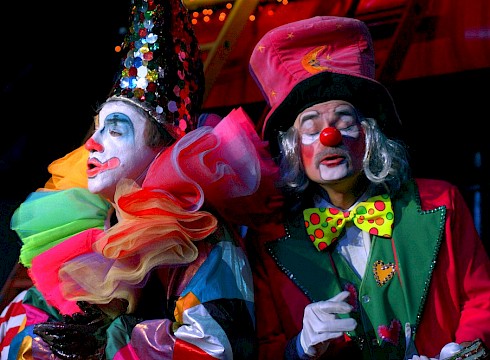
During the production, the troupe collaborated with the region’s only circus - the Baltic Circus - and its artists. This way, “Pagliacci” not only marked the different stages of company’s existence, but also witnessed the transformation of the circus. During the first shows in 2003, the Baltic Circus’ program for appearing in “Pagliacci” included not only aerial acrobats, jugglers, clowns, equilibrists, and fire eaters, but also wild animals. Later, in 2008 after the performance was revived under the flag of “Bohemians”, the stage featured only domestic animals, as well as an additional (directed) surprise where the hall was stormed by police officers with service dogs. Similarly, to current global practices, the most recent staging of this production does not feature any performances of circus animals. Interestingly, VCO’s “Pagliacci” helped to raise a new generation of circus performers: during the most recent shows the audience were fascinated by the winner of “Lietuvos talentai” juggler Kasparas Bujanauskas, whose parents - artists of the Baltic Circus - appeared in the first premieres of “Pagliacci”.
Creators


Set designer
Marta Vosyliūtė


Director of Baltic Circus
Petras Variakojis
Performers
Canio
Emil Ivanov (Bulgaria)
Canio
Badri Maisuradze (Georgia)


Harlequin
Vytautas Kurnickas

Participating in performance
LNOBT choir
Leader Česlovas Radžiūnas
The artists of Baltic Circus
Leader - Petras Variakojis
Premiere: 2008 November 12
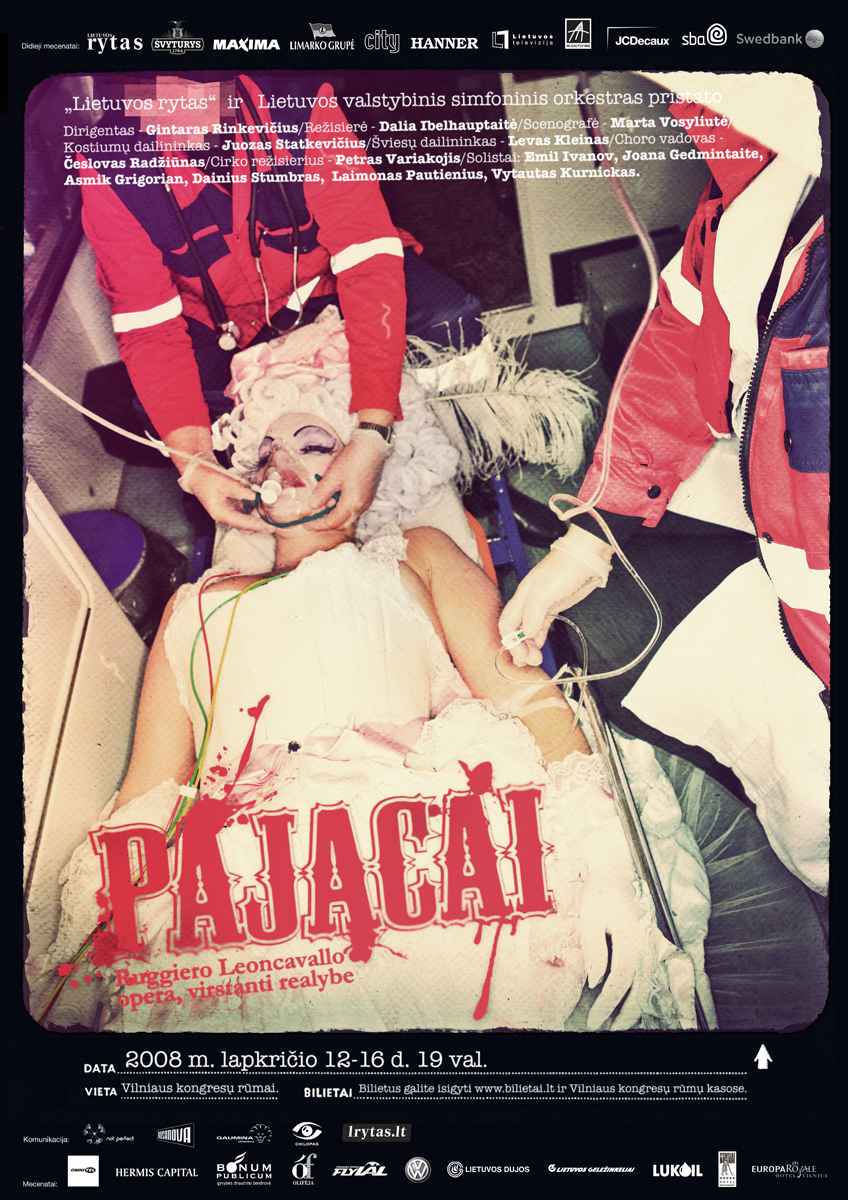
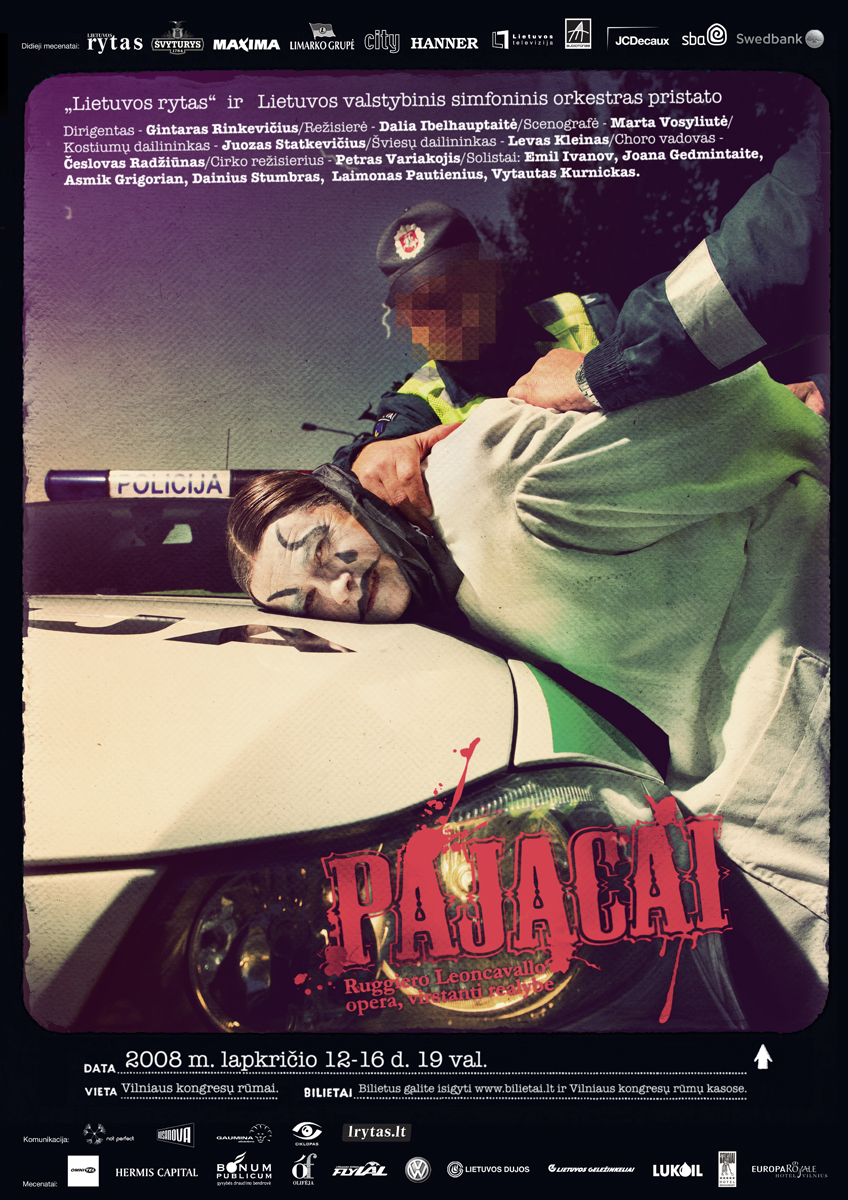
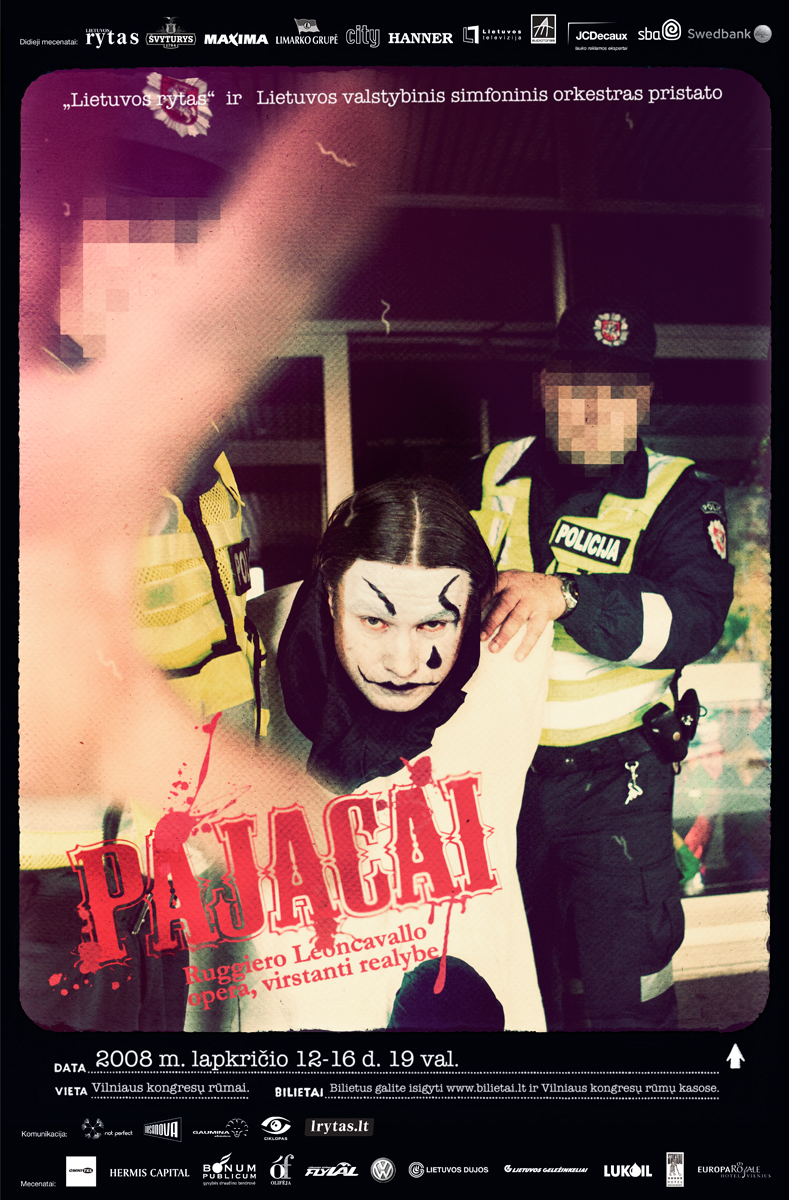
In 2015, the revived production was staged at the Klaipėda State Musical TheatrE
THE PARADOXES OF SUCCESS IN OPERA
The Italian composer Ruggero Leoncavallo (1857–1919), born in Naples, created around twenty stage works, including operas, operettas, and a ballet. However, it was one particular opera that etched his name in golden letters into the history of the genre - "Pagliacci", which was recognized as a true masterpiece on the very night of its premiere. This opera first premiered on May 21, 1892, at a theater in Milan and found instant success, which only grew over time. When Enrico Caruso - hailed as the most beautiful tenor voice of all time - recorded the famous aria "Recitar! Vesti la giubba" in the early 20th century, it sold in the millions. In music history, 1907 marks the recording of the first complete opera - and it was Pagliacci, supervised by the composer himself. In 1931, the first sound film version of an opera was created - again, Pagliacci. Today, Leoncavallo’s masterpiece ranks among the most frequently performed operas in theaters.
Pagliacci also carries with it a tale of “borrowed” ideas. Leoncavallo claimed to have written the opera’s libretto independently. However, writer Catulle Mendès accused him of plagiarism, alleging that the composer had used the plot of his novel La Femme de Tabarin ("Tabarin’s Woman") without attribution. Leoncavallo had to defend himself, and his letter to the publisher about the source of the opera’s plot survives to this day. He explained that the story was a musical adaptation of a real event from his childhood in Montalto, where a jealous gambler murdered his wife after a performance - an event that was tried by Leoncavallo’s own father, a judge. The memory of this real-life tragedy inspired the opera. Moreover, Leoncavallo had the idea to combine this realistic tragedy with the contrasting genre of commedia dell’arte. As he explained, this too was inspired by childhood memories - his family’s servant used to take little Ruggero to comedy performances. Although Mendès later withdrew his accusations, there are still several versions of the story regarding the libretto’s origins.
PAGLIACCI AND THE CIRCUS: A TRAGEDY OF AMBIGUITIES
Despite the historical and legal controversies, Pagliacci features a gripping and realistic libretto. In truth, the course of history added its own twist to Leoncavallo’s vision. The composer originally wrote the opera for one of the era’s most famous baritones - Victor Maurel, who performed the role of Tonio. Leoncavallo, it seems, aimed to please the singer by emphasizing his part. For example, the opera’s prologue gives Tonio a significant solo entrance. Even the final words of the opera - "La Commedia è finita!" ("The comedy is over!") - were originally assigned to Tonio. However, in many productions, this line is instead delivered by Canio, adding a more ironic and bitter tone. This shift is not accidental, as the role of Canio - the tragic clown - soon became the most popular and defining element of the opera. The aria "Recitar! Vesti la giubba" became Pagliacci’s calling card, due to the sheer intensity, expression, and emotional power it conveys.
Canio’s character embodies sincere, raw emotion and reflects the ironically tragic fate of the clown. This has sparked debate over the opera’s title, Pagliacci ("Clowns"). While the term usually refers to jesters or comic characters in commedia dell’arte - in this case, specifically the jealous husband of Colombina - in the context of Leoncavallo’s music, the word takes on a deeper, more ambiguous meaning. The second act of the opera includes pantomime elements derived from traditional commedia dell’arte, which traveling Italian actors performed for centuries. But is this simply a humorous love triangle between Colombina and Arlecchino, and a jealous husband scene? Not quite.
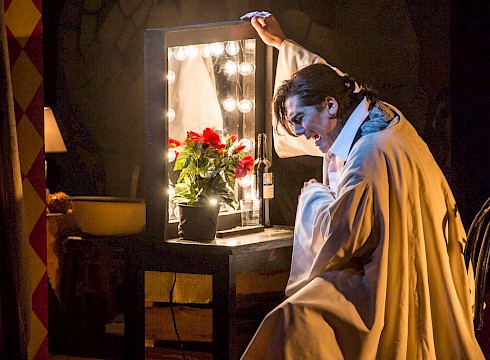
Leoncavallo infuses his opera with tragic realism, portraying a clown who smiles on the outside but hides deep suffering beneath thick white makeup. The audience laughs at his antics, oblivious to his inner torment. "Laugh, clown!" (Ridi, Pagliaccio!) - a line that now echoes with irony, sorrow, and pain.
The setting of commedia dell’arte, over which the tragedy unfolds, only deepens the opera’s emotional complexity. In director Dalia Ibelhauptaitė’s production of Pagliacci at the Vilnius Congress Hall, even actual circus acts were incorporated, further intensifying the dualities at the heart of the story. For many, “circus” evokes childhood wonder under a great tent and memories of magical performances in the ring. Yet the word has taken on a negative connotation in modern times, especially in politics - used to describe chaos or farce. The same can be said for "pagliaccio" (or the Lithuanian "pajacas") - no longer simply a jester, but often an insult implying foolishness or deceit.
It’s difficult to pinpoint when this shift occurred, when these terms lost their innocence and acquired bitterness. Somehow, the “fool” in Hieronymus Bosch’s 1500 painting The Ship of Fools has become a metaphor for today’s absurdities, which Gregory Norminton also explored in his novel inspired by that image - absurdities we now call a “circus.”
Leoncavallo’s opera, too, was based - he claimed - on true events and real emotions. But more importantly, it presents a deeply human story. The plot of Pagliacci is so grounded in realism that it mirrors the actual lives of professional clowns. Many have experienced the kind of tragic love triangle portrayed in the opera. The painful collision of theatrical illusion and harsh reality - of the clown’s public mask and private suffering - is captured masterfully in Leoncavallo’s music. This opera reshaped the perception of the clown character, transforming a comedic stereotype into a flesh-and-blood human being.
When the commedia dell’arte performance begins in the second act, it triggers a tragic turning point in Canio’s life. Reality and stage become indistinguishable; the betrayal seen on stage is no longer a performance - it is real. In the prologue, Tonio ambiguously warned the audience that even clowns have feelings. But by the time this is fully understood, Canio - Pagliaccio - is no more. Only the grimace of fate remains.
La Commedia è finita!
Related news
Bohemians Turn 20: Anniversary Season to Culminate in Norma with Asmik Grigorian

Sustainability in opera: how Juozas Statkevičius’s costumes were given new life a decade later

When everything hangs in the balance on stage: the invisible heroines of Dalia Ibelhauptaitė’s productions reveal the secrets behind the scenes

How Bohemians’ advertising took to the streets and changed perceptions of opera