TOSCA
Giacomo Puccini
Conductor:
Gintaras Rinkevičius
Director:
Dalia Ibelhauptaitė

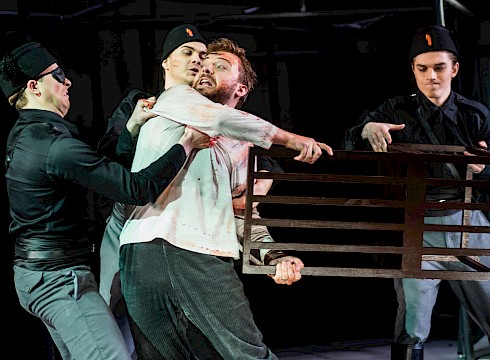
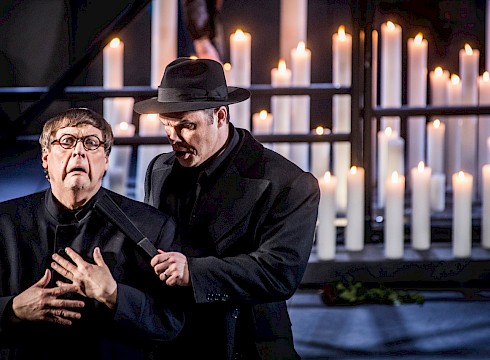
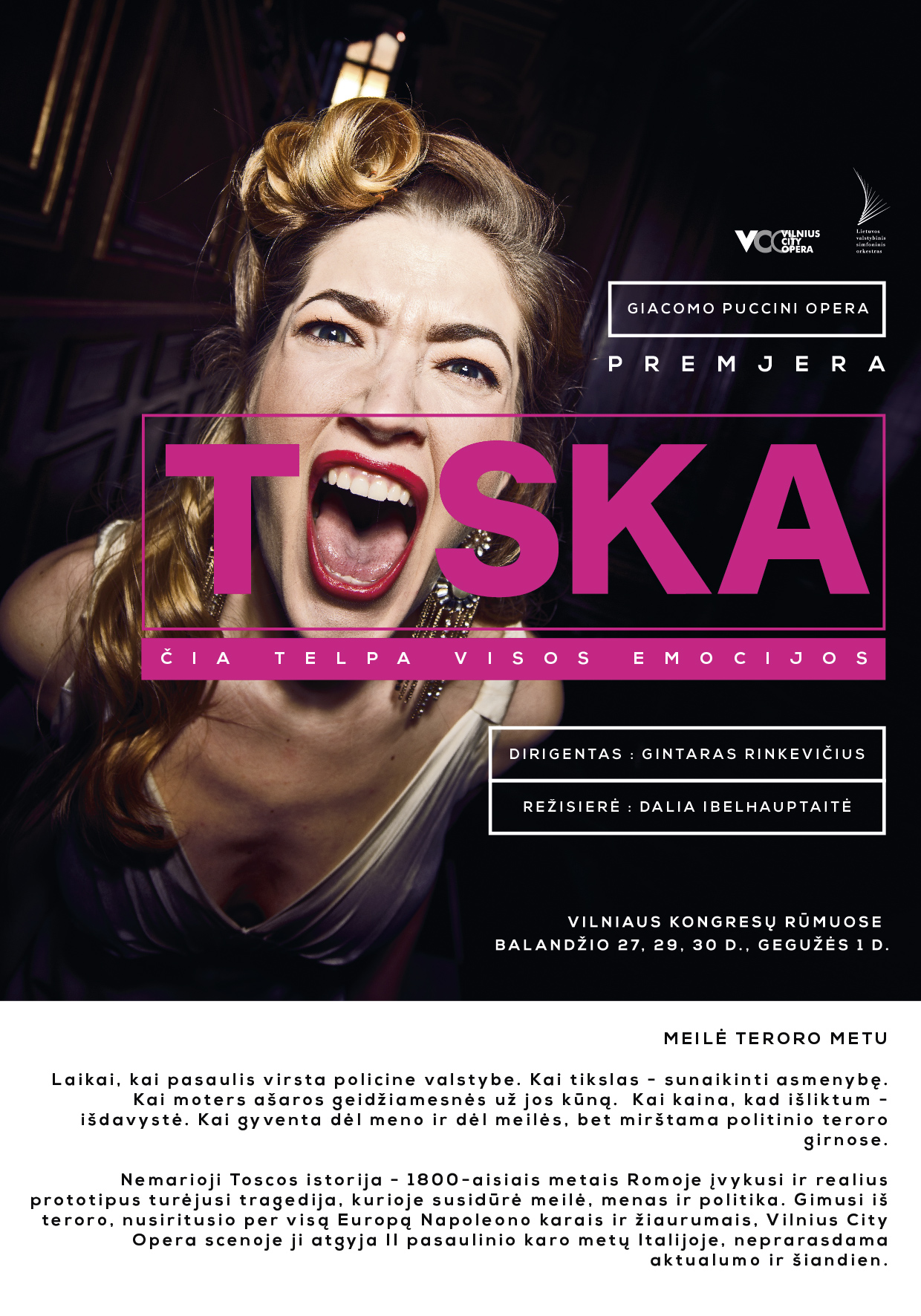
VCO’s third visit to the world of G. Puccini’s music was “Tosca” - one of opera’s most popular stories, about a diva, love, art and the struggle against authorities. Nearly half of the opera’s action takes place in a church, although nobody comes there to pray. All of “Tosca’s” settings usually used for productions have the common characteristic of military unrest and conflicts - be it the early 19th century during the Napoleonic wars depicted in the plot at the time when the opera was composed (1900) or D. Ibelhauptaite’s choice of 1940’s Fascist Italy torn apart by World War II and drenched in the ideology of terror.
Those were the times when the powerful were declared righteous, while the innocent were deemed guilty. Those were the times when those with different opinions would fall into the vise of political terror, while any individuality, emotion or thought, opposing the ideology of the “war’s winners”, would be destroyed. No wonder people began flocking to churches which have always been considered a place of refuge, especially at times when love, politics and art become destructive tools against each other while the entire country is turned into a police state.
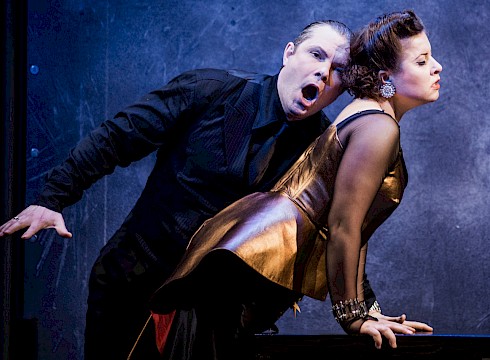
In VCO’s production a lot of attention was given to the visual aspect of the production, dominated by J. Morrell's costumes, which accurately convey the character of the time. They were inspired not only by photographs of the movie stars, but also by the Nazi youth as well as prevailing image of New York mafia bosses.
Creators


Performers
Tosca
Svetlana Kasyan (Russia)


Scarpia
Evez Abdulla (Azerbaijan)


Participating in performance
Vilnius City Opera ensemble
Leader Česlovas Radžiūnas
Children’s choir
Leader Samanta Bielskytė
Premiere: 2016 April 27
IMAGES OF 1940s ITALY
Though it's often joked that the nature of the Italian people is far from compatible with the rigidity of a fascist regime, Benito Mussolini had a clear plan. After World War I, Italy was plunged into an economic crisis and was ready to accept anything that might change the situation. Such an environment was ideal for the spread of revolutionary and radical ideas, which Mussolini exploited during his twenty years in power.
He understood what the key tool for controlling his country’s citizens was: education. Under Il Duce’s rule, education became especially important. It was through school lessons that children were taught fundamental values that bound them tightly to their country as an indivisible unit, which the leader - through his (of course) hard work - would provide for.
Significant attention was also given to shaping gender roles. Various programs were used for this: fascism promoted a pro-natalist policy, thereby cementing the woman's role as a mother and caretaker of the home, while at the same time militarizing boys' education. Boys were raised to be citizen-soldiers, always ready to defend their families and the greater family - the homeland. The clearest image of this is the now-iconic photograph of a small boy saluting at the front of 40,000 fascist youth. To us, this may resemble militarized pioneer parades, but the key difference is that in Italy, these youths were also armed...
The most influential fascist organization, however, was the Opera Nazionale Dopolavoro (“National Leisure Club”), which also targeted parents. This organization ensured that as many citizens as possible had access to radios so they could listen to Il Duce’s speeches. It also provided discounts for special theater and cinema screenings.
The 1940s, marking the final days of the fascist regime, slid once again into chaos, culminating in the public execution and display of Il Duce’s body in Milan in 1945. The people, long held tightly in Mussolini’s grip, struck back with equal force. Though today it may be hard to understand such uncontrollable and nearly savage behavior or find explanations for it, the desperation that had gripped the nation becomes easier to comprehend.
It’s no surprise that when we try to visualize Italy from that era today, our minds often turn to the Italian neorealism cinema movement. Although most of its iconic films were made after World War II, its roots can be traced back to 1935, in the works of Jean Renoir and Alessandro Blasetti. Later, more developed and widely recognized examples include the famous films of Luchino Visconti, Roberto Rossellini, and Federico Fellini.
A grey, ravaged, depressive country, yearning for a miracle. We wouldn’t be entirely wrong to call Italian neorealism films documentaries - many were shot on real locations with passersby as extras, due to a lack of funding. Often, even the main actors were non-professionals.
This focus on the lowest social classes - who at the time formed the majority in the country - may remind some of Soviet Lithuanian photography. In its black-and-white frames, we see people on the margins: sometimes worn-down, sometimes happy, their emotional states contrasting with their environment. What often remains after these images are the eyes of the people, in which pain seems permanently etched - but hope still lives on.
It’s in this seemingly cold environment that the heroes of Tosca reside. Scarpia and his blind subordinates feel right at home here, while their opposites - Cavaradossi and Tosca - seem to have arrived from that abstract world of hope, where love, justice, and of course, art (as a symbol of awareness) still matter.
Is it right that in the end none of the heroes triumph? It’s hard to say. History from previous centuries repeats itself, so perhaps this plot is like a cry in the wilderness - a reminder that cruelty has never been and can never be the answer?
“TOSCA” – A PERFECT OPERA STORY?
The opera genre - and opera theatre itself by its nature - has always been wedged between art and political games. Some of the most prominent artists, like Richard Wagner, believed that opera was the closest thing to the perfect form of total theatre, capable of embracing and uniting all branches of art to create an unparalleled and impactful experience. Today, we have directors like Robert Wilson, Jan Fabre, and Krzysztof Warlikowski, who don’t need to turn to opera in order to create this synthesis of the arts. Even when staging dramatic plays, they transform them into works of much broader scale, surpassing the bounds of traditional perception.
Once upon a time, scale itself was the most essential element of opera theatre. And that was precisely because politicians and other figures of authority used this art form to represent their countries. Formally, that makes sense: the more creators from various artistic disciplines professionally perform their work in a grand space, the more a country can present itself as economically strong - essentially declaring: “Not only do we not worry about food, we can afford this, too.”
Even as times have changed, the long period of opera being used as a “political tool” locked its artistic consciousness, reducing it to a mere collection of beautiful arias. Though in recent decades opera has caught up rapidly with dramatic theatre, many audience members still flinch at bold, conceptual choices made in this "temple of music," asking: “Is that allowed?”, “Is this necessary?”
This leads us to the story of Tosca. First and foremost, it was a play written specifically for one of the most famous actresses of the dramatic stage and early cinema - Sarah Bernhardt. The resemblance between the main heroine and the actress herself is striking. Both were celebrated artists of their time, capable of influencing not only the stage but also the real world. Alongside fame, beauty, and female ambition, both carried with them a great sense of influence and self-confidence. It’s no coincidence that Sarah Bernhardt was the first woman to play Hamlet. On the other hand, Toscabecame her fateful role - after one performance, she seriously injured her leg, which never healed and eventually had to be amputated.
In Puccini’s opera, Tosca becomes the “pure diva”, merging these portraits into one dramatic character. Opera prima donnas, unlike many dramatic actresses, always carried a long veil of mystery around them. Their professional tool - the voice - enchanted with its sound, drawing them closer to dangerous, seductive nymphs. The associations could go on, but what remains a fact is that Tosca became the ultimate role for any opera soloist. Every singer who takes on this role has the potential to become a global star - but must also face the price that comes with it. Even putting aside each production’s unique concept, the role itself becomes a play-within-a-play: the singer playing a singer.
The Vilnius City Opera’s choice of the 1940s as the setting strengthens the image of a determined woman. It was during WWII, as the majority of working-age men were mobilized, that women began taking over their jobs. A new portrait emerged: that of the confident and independent woman. In this light, Tosca gains even more dimension - she’s not just a singer and seductress. She becomes a strategist, planning her moves like a secret agent in wartime, masterfully performing through each situation.
Of course, none of this would be necessary in a different historical context. Though Puccini was primarily searching for a strong story for his opera - one that would allow him to create the kind of work he needed - by choosing this particular drama, he consciously or not encoded much more into it than a melodramatic love triangle. While it’s often said that the composer was quite apolitical and that the Napoleonic Wars setting merely served to intensify the conflicts, it’s precisely the themes of power and politics that give Tosca its enduring relevance. It seems almost fated that the opera’s premiere was postponed due to political unrest in Rome.
Wars in the 19th, 20th, or 21st centuries are, above all, the time of power games - led by authoritarian and manipulative individuals. Scarpia becomes a portrait of them all. And it doesn’t matter whether we call him the head of the police, the military, or an ideology. He is always a reminder of those who come to power with a single goal, never bothering to question the morality of how to achieve it. Through terror and persecution, they convince others of their truth. These are their times, when the powerful are declared just, and the innocent guilty; when anyone who thinks differently is crushed under political terror, and any individuality, emotion, or thought not aligning with the “victor’s” philosophy is annihilated.
So, what role remains for art in such a world? A “safe” and “comfortable” one - useful within the territory ruled by a single leader. But we must never be fooled into thinking that power will confront art or free speech directly or publicly. Just as Scarpia extracts the truth from Tosca in his private chamber, so too does the regime gradually bend the individual. Power sits too close to the theatre not to exploit its tools: a gripping plot, a well-rehearsed deception, impeccable acting. This is precisely why in the opera the true battle is between Scarpia and Tosca - not Cavaradossi.
So, returning to the question: should contemporary opera push boundaries as boldly as drama, performance, or the visual arts? Unequivocally, yes. Today, more than ever before, with new threats rising around us - threats we feel and read about every day - opera, which for so long served as a representational tool of power, must open its eyes wide. Tosca truly becomes a perfect example of a story that recurs each century - one that merges the beauty of art with the painful consequences of its exploitation.
Related news
Bohemians Turn 20: Anniversary Season to Culminate in Norma with Asmik Grigorian

Sustainability in opera: how Juozas Statkevičius’s costumes were given new life a decade later

When everything hangs in the balance on stage: the invisible heroines of Dalia Ibelhauptaitė’s productions reveal the secrets behind the scenes

How Bohemians’ advertising took to the streets and changed perceptions of opera