COSI FAN TUTTE
Wolfgang Amadeus Mozart
Conductor:
Gintaras Rinkevičius
Director:
Dalia Ibelhauptaitė

How do we receive a piece called “Così fan tutte” (“All Women do the same”) today? Mozart was a cunning composer. None of his operas are really what they seem to the listener hearing them for the first time, i.e. light and full of repetitive themes. A more attentive approach suddenly reveals that this “easy” music actually deals with serious and profound topics.
Today Mozart’s opera speaks first of all about the importance of believing in our own truth, of having our own path and of holding firmly to our own beliefs. If you feel loved, believe in that and don’t try to test your significant other’s fidelity, as this might turn against you. This opera, however, is also quite incompatible with overly “serious” setting, therefore VCO decided to move the action to Capri, an island in Italy, while the characters became light-hearted rich and spoiled “golden youth” whose problems are in a way reminiscent of the life of the Kardashians. Take their costumes, for instance - in VCO’s production, hand-made high couture dresses were designed by Juozas Statkevičius, who felt very much at home with the concept of this staging.
The reality show obsession of the 21st century, the perverted desire to spy through a keyhole on other people’s lives, especially their misfortunes, became a modern background for Mozart’s classical story. “Così fan tutte” is an excellent satire that clearly demonstrates the outcome of reality show-based trials and the wish to find truth through deceit, but, most importantly, it also cheerfully reminds us that the relationship between men and women has always been a source of misunderstanding.


Creators


Performers


Dorabella
Rachel Frenkel (Israel)
Dorabella
Nina Tarandek (Croatia)


Ferrando
Blagoj Nacoski (North Macedonia)

Despina
Viktorija Miškūnaitė


Participating in performance
Vilnius City Opera ensemble
Leader Česlovas Radžiūnas
Premiere: 2013 May 08

ABOUT OPERA AND TINDER
Gabija Grušaitė
Sometimes, while swiping left and right through Tinder profiles, there’s a temptation to imagine that once upon a time everything was real, clear, simple - and that men/women were looking for love, not “external validation.” Surely all this alienation, that bone-deep loneliness, those awful moments at the bar wondering if she just went to the bathroom or actually left you hanging - surely this nonsense started because of… technology? Are smartphones to blame for all the ghosting (the worst ghosts are the ones who never answer calls or texts, but still watch your every Instagram story. Watching silently)? Right?
The human mind is designed to shirk responsibility like a snake, so we often project our anxiety onto Facebook, our phones, the globalized world. And then we indulge in nostalgia for the past, which from today’s perspective - softened and polished by time - seems much better.
But that’s not the case. As an antidote to nostalgia, Così fan tutte (“All Women Do It”), written by Mozart at the end of the 18th century, surfaces. Surprisingly relevant in the age of OkCupid and Grindr, this opera shows that emotional detours at someone else’s expense aren’t an invention of the digital age. The opera might look superficial on the surface but goes much deeper, touching on the darkest corners of loneliness and alienation. The story is quite simple - two men brag about their fiancées and end up betting with Don Alfonso that the women won’t fall for other men’s advances, even under temptation. Disguised as Albanians, they each try to seduce the other’s woman. At first, the women resist, say no, say no again, but then slowly soften and eventually melt. Guglielmo and Dorabella exchange lockets - the modern equivalent would be Guglielmo appearing on Dorabella’s Instagram. But the essence is the same.
At the end, when the deception is revealed, the men sing “all women are like that” and reconcile with their fiancées, living happily ever after. A comedic surface, a light-hearted plot - so where lies the modern relevance of Così fan tutte?
This work encodes the essence of modern identity conflict. But first, perhaps we should define what “modern identity” is and how it differs from what came before. In traditional societies, people were born into the role they would have for life. If you were born a peasant, noble, or slave, chances are you’d die as one too. Identity was fixed, strictly defined, unchanging, and inherited. People had a place in the social hierarchy, more like trees rooted in their designated spot, doing better or worse with what they were given. In contrast, modern identity is stretchy and malleable, constantly changing shape and taking on new forms. People move freely around the world, switch professions, gain new friends, and evolve. Cities themselves are flexible, allowing free movement between social layers and enabling individuals to wear more than one face at a time. A dutiful office worker can become a club kid at Opium on the weekend. A young mom might create a Tinder profile during a girls' trip with no mention of her husband or kids. And novelists sometimes bluff their way through writing about operas they know nothing about.
Così fan tutte is an intimate dramatization of this fluid identity - two men dress up as Albanians and seduce each other’s partners. A deeply repressed sexual fantasy: to swap women, swap lives; to briefly become someone else; to move into a parallel reality. To look at oneself from the outside and then safely return. At least that’s what Guglielmo and Ferrando imagine when they bet with Don Alfonso.
But the problem with this kind of reality is that once you blur boundaries, it becomes almost impossible to put them back. Once you enter a world of endless simulation and variation, you yourself begin to change. Agent Cooper travels back in time to save Laura Palmer, but when he returns to the present, he finds Twin Peaks slightly altered. On the deepest level, Così fan tutte is a story about how our intentions, attitudes, and perceptions shape reality - it becomes what we expect to see. By making their bet, Guglielmo and Ferrando provoke the chain of events that follow. If they hadn’t had the flippant idea to disguise themselves, their fiancées wouldn’t have “slipped.” On an ethical level, betting on your fiancée’s fidelity is disrespectful - so, “as you shout, so shall you hear.” This 18th-century fantasy has become our everyday reality - we’ve gone from rooted trees to deer that wander freely through the hidden paths of reality. And that means we have to take responsibility for where we end up. Guglielmo and Ferrando got what they deserved - but still concluded “all women are like that,” shifting the blame to their fiancées, albeit lightly, since the ending is ultimately happy.
What do Mozart’s opera and Tinder have in common? Perhaps only this: that we very often get exactly what we deserve. All those ghosts from the past... Often we make little bets with ourselves: how much deeper can we dive? Sometimes we dress up as Albanians to test our partner’s feelings - and end up realizing that Così fan tutte.
Related news
Bohemians Turn 20: Anniversary Season to Culminate in Norma with Asmik Grigorian

Sustainability in opera: how Juozas Statkevičius’s costumes were given new life a decade later

When everything hangs in the balance on stage: the invisible heroines of Dalia Ibelhauptaitė’s productions reveal the secrets behind the scenes

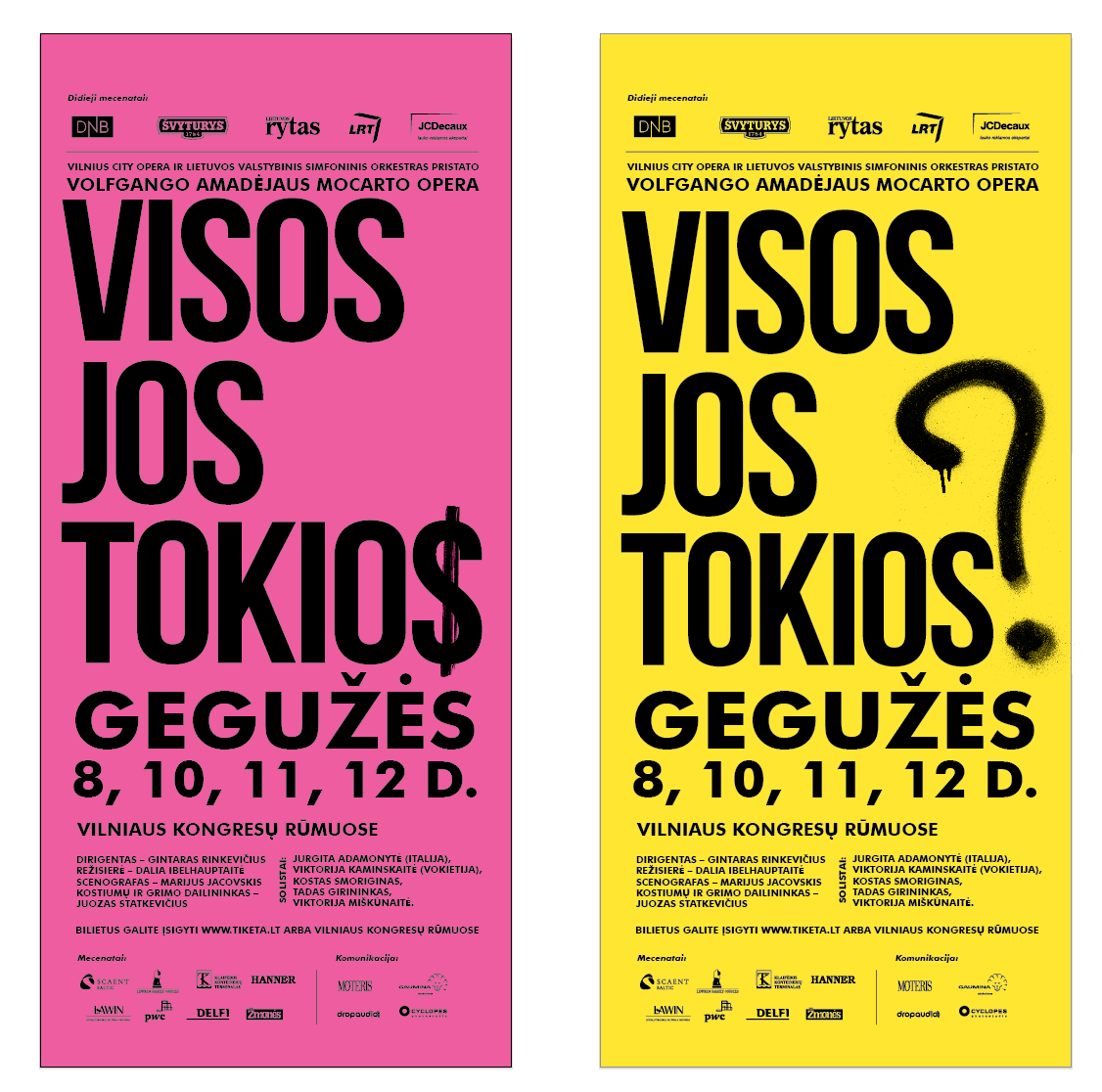
How Bohemians’ advertising took to the streets and changed perceptions of opera