HÄNSEL UND GRETEL
Engelbert Humperdinck
Conductor:
Ričardas Šumila
Director:
Gediminas Šeduikis

“VCO’s production of “Hansel und Gretel” is a meaningful and, most importantly, professional investment of the creative team into the future audiences of opera”, wrote critics about Dalia Ibelhauptaitė and Gintaras Rinkevičius’ assistants', director Gediminas Šeduikis and conductor Ričardas Šumila debut work “Hänsel und Gretel”, while the young audience didn’t spare warm applause. Having chosen the famous Brothers Grimm story about Hänsel and Gretel, the creators decided to view it not as a fairy tale for children, but rather as a real-life drama – a brother and sister’s adventures. It is a story about a child's transformation into a teenager, separation from parents and a journey into the “woods” of real life. As soon as the creative process began, the whole young team kept discovering more and more new parallels between the famous story and their own lives.
The decision to undertake an opera targeted at youth was another challenge for the VCO. According to them, there is a huge vacant niche of youth-targeted culture in Lithuania. Specifically – in opera. The Vilnius City Opera troupe is always contributing to education and searching for new talent, so there was no surprise that they were the first to undertake the responsibility of educating the young audience and, moreover, strove to do that in a modern way.
According to director G. Šeduikis, “Hänsel und Gretel” is a clean fresh space for a new meeting: the first production of the young creators is primarily targeted at the young audience which might be visiting opera for the first time. The creative team’s main goal is to approach the famous story from a fresh angle and, together with a modern young viewer, create an exciting world of teenagers. The new world which would also be interesting to their parents and younger siblings.


Creators


Set designer
Will Holt (Didžioji Britanija)
Costume designer
Eglė Čekanavičiūtė


Performers


Sandman, Dewman
Vera Talerko


Participating in performance
Children’s choir
Leader Samanta Bielskytė
Premiere: 2014 September 25
GOLDEN STAGE CROSS - “DEBUT / YOUNG ARTIST” FOR CONDUCTOR RIČARDAS ŠUMILA AND DIRECTOR GEDIMINAS ŠEDUIKIS (2015)
Youth Culture - a “forgotten zone”, says Dalia Ibelhauptaitė
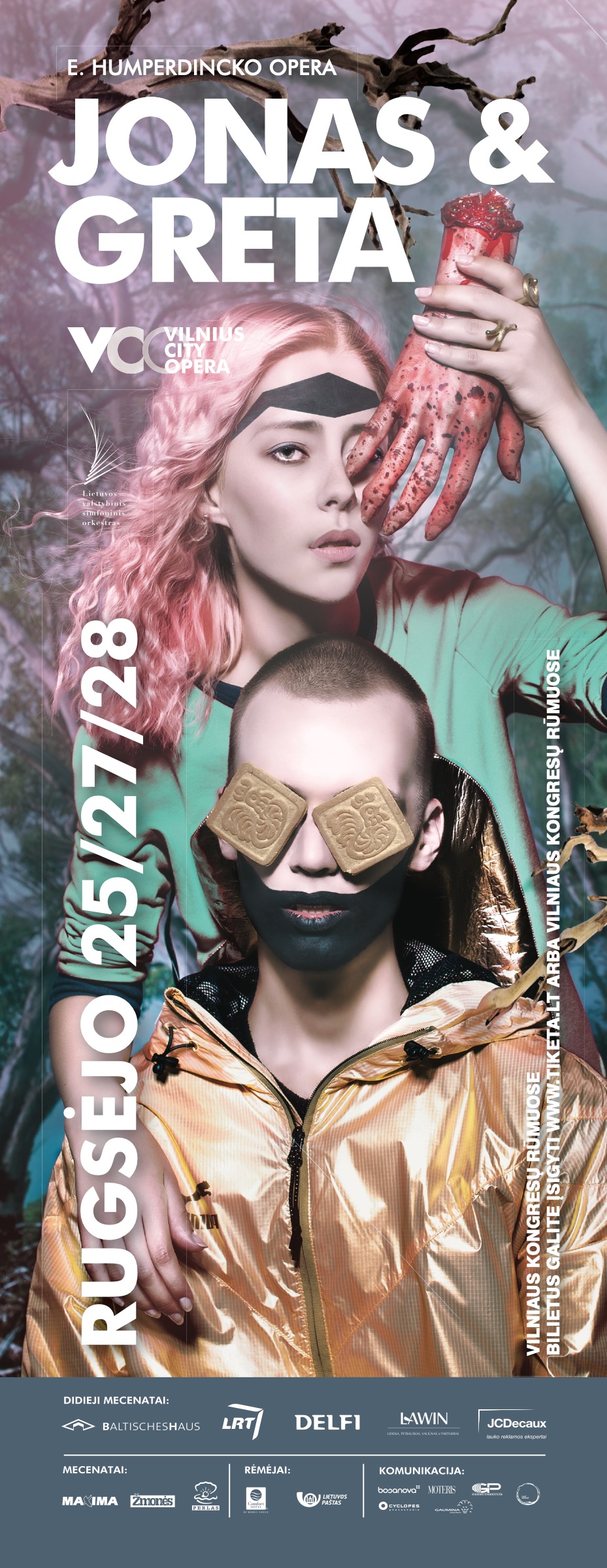
Why is it said, both before the premiere and for the upcoming February performances, that your show’s advertisement is very drastic?
Dalia Ibelhauptaitė, artistic director:
"I don't know who thinks that - probably the teachers or parents who are still wondering whether to take a chance and bring their children, or not. We had a similar situation with the advertisement for the opera Sweeney Todd. Young people immediately understood it’s a story about good and evil, not human-pie making.
The theatre is full of metaphors, figurative expression. This opera (Hansel and Gretel) speaks about the struggles a young person faces - the first loneliness, growing up, and what happens when a young person finds themselves in the jungle of city life. We all have gone through these experiences. Nevertheless, even after leaving home, everyone survives, copes, shows how cool and wise they are. And the theatre today isn’t as rosy, with crinolines, as it was 100 years ago. We show it as it is today.
Some say we undermine morals and the psychology of youth - in Sweeney Todd there was a nine-year-old boy in the audience. He kept watching and then said, ‘Director, this is not realistic!’ There’s blood splashed, props, but I ask him, how does he know? And he says, ‘I saw it in the movies.’ Young people normally orient themselves; they do not need instructions about what’s good or bad.
I do not think the advertisement is drastic - to me, it’s quite gentle (laughs) for these times. All the team members and designers were from the younger generation. Eglė Čekanavičiūtė designed the costumes, Marla Singer did the photoshoots, and the set was designed by a young talent from England, Will Holt. If we want to bring young people to the opera, we need to speak their language."
Did you feel assured before the premiere that everything was ready?
Gediminas Šeduikis, the director:
"Actually, before a premiere, an artist feels a bit like a mother in her ninth month of pregnancy. You feel the baby is about to be born - it's a little scary, but much longed-for. What's most interesting is that after you let it into the world, it starts living its own life. Later, much like a teenager, it says, ‘Don’t tell me what to do, I know how to live,’ yet you still try to guide, to advise (laughs).
I'm delighted we created living, realistic characters - ones we can identify with. The heroes aren’t some distant people from the past; they're us - you, your friends, your acquaintances. The setting is alive, close, realistic. Perhaps I wouldn’t wish for parents like in our performance, but there are many people like them in real life. Or we turned the witch into a vampire - that's a much broader topic, energetic vampires. Spend a few minutes with people like that, and you age by a couple of years…
I wouldn’t call this piece just an opera - many forms intertwine here. It’s a musical drama; even the composer crosses many borders. There’s a lot of action, much like a good movie. So I warmly invite you to see how our baby is growing up."
What’s different in the music itself? After all, it’s classical!
Ričardas Šumila, the conductor:
"The music is strongly influenced by the characters and their personalities. If the conductor and the director are on the same path - their visions matching or at least overlapping - then the music reflects that shared view. I’m delighted that we make a great team with Gediminas, and this is evident in the way the score sounds - it's modern.
E. Humperdinck’s score is flexible, which made it easy to adapt for a younger generation. We have a lyrical side, elements of rock, and even flamenco. We tried to combine everything in a way that feels contemporary and attractive. I think we did a pretty good job. If you listened to a traditional recording alongside our version - they’d be very different."
Why are there so many young people involved in both the premiere and these productions?
Dalia Ibelhauptaitė, artistic director:
"Young talents need to grow up not at university, but through practice. Only when you’re taken out of a ‘greenhouse’ and thrown into deep water - where it’s cold, tough, and challenging - can you really discover your path and your abilities.
While creating All Are Such, we made a deal with the Lithuanian Academy of Music and Theatre (LMTA) that young talents could come and collaborate with us. So we put together an ensemble of young, up-and-coming soloists. Naturally, if I want to be Hamlet, I shouldn’t have 15 other Hamlets in the team - that's a psychologically difficult moment - but these young people had a chance to work alongside colleagues who have already achieved much, like Edgaras Montvidas, Kostas Smoriginas, or Jurgita Adamonytė.
They could observe and learn from their experience every day. Eventually, all these young people created very strong and unique roles. So being on stage, in a “workplace”, is very important - it brings knowledge and confidence in their abilities."
Why are there not more productions of this kind (aimed at young people)?
Dalia Ibelhauptaitė, artistic director:
"Firstly, it's politically correct to say we care about youth - but in reality, we do very little. The main reason is simple: a young person - a teenager, a student - cannot pay much. When we started this production, I was met with disbelief: ‘Are you crazy?’. It turns out not even TV shows are made for them today - they're a ‘non-profitable’ group, a forgotten zone.
But they're our future - that's where we should invest. This is the main problem when we talk about classical culture, for example opera or theatre. Probably only the National Drama Theatre reaches that group. The rest are isolated cases - individuals who care, collaborate, create for the young - but there’s a shortage of state support, while for everyone else, the main concern is financial survival. So we produce for those who pay.
Additionally, very few care for growing new talent in the arts. When I first started, people had permanent employment - they stayed until retirement, until they'd be carried out feet first. This has changed in the last 10-12 years, but there’s still a shortage of opportunities for talented young people to realize their potential.
I care about youth - about the future of Lithuania. I care that you have, and see, the values I saw when I was a young person at the Youth Theatre with E. Nekrošius and D. Tamulevičiūtė. And I care that you have your own voice."
Is this production profitable?
Dalia Ibelhauptaitė, artistic director:
"I, as a producer, should be thrown into the Neris River. But this is a moral triumph for the team - a new start, a new energy. Because I believe that in 10 years’ time, this group of young people will be creating Vilnius City Opera, while I will be sitting somewhere under a palm tree, proud, and hopefully able to tell you stories about how wonderful it is to do something more than just produce operas (laughs)"
Related news
Vilnius City Opera “There Will Be No Encore: Macbeth” – A Lithuanian Phenomenon Astonishing the World

How did Lithuania become opera’s talent factory? Leading singers explain

Family and stage responsibility: Irena Milkevičūtė and Asmik Grigorian

Asmik Grigorian and Irena Milkevičūtė – a Conversation Across Decades
