Macbeth
Giuseppe Verdi
Conductor:
Gintaras Rinkevičius
Director:
Dalia Ibelhauptaitė
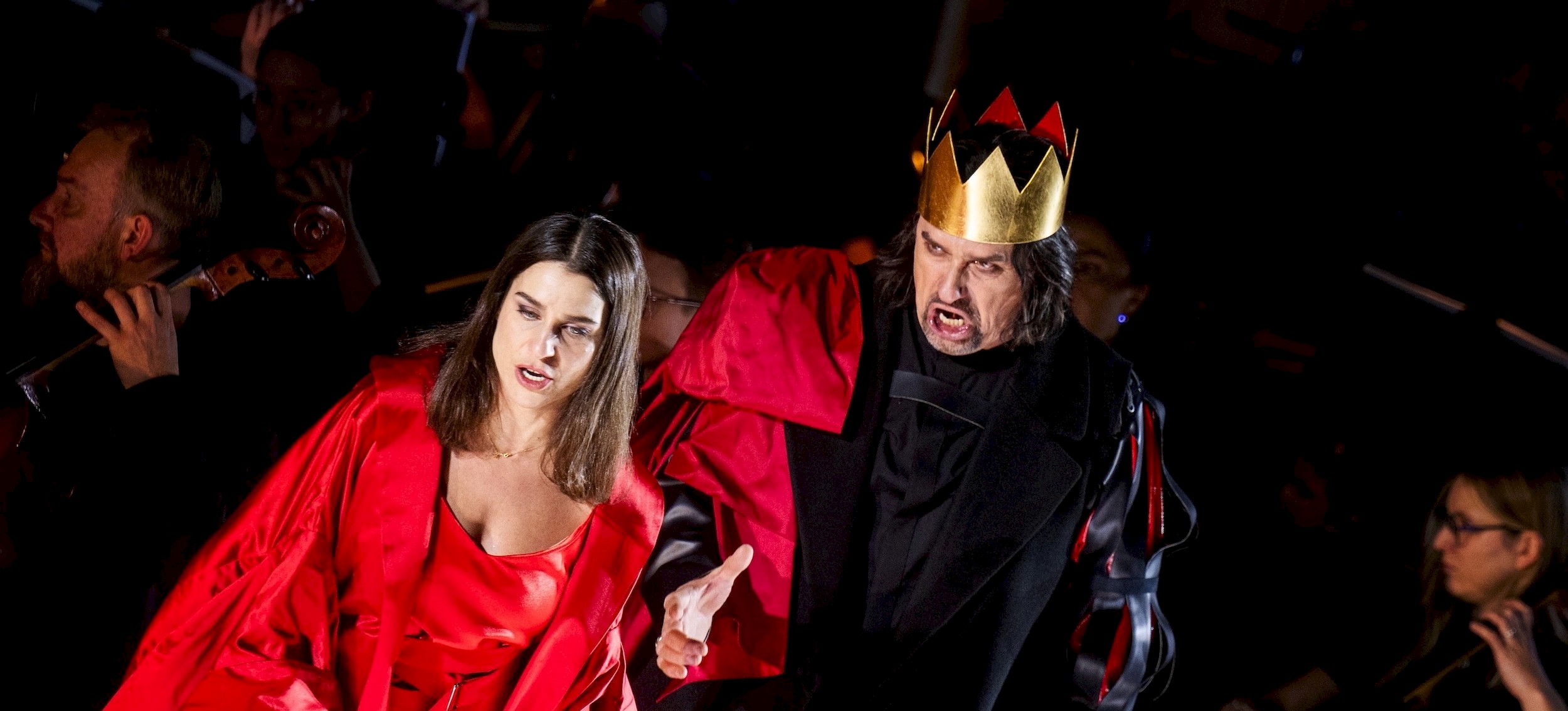
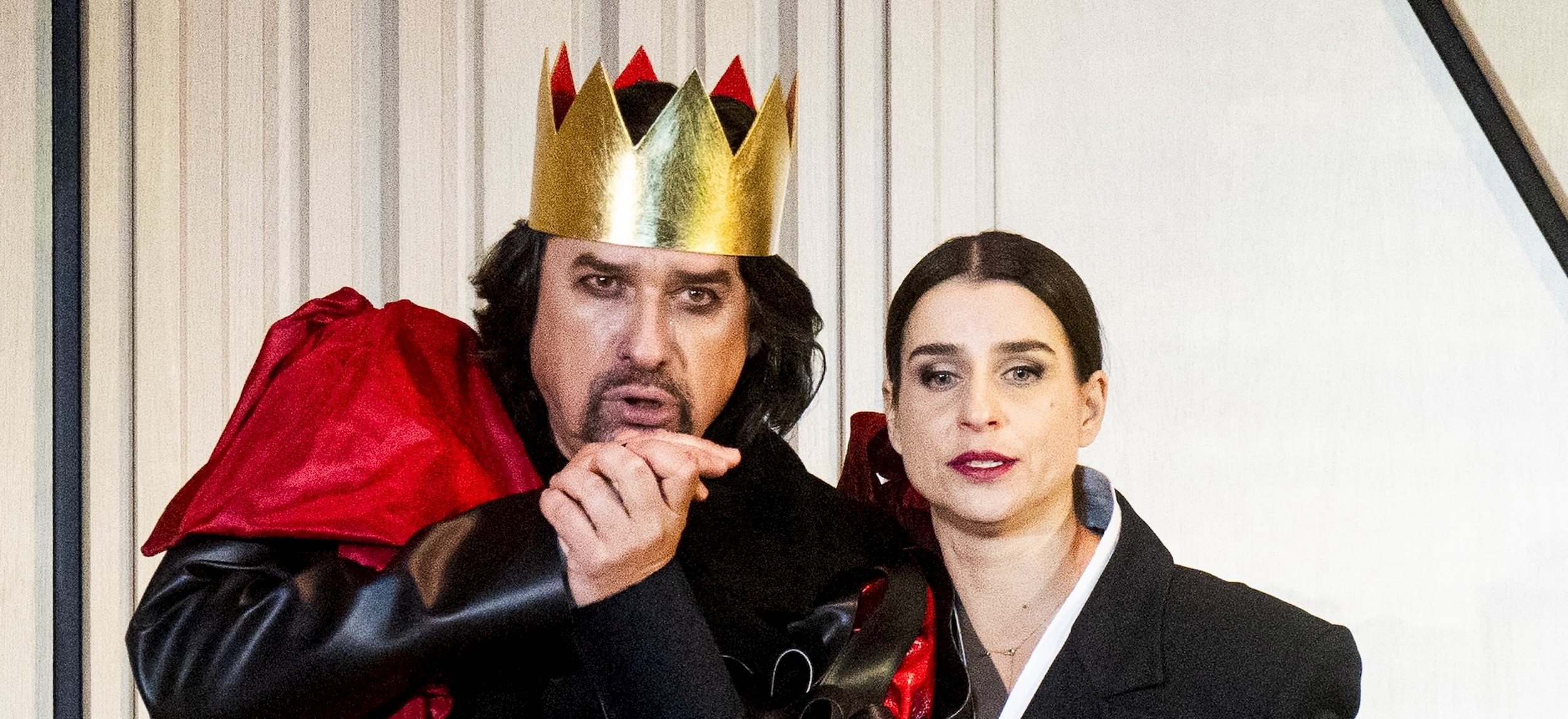
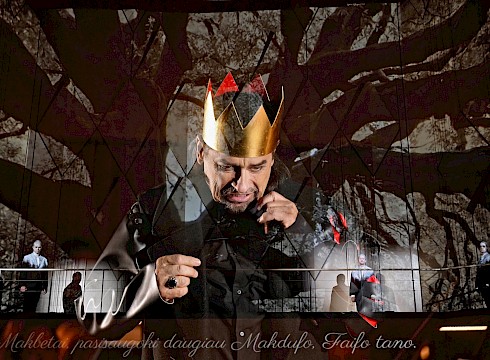
“Macbeth,” which unites the greatest talents in drama and classical music - Giuseppe Verdi and William Shakespeare - draws us into one of the darkest stories in the history of art. In the world of theatre, this work, surrounded by legends and superstitions, is often called “the Scottish play,” as people fear even saying the title, believing it brings misfortune.
In the opera “Macbeth” the focus is on the darkest corners of the human soul, attempting to see and understand how the darkest and most complex emotions are born in a person. Verdi analyzes the processes taking place inside the hero that lead to numerous frightening and irrational decisions, a multitude of murders, and ultimately consume the heroes themselves. The work presents many visions through which, guided by the composer, we look into the subconscious, into what lies beneath unpredictable actions, as if allowing us to feel what the characters experience.
The character of Macbeth can be clearly seen as an echo of modern authoritarian power. It is easy to name at least a few current world leaders who are only a few steps away from Macbeth. Importantly, Shakespeare did not create a solitary, isolated tyrant, but a pair. Without Lady Macbeth, the story would not happen. Their relationship and the complex portrait of a cold-blooded woman provide a deeper psychological perspective.
Creators


Chorus Leader
Robertas Šervenikas


Performers
Macbeth
Dalibor Jenis


Servant, Murderer, Herald
Nojus Žalys

Participating in performance
Kaunas State Choir
Leader – Robertas Šervenikas
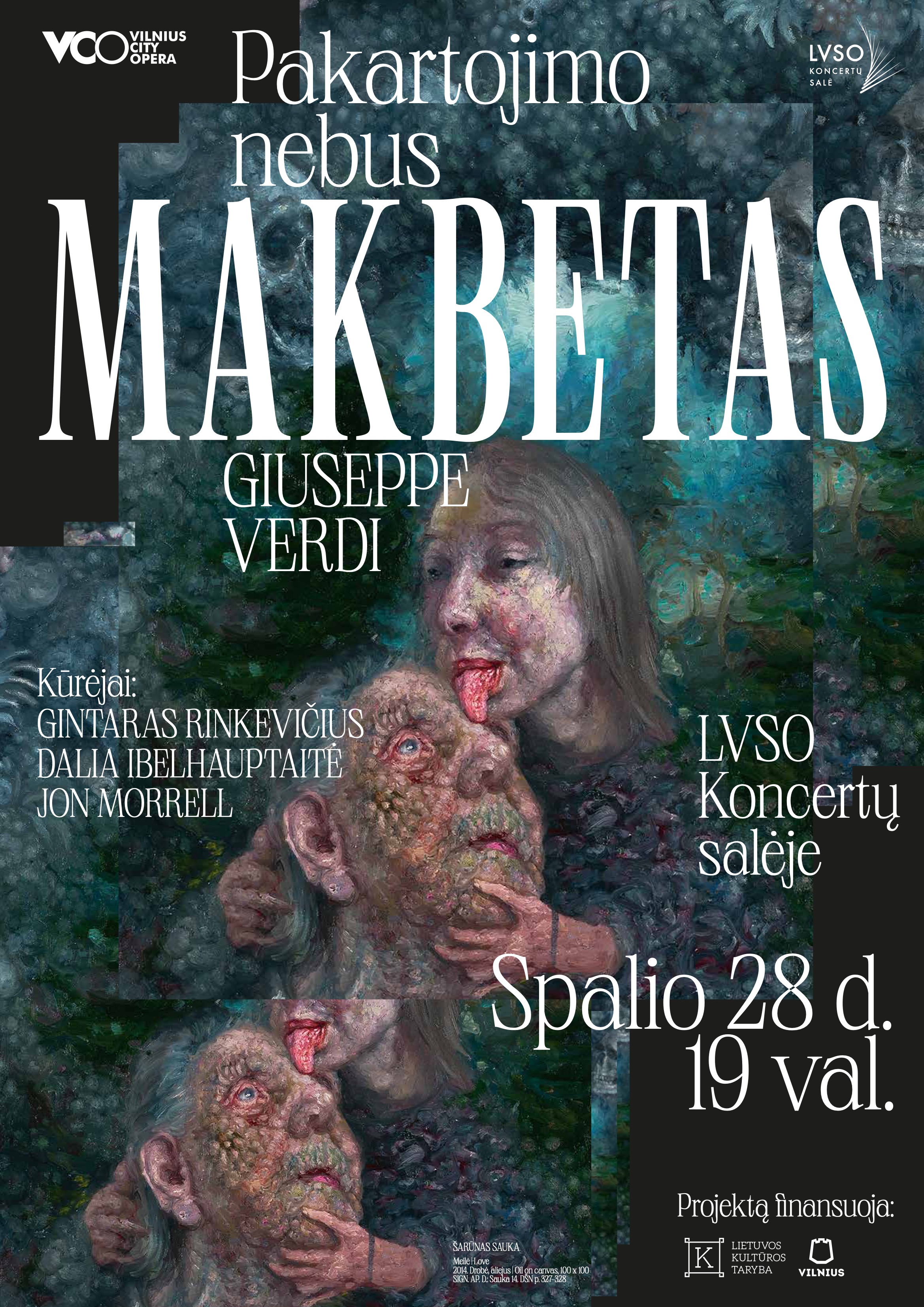
Premiere: 2025 October 28
KINDRED SPIRITS: GIUSEPPE VERDI AND WILLIAM SHAKESPEARE’S “MACBETH”
If you were to visit the villa in Piacenza where Giuseppe Verdi spent almost all of his adult life, you would find two complete collections of William Shakespeare’s works translated into Italian. They still lie where Verdi left them - not in his study or living room, but beside his bed. This reveals the depth and intimacy of Verdi’s connection with Shakespeare’s plays, as if he believed that even in sleep their spirit would permeate his being.
Verdi’s greatest idols were usually not musicians. Among those he admired were Michelangelo, Dante, Schiller - and at the very top of the list, Shakespeare. “I have held his works in my hands since childhood… I constantly reread them,” the composer said at the premiere of his opera Macbeth. At the time of creating this early and still controversial adaptation - the first of three operas Verdi based on Shakespeare - he drew theatrical and musical inspiration from the playwright’s work.
Verdi considered Shakespeare’s Macbeth one of the “greatest creations of mankind.” Although he did not share the 19th-century European fascination with Scottish landscapes, mythology, and romantic poetry, he more than compensated for this with his deep interest in the “Scottish play.” It is also possible that Verdi had heard the melody of the Scottish anthem, whose first four notes are identical to the opening of “Va, pensiero,” the famous Chorus of the Hebrew Slaves from his opera Nabucco.
When he began composing Macbeth, Verdi wrote to his librettist Francesco Maria Piave: “If we cannot create something great, let us at least try to create something unusual.” And he certainly did. He created the first Italian opera to capture the dramatic pace and depth of Shakespeare’s play; the first filled with minor tonalities and dark orchestral colors that enhance the impression of wild Scotland and its characters; and the first in which coloratura technique transformed from something beautiful and ornamental into something dramatic and terrifying.
In Macbeth, Verdi created some of his most vivid characters. Unlike many of his other works, the focus here is not on romantic relationships or father-daughter bonds, but on a powerful couple and their disturbing behavior driven by greed and trauma. To translate this into music, Verdi had to break operatic conventions.
The most striking example is Lady Macbeth. Verdi insisted that the singer portraying her must sound unlike any soprano heard before on the operatic stage. During auditions, he seemed to ask for the impossible: a coloratura soprano whose voice would be “unnatural and dark,” containing “something diabolical.” He wanted vocal agility not to display beauty, as was customary, but to express the manic madness of a character willing to push her husband into brutal murder.
This is especially evident in Act I, Scene 2, in the crucial duet between Lady Macbeth and her husband. While Macbeth tries to persuade in long, lyrical lines, his wife interrupts him with short, sharp coloratura phrases. As musicologist Roger Parker observed, “what was traditionally attractive and decorative is now used to depict hysteria or unnatural gaiety; vocal ornament becomes harsh and charged with negative meaning.”
As the opera unfolds, Verdi gradually darkens Lady Macbeth’s harmonic and instrumental palette. In the sleepwalking scene of Act IV, he demanded something entirely new: “This part must not be sung,” he instructed. “It must be acted and declaimed in a very hollow and mysterious voice.”
Verdi worked closely with soprano Marianna Barbieri-Nini, the first performer of the role, urging her to minimize mouth movement while navigating techniques ranging from whispers to full vocal power. Here, coloratura is not decorative but reveals inner psychological disintegration. This was nearly revolutionary at the end of the bel canto era, when vocal beauty reigned supreme.
All evidence suggests that Shakespeare - and the dramatic force of his play - pushed Verdi toward these innovations (as would happen again forty years later with Otello). Macbeth encouraged the composer to prioritize character over beauty, a principle he extended to the orchestra, which obsessively repeats small motifs to represent the growing presence of evil. When Macbeth returns after murdering King Duncan, the orchestra introduces a chilling motif: a repeated oscillation between C and the semitone above, accompanying his words “Tutto è finito!” (“It is finished!”). The orchestra thus takes on a semantic role, telling us what the characters cannot.
The music of Macbeth can be divided into two realms. Reality is represented by Lady Macbeth and her husband, a baritone general positioned between tenor and bass registers, reflecting his dual nature. But before we meet them, we encounter another “family”: the witches. Like Lady Macbeth, they exert immense pressure on him.
From the very beginning, Verdi gives the witches a distinctive “color” (he used the Italian word tinte). Their music is inherently unsettling: constantly shifting meter, rhythm, and texture, filled with “magic” - sudden tightly coordinated passages combined with dark wind instruments. Verdi wrote to Piave that their music should be “vulgar, yet strangely refined and original.”
In Shakespeare’s play there are three witches, but in Verdi’s time it was common to present many on stage. This likely inspired him to write choruses for three groups of witches. They appear mainly at the beginnings of Acts I and III, where their music shifts from minor to major keys - a psychological device meant to convince both us and Macbeth that their ominous prophecies will bring positive outcomes.
Although Verdi trusted Shakespeare deeply, he knew the play only through Italian translation and spoke little English. He first saw Macbeth performed in London in 1847, shortly after his opera premiered at the Teatro della Pergola in Florence. When he revised the opera in 1865 for the Théâtre Lyrique in Paris (creating the version most often performed today), he incorporated what he had learned from stage productions and demanded greater realism in performance.
Verdi worked brilliantly with Shakespeare, and Shakespeare’s work suited Verdi just as well. The playwright’s dramatic situations reflected the essence of human theater that fascinated the composer: manipulation, tension, blind love, betrayal, and guilt. One of the most moving moments is Macduff’s aria mourning the murder of his family - “Ah, la paterna mano.”
Both men, captivated by the possibilities of theater, were also drawn to the supernatural and equally committed to refining dramatic art. Together, they created works that transcend time. Macbeth tells the story of overthrowing a tyrannical, illegitimate ruler and liberating an effectively occupied country - parallels easily drawn with Verdi’s Italy during decades of political unrest. The following year, revolution broke out in Milan. Verdi supported the Risorgimento movement that sought to unify and free Italy. By 1861, Italy was unified. A few years later, Verdi returned to Macbeth, adding the “Chorus of Scottish Refugees” - perhaps echoing the Hebrew slaves of Nabucco. Perhaps he was imagining a new, better form of governance.
Andrew Mellor
Andrew Mellor is the Scandinavia correspondent for Opera, Opera Now, and Oper! magazines and the author of The Northern Silence – Journeys in Nordic Music and Culture (Yale University Press).
Few authors have created as many characters that have become archetypes of Western - and indeed global - culture. The existentially lost Hamlet, the jealous Othello, the greedy Shylock, the tragic lovers Romeo and Juliet - the list goes on. Macbeth certainly holds a prominent place among them, having become a byword for карьерism, blind ambition, and the lust for power. The ruthless determination of Macbeth and Lady Macbeth to overcome all obstacles - real or imagined - in order to reach the вершина of power is one of the most powerful stories in literary history about how the desire for power can blind, and how power can become self-justifying.
What makes Macbeth’s story so compelling (alongside Shakespeare’s extraordinary literary genius) is that at the beginning of the tragedy, Macbeth appears as a positive character. His bravery secures victory in a decisive battle, and the grateful King Duncan is ready to reward him generously. This harmony is shattered by an intrusion from the supernatural world: witches prophesy that Macbeth will become king. An ambition that may have been hidden deep within him now takes shape. What he may not have admitted even to himself now appears as destiny - a decision of higher powers. Thus, Macbeth and Lady Macbeth initially pursue power not out of selfishness, but as if fulfilling fate. This raises one of the central tensions of the tragedy: is ambition a personal choice or a matter of predestination? In the second half, however, the dramatic tension shifts. Power becomes not a means but an end in itself. Increasing energy is devoted not to what to do with power, but how to retain it. Everything becomes a threat; everyone, a potential rival.
In this sense, Macbeth’s story is a descent into tyranny. It is a metaphor showing that even power rooted in the best intentions, once convinced it embodies destiny, inevitably turns into its opposite - power devoted solely to self-preservation. The dictatorships of the 20th century illustrate this clearly: leaders often come to power with visions of a better world and broad support, but their belief that only they “know the way” becomes justification for repression, violence, and clinging to power. Stalin, Putin, Hitler, Pol Pot - all demonstrate where such conviction leads. Macbeth is their prototype.
In contemporary Lithuania, these questions arise with renewed force. It is evident that positions of power are increasingly occupied by случайные люди who seem unsure how they got there, confusing others with their lack of competence and direction. Yet paradoxically, they quickly grow accustomed to power, begin to feel like rightful owners, and treat their position as proof of their merit. Being in power becomes, in their eyes, a sign of destiny. Macbeth’s story shows how quickly such transformations occur - how rapidly people adapt to power and come to see it as something they were always meant to have. Power corrupts, and absolute power corrupts absolutely.
However, Macbeth’s story also teaches something else. That which raised Macbeth to the summit of power – blind belief that it is so destined – at the same time became also the cause of his downfall. The witches foretold not only that he would acquire the king’s power, but also the conditions under which he would lose it. True, the witches’ scenario is fantastical, unbelievable – Macbeth would lose power when against him would rise Birnam Wood. “I will not have to see that! – exclaims the happy Macbeth. – Who can order the trees of the forest / to tear themselves out of the ground with roots / and go to fight? What a wonderful fate!” As the battle against Macbeth approaches, Duncan’s son Malcolm orders his soldiers to cut for themselves a branch from the nearby Birnam Wood, in order to conceal their number:
“Let the soldiers / each for himself cut a branch / and hold it before himself: in the shade of leaves / we will hide the number of our men / and in this way deceive the scouts.” A guard on duty reports to Macbeth what he has seen: “I stood on watch on the hill, / looking toward Birnam; suddenly / it seemed to me that the forest moved.” The same fate, the same demon that enabled Macbeth, now makes him powerless – his entire vulnerability is revealed; power, army, the king’s title, other external attributes of strength become meaningless. The king always was naked, and a naked king is no king. Perhaps this lesson of Macbeth is worth remembering even today.
Viktoras Bachmetjevas, philosopher
Related news
Bohemians Turn 20: Anniversary Season to Culminate in Norma with Asmik Grigorian

Sustainability in opera: how Juozas Statkevičius’s costumes were given new life a decade later

When everything hangs in the balance on stage: the invisible heroines of Dalia Ibelhauptaitė’s productions reveal the secrets behind the scenes

How Bohemians’ advertising took to the streets and changed perceptions of opera