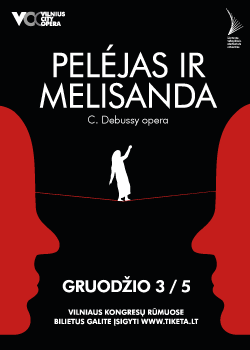
PELLÉAS ET MÉLISANDE
Claude Debussy
Conductor:
Gintaras Rinkevičius
Director:
Dalia Ibelhauptaitė

Before VCO’s decision to stage the exceptional C. Debussy’s “Pelléas et Mélisande”, this opera had been staged in Lithuania only once. “Pelléas et Mélisande” is one of the most important and complex operas of the 20th century and the most desired piece among the world's most famous conductors... This chamber, impressionist, psychological family drama is highly emotionally charged and deals with deep inner subject-matter. This opera reminds us of a multi-layered symbolistic drama performance, worthy of its creator French playwright Maurice Maeterlinck.
VCO series “Gourmet Opera” presents a minimalist, intimate, but dramatically expressive production of this opera, reminiscent in its style of A. Tarkovsky's films. “Pelléas et Mélisande” is an opera for adults, which, like a secret fantasy, is transfused with danger, passion, and desire. It centers around a young woman of stunning beauty, innocence, elegance, and light, who hides within herself the power to wreak chaos and destruction. In the finale there is not a single man who, one way or another, wouldn’t have confessed his love for Mélisande.
The opera’s protagonist lives in her secluded world of emotions. This is often the case in the 21st century where people are not willing to take responsibility for their own actions. In the opera, the divinely beautiful music of Debussy is deceptive, as behind it lies an intriguing plot and a great drama. Often in real life things are also not as they seem at first.
The symbolistic story and the impressionist flow of music accommodates exceptionally complex vocal parts that not every soloist can master. In many opera houses there are cases of emergency when the need to find a new performer can arise at the last moment. In “Pelléas et Mélisande” the choices would really be very scarce, as currently there are only 17 soloists in the whole world who are able to perform Golaud’s part! That is why the opportunity to have our own - Jurgita Adamonytė’s Mélisande - was an exceptional event, especially after her appearance in this role in Great Britain, after which critics praised has as the “Lithuanian Ingrid Bergman”.


Creators


Performers


Golaud
Vladimir Moroz (Belarus)


Yniold
Thomas John (UK)

Premiere: 2015 December 03
WHY I WROTE "PELLÉAS"
Claude Debussy's notes, written in early April 1902, in a letter to Georges Ricou – the director of Opéra Comique. First published on October 17, 1920, in “Comœdia”.
My acquaintance with Pelléas dates back to 1893… Despite the enthusiasm it sparked during my first reading – and perhaps some secret thoughts about possible music – I did not seriously consider this possibility until the end of that year.
I had long been looking for an opportunity to compose music for the theatre, but the form I envisioned for this was so unusual that, after several different attempts, I almost gave up. All my directed explorations led me to develop a hatred for classical dramatic development, since its beauty lies solely in technique – something that might only interest the Mandarins of our class. I wish for music a freedom that perhaps fills it more abundantly than any other art – not limited to a more or less accurate representation of nature, but rather discovering the mysterious connections between nature and imagination.
After several years of passionate journeys through Bayreuth, I began to doubt the Wagnerian formula; or, more precisely, it seemed to me that it could only apply to Wagner’s particular genius. He was an excellent builder of formulas, merging them into his own personal system, at a time when people were not well-acquainted with music. And without denying his genius, one can say he placed a full stop in the music of his time, just as Victor Hugo encapsulated all the poetry created before him. Therefore, one must look beyond Wagner – not merely follow him.
The drama of Pelléas, despite its dreamlike atmosphere, is filled with far more humanity than so-called “documents of real life” and was perfectly suited to what I wanted to achieve. It was a magical and evocative language, whose sensitivity could be extended in music and orchestration. I also tried to follow one law of beauty, which we often forget when speaking of dramatic music: the characters in this drama strive to sing naturally, not in some arbitrary language shaped by outdated traditions. This is the origin of the complaints about my supposed preference for monotonous declamation, in which melody supposedly never appears. First – this is entirely false; and second – one character’s feelings cannot always be expressed melodically. Moreover, dramatic melody must be something entirely different from what we usually call melody.
People who go to the theatre to listen to music are like those who gather around street singers! There, for a couple of sous, you can get melodic emotions… You can also be sure to get more attention than usually granted by the directors of subsidized theatres and a “desire to understand” – something completely absent among the aforementioned audience.
A peculiar irony: this audience demanding “novelties” is the same one that becomes frightened and mocks any attempt to lead it out of its circle of habits and routine murmurs… All this may seem incomprehensible, but we must remember that a work of art, an attempt at beauty, will always appear to many as a personal insult.
I don’t pretend to have discovered everything in Pelléas, but I tried to open a path for those who might later follow – who might create with their own ideas, perhaps liberating dramatic music from the heavy constraints in which it has lived for so long.
Pelléas was first completed in 1895. Since then, I repeatedly revisited and revised it, and so on – it represents nearly twelve years of my life.
“PELLEAS AND MELISANDE”: MYTH, SYMBOLISM AND REALITY
Probably no other work chosen by Vilnius City Opera has been as gourmet and refined. Claude Debussy’s opera Pelléas et Mélisande compels everyone to not only become interested in, but even deeply study, not only this opera and its composer, but also the playwright behind the story. Not the librettist—specifically the playwright. This impressionistic French opera is based on a dramatic work. While not a rare occurrence in opera history, few playwrights create material that is not only so well-suited to music but that actually inspires it. So let us introduce you: the playwright, poet, and essayist Maurice Maeterlinck.
Born in Belgium into a wealthy French-speaking family, Maeterlinck could have easily followed in his father's footsteps and become a lawyer. That seemed to be the plan: after finishing Catholic school, Maurice enrolled in law at the University of Ghent. Yet in 1885, after receiving his diploma, he left for bohemian Paris for several months. At that time, the Symbolist movement was already in full swing. In literature, this movement began with Charles Baudelaire’s 1857 poetry collection Les Fleurs du mal (The Flowers of Evil). Both the author and his work were received extremely negatively by institutions, and the original form of the collection was banned from public view for nearly a century.
Today, it is difficult to understand why a Symbolist work might have seemed dangerous to anyone. Baudelaire, Stéphane Mallarmé, and Paul Verlaine refined a highly aesthetic style that now seems mysterious, not easily understood, encoded with layered meanings. In 1886, Jean Moréas published the Symbolist Manifesto in Le Figaro, arguing that the highest goal of art was to represent absolute truths—truths that could only be expressed indirectly. In simple terms, Symbolism stood for art for art’s sake (a common trait in many modernist art movements) and a focus not on objects themselves, but their effects and the impressions they left behind. Essentially, it was a rebellion against the prevailing Realism style, which was pushing the boundaries of absurdity both in literature and theater.
Thus, Maeterlinck arrived in Paris at the heart of this cultural storm. It would be naive to say that his new acquaintances alone inspired him to turn to poetry and theater. Writing—like beekeeping (possibly linked to his father's promotion of greenhouses!)—was never foreign to the future Nobel laureate. Even while walking the path chosen by his parents, Maeterlinck always saw himself as a creator and had already begun writing during his studies. It was only a matter of time before his creativity burst forth. The timing couldn’t have been better. His interactions with French Symbolists undoubtedly pushed him in a specific direction.
1890 marked the beginning of Maeterlinck’s fame. That year, Le Figaro’s chief literary critic, the renowned Octave Mirbeau, praised his play Princess Maleine, declaring that this playwright had surpassed even Shakespeare. This was followed by Maeterlinck’s best-known plays: The Intruder (L'Intruse), The Blind (Les Aveugles), and Pelléas et Mélisande, which was dedicated to Mirbeau himself.
The play Pelléas et Mélisande premiered on stage in 1893. It was directed by Aurélien Lugné-Poe, also the first to stage the legendary play King Ubu. While critics mocked the production, it was supported by Symbolists and by Mirbeau. This staging marked a crucial step forward in the development of theater direction and scenography. It introduced a translucent, netted curtain and extremely dim lighting—the entire performance took place in a half-light, like a dream or another world. These are all key concepts in describing Maeterlinck’s work.
In both the play and the opera, motifs of water and twilight are vital and recurring. Mélisande and Golaud meet in a dark forest near a well. They arrive at their new home by water. Mélisande's crown and ring are lost in water—and so on. Darkness is a recurring topic in dialogue, especially from Mélisande, who constantly suffers from life in a dark castle in a land where the sun rarely shines and the sky is hardly visible.
Looking for the inspiration behind Maeterlinck’s drama, we could find many possibilities, but one, in particular, offers a compelling explanation. In medieval European folklore, we encounter Melusine—a feminine spirit of springs, rivers, and lakes—often depicted as a woman with a fish or serpent tail.
The most popular version of the myth tells of Pressina, whom King Elynas encountered while hunting in the woods. He married her under one condition: he would never enter her chamber while she was giving birth or bathing their three daughters. He broke this promise, and Pressina left with the girls to the legendary island of Avalon. At fifteen, the eldest daughter learned of her father's betrayal and vowed revenge. After executing their vengeance with her sisters, they incurred their mother’s wrath and were punished. The eldest—Melusine—was cursed to grow a serpent’s tail instead of legs every Saturday.
Then the story repeats itself: like her mother, Melusine met her future husband in the forest and agreed to marry him on the condition he would never see her on Saturdays. He broke his promise, and though she forgave him, during a later argument when he called her a serpent, she transformed into a dragon and left him.
Mélisande and Golaud meet in remarkably similar circumstances. The girl, clearly traumatized, is weeping near water when the prince, lost while hunting, finds her. Although Maeterlinck’s play lacks direct conditions, promises, or dragons, themes of privacy, trust, and inevitable fate are clearly present. Who triggers what? Is it Mélisande and Pelléas’ friendship that incites Golaud’s jealousy—or is the jealousy what deepens their bond? Or is something else entirely at play?
Equally important is the isolated, dark world the characters inhabit. Perpetual twilight and gloom pervade every setting. Golaud’s family lives in a castle seemingly located in the middle of nowhere, on a harsh coast—or perhaps even on an island, a kind of Avalon counterpart. It’s a rough, merciless world where people adapt to the darkness by giving up on the search for light. Anyone who dares to live differently is met with suspicion and immediate condemnation, destined for a weakling’s fate. Two such characters are Pelléas and Mélisande.
Yet this is just one narrow perspective—a starting point for interpreting the work. And it is based solely on Maeterlinck’s text. The layers of meaning added by Debussy’s music are countless. Although the artists had a major dispute and Maeterlinck only saw the opera a few years after Debussy’s death, he could not deny the composer’s genius: “In this case, I was completely wrong, and he was a thousand times right.”
Debussy spent a long time searching for the right libretto for his opera. Pelléas et Mélisande became the only opera he ever completed. Its premiere took place in 1902 at the Opéra Comique in Paris. From then on, the drama began a new life—as an opera.
Returning to Symbolism, its principles and how to better understand them, one of the most prominent literary figures of the 20th century, W.B. Yeats, once compared this style insightfully to fire - “We believe in it because it leaves behind ashes.”
Symbolism’s true value is revealed only after experiencing the artwork—after the action, the “here and now,” has burned away and the viewer carries home the ashes: the remaining meaning. Once, from this drama, not only did something remain—but an unforgettable opera was born, and from it, new productions and interpretations continue to emerge. What will remain with the audience after Vilnius City Opera’s Pelléas et Mélisande?
THE PRINCE OF DARKNESS – CLAUDE DEBUSSY
Today, Claude Debussy (Claude-Achille Debussy, 1862–1918) would likely no longer be offended to be called the most prominent and influential figure in musical Impressionism. Few have not heard the dreamy name of this French composer, most often associated with music filled with dreams and fantasies. Like many artists at the turn of the 19th–20th century, Debussy was deeply influenced by the Symbolist movement and Impressionist painting—not just in his compositions but in his cultural engagements. His only opera, Pelléas et Mélisande, and his work with Maeterlinck’s play are enduring evidence of this.
Debussy began piano lessons at age seven, and by ten he had entered the Paris Conservatory, where he spent the next eleven years. Like Georges Bizet, he was a brilliant pianist capable of sight-reading any piece. Had he wished, he could have had a professional pianist's career. However, Debussy was drawn to experimentation from the start, seeking what was not taught at the time.
In 1880, Pyotr Tchaikovsky, after reviewing a piece by the young composer, wrote in a letter: “It’s very beautiful, but too short. No idea is fully developed, the form is very compressed, and it lacks unity.”
By age eighteen, Debussy was already developing his musical style. His work was met with both sharp criticism and growing recognition—both of which would follow him throughout his career. As critics said after the scandalous premiere of Prelude to the Afternoon of a Faun in 1894: “Such pieces are meant to be written, not performed.”
That ten-minute piece both scandalized and revolutionized the music world.
Debussy soon became known not only for his music but also his romances. One of the most influential was with the married singer Marie-Blanche Vasnier, who introduced him to key writers of the time, inspiring many of his early compositions.
In 1884, to his own surprise, Debussy won the prestigious Prix de Rome for his composition L’Enfant prodigue (The Prodigal Son), which granted him a scholarship to study at the Academy of Arts in Rome, at the Villa Medici. According to letters sent to Vasnier, he was unimpressed by Italy—the creative atmosphere felt stifling, the company boring, the food bad, and housing awful. He disliked Italian opera, which didn’t match his taste. Debussy was depressed and couldn’t compose. His peers nicknamed him the prince of darkness. In June 1885, this disillusionment led him to a decision: “I’m convinced the Institute won’t allow this, since it concerns a path they consider sacred and exclusive. But it’s too late! I’ve fallen too much in love with my freedom and believe too strongly in my ideas!”
Often, when people attempt to describe Debussy’s music, they say that unlike others, he didn’t try to express feelings directly but rather to dream, to imagine, to fantasize: “I could never live among people. A true creator lives in a world of dreams and phantoms.”
He was inspired not only by Symbolist texts, which searched for new meanings in old words, but also by Impressionist painters, who rendered endless variations of the same color in shimmering detail. Debussy composed in a similar way—his music often surprised and unsettled listeners with its unfamiliar sound. Some say Debussy, unknowingly, laid the groundwork for jazz.
After his bold statement about freedom, Debussy sent four compositions to the Academy, where they were criticized for being strange. He was accused of “advocating the unusual” and disappointing expectations for such a talented student. Nonetheless, in those works, we already hear elements of Debussy’s later style.
Like many young musicians of his time, Debussy was inspired by Richard Wagner and his music, which left lasting traces in Debussy’s own works—especially Pelléas et Mélisande. This opera became a groundbreaking new model, in which arias disappeared and the natural sound of words became most important. Another major inspiration came in 1889 at a grand Paris exhibition, where Debussy encountered Javanese gamelan music. Its percussive, Eastern motifs became another hallmark of Debussy—one of the first Western composers deeply intrigued by Eastern sounds.
Returning to Debussy’s personal life: after the end of his long-term relationship with Gabrielle Dupont (referred to here as Vasnjė), he went through a series of romances with various women and even a brief engagement. Such behavior was not socially acceptable at the time and even cost the artist several friendships. It appears, however, that Debussy did not care. In 1899, he married model Rosalie Texier—but only after threatening to kill himself if she refused to marry him. Rosalie was sweet, practical, and straightforward, and the couple’s friends liked her. However, over time, the composer grew weary of her limited intellectual capabilities, lack of musical sensitivity, and fading beauty. Additionally, she was unable to have children.
In stark contrast, in 1904, Emma Bardac entered Debussy’s life: an educated woman, a brilliant conversationalist, a recognized singer, and the wife of a Parisian banker. The new couple secretly vacationed on the island of Jersey, and upon returning, Debussy informed his wife of their separation by letter. Just five days before their fifth wedding anniversary, Rosalie attempted suicide, shooting herself in the chest in one of Paris’s main squares—Place de la Concorde. She survived, but the bullet remained lodged in one of her spinal vertebrae for the rest of her life.
The scandal dragged on, and both lovers paid a high price in lost respect from friends and family. Nevertheless, in 1905, they married and, trying to escape public scrutiny, moved briefly to England. Upon returning, they bought a house in Paris on the Avenue du Bois de Boulogne (now Avenue Foch), where Debussy lived until his death.
Their only child, Claude-Emma, affectionately called "Chouchou," was born that same year. She became the composer’s greatest inspiration. It is no coincidence that 1905 also saw the creation of La Mer, one of his most brilliant compositions. Toward the end of his life, while gravely ill, Debussy confessed that, if not for his daughter, he might have committed suicide. Sadly, Chouchou survived her father by only a year—she died during a diphtheria epidemic, after a doctor made a fatal mistake in her treatment.
Debussy died of cancer in 1918 at his home. His funeral procession took place during German bombardments, along the empty streets of Paris. The entire Debussy family is buried in the small Passy Cemetery, fulfilling the composer’s final wish to rest “among trees and birds.”
Mary Garden, who played the first Mélisande in the 1902 premiere, once said about the composer: “Honestly, I don’t know if Debussy ever truly loved anyone. He loved his music—and probably himself. I believe he was entangled in his own genius. He was a very, very strange man.”
Related news
Bohemians Turn 20: Anniversary Season to Culminate in Norma with Asmik Grigorian

Sustainability in opera: how Juozas Statkevičius’s costumes were given new life a decade later

When everything hangs in the balance on stage: the invisible heroines of Dalia Ibelhauptaitė’s productions reveal the secrets behind the scenes

How Bohemians’ advertising took to the streets and changed perceptions of opera