THE QUEEN OF SPADES
Pyotr Tchaikovsky
Conductor:
Gintaras Rinkevičius
Director:
Dalia Ibelhauptaitė

In years past fame was achieved by live performances, personal meetings or salacious rumors, but now celebrities create their own legend by distorting the facts and uploading carefully selected photos to social networks. Nevertheless, this only proves the fact that influential people have always been, are and will be, mystifying to others. VCO's “Queen of Spades” invites the audience to experience the thin line between fantasy and reality. It is a piece about human materialism, greed, selfishness, admiration for money and position in society. And the willingness to sacrifice love, soul, and feelings to that end.
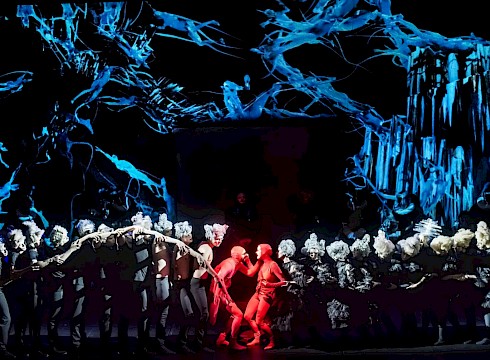
For the first time in the history of VCO productions, the usual multifunctional moving stage set was replaced by video projections. Those and the surreal costumes transported the audience from the more realistic 18th century setting to the supernatural world of the same period, full of belief in fate, luck, legends and even ghosts. The theme of reality and fantasy, chosen by the creators, is complemented by the modernly stylized romantic images.
VCO's interpretation offers the viewer an ambiguous approach to the characters of the well-known story. In the opera, these characters act as if in a never-ending masquerade where they constantly change their faces and probably cannot even remember which one is real and which one is intended for the public eye. The ambivalence of characters is enhanced even further by gossip and vivid imagination of those around them. This way an unreal and even supernatural portrait of the Countess - the Queen of Spades - is created, turning her into a living legend. In the finale, one might ask oneself whether she really existed, or was she simply a bait for luring the gullible hothead Hermann into a game doomed for failure, where the card table brings the finale in the madhouse.


Creators


Performers


Narumov
Paulius Prasauskas

Governess
Gabrielė Kiršaitė
Governess, Masha
Monika Kučinska


Participating in performance
Kaunas State Choir
Leader Petras Bingelis
Vilnius City Opera ensemble
Leader Egidijus Kaveckas
Dancers (V. Gineitytė, E. Kančiauskaitė, K. Katasonova, G. Šepliakovaitė, G. Viliūtė, M. Bendžius, D. Buinevičius, L. Ignatavičius, D.Stech)
Leader Jūratė Sodytė
Premiere: 2019 February 20

The Powers of the Queen of Spades
This character certainly will not appear on the Vilnius City Opera’s stage. But without him - the legendary Count Saint Germain - the Queen of Spades might not exist. He was an 18th-century man of mystery, a person who claimed eternal youth, the elixir of life, the philosopher’s stone, and much more. He was able to create or “heal” gemstones (repair defects or cracks). Once he “healed” Louis XV’s diamond, gaining the king’s favor and a generous honorarium. Louis XVI liked him as well. Some saw him as an alchemist, a charlatan, or even a spy; for others, he was an eternally youthful, charming, yet solitary man. All found him a fascinating and charming companion - a master of medicine, a multi-instrumentalist, a composer, a painter, and, it is said, fluent in as many as twelve (!) languages - wherever he went, he made a new home for himself. He presented himself as the son of a Transylvanian ruler, kept much about his past a mystery, and was known by many names.
Naturally, rumors about the immense fortunes, magical powers, and extravagant lifestyle of this successful and enigmatic person soon circulated - and they did not escape the ears of Natalya Petrovna Golitsyna, who later became Pushkin’s prototype for the Countess in The Queen of Spades. This woman, rumored to possess magical charms herself, was a distant relative of Pushkin on his mother’s side, which meant he heard these stories as a child.
Who Is Venus Moscovite?
Golitsyna was not just an ordinary duchess, a woman of high society. According to various sources, she spoke four languages, lived in Berlin, London, and Paris, danced with two French kings in her youth, and was courted by the future King of England. Her acquaintance with Maria Theresa of Austria, a passionate card player, was fateful: the charming Russian woman quickly fell under the spell of gambling. When Golitsyna and her husband went abroad, Maria Theresa provided a letter of recommendation to her daughter, French Queen Marie Antoinette - for whom gambling was a much-loved form of entertainment. The lavish salons of Versailles were a perfect setting for this passion, where members of the French Royal Family, ministers, officers, and other notable figures frequently sat down at the card table. Here’s what Pushkin wrote in The Queen of Spades: “It is worth noting that my grandmother went to Paris sixty years ago and was quite a sensation there. Everyone was eager to see the Venus Moscovite (Venus of Moscow). Cardinal de Richelieu courted her, and, as my grandmother insisted, nearly fell victim to her rejection.” In those days, the game of choice was faro. Once, the Countess lost a huge sum to the Prince of Orléans. Returning home, while removing the artificial beauty marks from her face, she informed her husband about the gambling losses and demanded that he pay up - although he was afraid of his wife and had previously been forced many times to cover her gambling debts, this time he refused.
What to do? How to avoid catastrophic disgrace? The Countess’s mind quickly turned toward Count Saint Germain, who might be able to help. She wrote him a dramatic letter, describing the danger of shame - and the gentleman was ready to aid her. But not in the simplest way, by handing over a bag of coins. Instead, he entrusted her with something much more - a magical secret for which passionate gamblers would pay a heavy price. This combination of cards (the triad, the seven, the ace) was a form of magic that helped her win back everything - yet the Countess kept it from her four gambling sons.
The Queen of Spades, Templars, and Occultism
Count Saint Germain not only helped Natalya Golitsyna win back her losses; he also shared his ability to foresee the future, drawing her into the occult. Mystics believed he was the last Grand Master of the Knights Templar, that he possessed a stone that could reveal future events, and that he belonged to numerous clandestine organizations. After the French Revolution, Golitsyna returned to Russia, where her name inspired awe - no one in high society wished to cross her, yet everyone rushed to attend her salons - where the hostess kept a stiff demeanor. Some say even her own son, a high state official, did not dare sit down in her presence. Her salons typically ended at the card table, where, due to her fading eyesight, larger cards were provided for her.
Saint Germain left many stories and rumors in his wake. It is believed he lived from 1712 to 1784, but his true birth and death remain a mystery - for he was frequently sighted after his death. While alive, he casually referenced his friendships with historical Roman figures: “Once my friend Gaius Julius Caesar said...” His valet was as enigmatic as his master - when curious people pressed him for details, he would respond briefly: “I have been serving him for … 300 years.” The colorful life of Saint Germain fascinated not only his contemporaries but many subsequent generations - he is even a character in Umberto Eco’s “Foucault’s Pendulum”. And in 1930, in the USA (Chicago), a religious movement was founded in his honor, their founder stating he had met Saint Germain in person and received guidance from him.
Lithuanian Gamblers
There is no record that the Countess Golitsyna or Count Saint Germain ever visited the lands of Lithuania, but there is no doubt they would have kept busy there. In the 18th-century Grand Duchy of Lithuania, gambling was ubiquitous - from kings, high-born nobles, and bishops, down to ordinary, less fortunate members of society. Bishop Ignacy Jakub Massalski, for instance, was a passionate gambling man - although not a very successful one. It is said that the builder of Verkiai Palace and a major restorer of Vilnius Cathedral frequently lost large sums at cards.
Sonata Šulcė’s book “Vilnius Stories: A Guide to the 18th-century” City describes a moment when the high-born Liudovika Byševska played cards with Bishop Ignacy Jakub Massalski in Verkiai Palace - a moment recorded in her Polish travel diary. Another tale speaks of a nobleman, Cibulskis, who gambled away his wife. So, just as elsewhere in gambling-crazed 18th-century Europe, many fell victim to the whims of the cards - and the Queen of Spades appeared to undermine even the best-laid plans…
Related news
Bohemians Turn 20: Anniversary Season to Culminate in Norma with Asmik Grigorian

Sustainability in opera: how Juozas Statkevičius’s costumes were given new life a decade later

When everything hangs in the balance on stage: the invisible heroines of Dalia Ibelhauptaitė’s productions reveal the secrets behind the scenes

How Bohemians’ advertising took to the streets and changed perceptions of opera