IL TROVATORE
Giuseppe Verdi
Conductor:
Gintaras Rinkevičius
Director:
Dalia Ibelhauptaitė
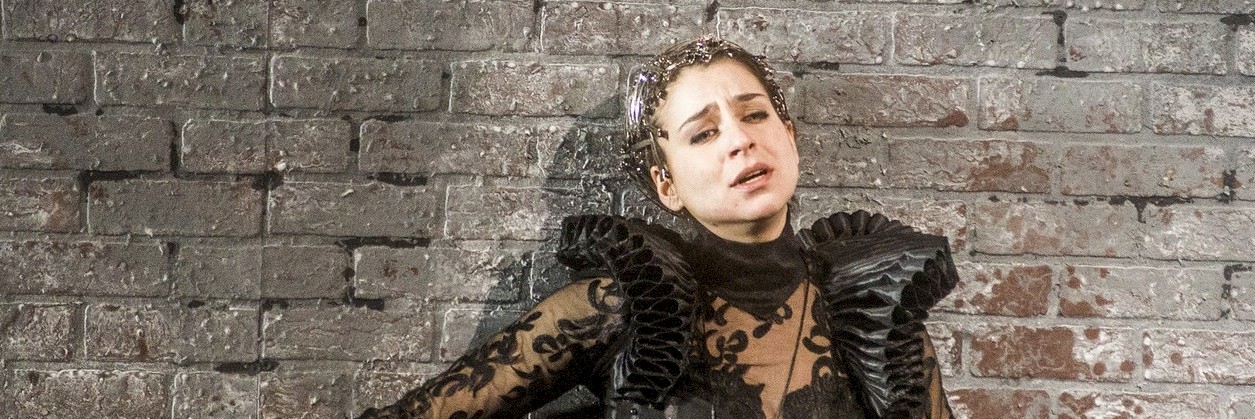
“Il trovatore” marks the maturity of VCO. The troupe finally took on the magnificent music of G. Verdi knowing that the voices of their singers had matured and were ready for this task. The twists and turns of the plot of “Il trovatore” is not inferior to the best modern thrillers.
The story has biblical fratricide, people burned at the stake, deadly curses, heroic, selfish and cynical deeds, and vivid characters. It is a passionate masterpiece full of drama, emotional depth and wisdom of life. A story about vengeance and hatred that gnaws on the human soul. “Il trovatore” plunges the viewer into a whirlpool of gothic love, jealousy, anger, and war. The opera’s creative team brought the 15th century closer to our times. However, this is not a customary adaptation of the plot to modern times, but rather a synthesis of several different periods. At first glance, the story is full of fantasy, but on the other hand, it reveals the musical drama’s timelessness.
Creators


Performers
Manrico
Murat Karahan (Turkey)

Manrico
Gaston Rivero (Uruguay)
Manrico
Marcelo Puente (Argentina)

Manrico
Zurab Zurabishvili (Georgia)
Manrico
Arnold Rutkowski (Poland)


Azucena
Laura Brioli (Italy)


Conte di Luna
Mikolaj Zalasinsky (Poland)

Ines
Viktorija Miškūnaitė
Ines
Aurelija Stasiulytė
Ruiz
Maksim Pogrebniak


Participating in performance
Kaunas State choir
Leader Petras Bingelis
Vilnius City Opera ensemble
Leader Česlovas Radžiūnas
Premiere: 2014 December 02
VILNIUS CITY OPERA’S “IL TROVATORE,” OR GOTHIC IN THE 21ST CENTURY
Verdi was in search of a highly dramatic plot and intense passions, which is why the story of Il Trovatore, created in 1853, is set in the dark and brutal Middle Ages. “The bolder, the more unexpected - the better,” Verdi wrote to his librettist, hoping for drastic plot twists. Although the 15th century is considered a bridge to the Renaissance, it was a complex transitional period for all of Europe. The recent “Little Ice Age” had dealt a heavy blow to the continent’s economy and agriculture. The Church, which held an extraordinarily influential position in society, was already ripe for reform and had become a place not only of devotion but also of large-scale corruption. A breaking point was near.
It was the clergy who made up the highest class in this society. Next came the aristocrats who lived comfortably whose primary concerns were recurring disputes with monarchs and the struggle for power and spheres of influence. At the same time, the new bourgeoisie emerged - a class made up largely of merchants. They fought for their freedom for a long time, and once gained, they continuously strengthened their political and economic influence. Below them was the majority of the population - from the unemployed to teachers - who, to put it mildly, lived in poverty and saw no hope of climbing the social ladder.
This fragmented and internally competing society lived on a similarly fractured continent, where weakened empires still held sway, nascent nation-states were forming, and endless land disputes prevailed. Spain, Italy, and Portugal capitalized on this situation. Their sailors, disengaged from continental conflicts, ventured to other continents. Columbus, Vasco da Gama, Amerigo Vespucci, and others opened the world to Europe - and Europe to the world. The end of the 15th century in the Old World was marked not only by internal division but also by the arrival of people from newly discovered lands and cultures.
It is no coincidence that records from this period contain the first signs of tension with newcomers, particularly the Roma, or Gypsies. Though they had arrived in Europe as early as the 12th century, by the 15th they had spread across the West, from where they began to be expelled. Intolerance toward people of different nationalities, races, or cultures was already deeply ingrained at that time.
Verdi took advantage of this tense, conflict-ridden era, and with librettists Salvatore Cammarano and Leone Emanuele Bardare, created an overheated and sharpened drama. Here, people from different views, classes, and even cultures clash. The nobility, officers, nuns, servants, and gypsies all take part. Their opposing social positions spark personal animosities - driven by revenge and the theft of love and happiness. Those who reach for what is most valuable must pay the highest price. All of Verdi’s characters face the question of life and death. Each is on a path to ruin: sacrificing for love, being murdered out of jealousy, being sentenced to execution, or living with the guilt of fratricide.
Nineteenth-century creators seemed to consciously echo the imagery of danse macabre - the Dance of Death - that emerged in the 15th century, proclaiming that death levels all differences. After death, all become equal. The opera ends with the death of several characters, suggesting that in such a world, this is the only possible outcome. Perhaps this offers hope - that by destroying what functions solely through a destructive principle, a different kind of world and humanity might emerge. Or perhaps it suggests that nothing has changed - and never will. Perhaps we have indeed lost our humanity and the ability to see others without immediately seeing them as enemies.
There is little need to explain how these themes resonate in today’s context. Everything feels familiar, recognizable, and frighteningly precise: military conflicts, territorial struggles, issues of social equality, intolerance of foreigners, murder, and suicide... Even in his own time, Verdi, by looking centuries back, was able to create a work that spoke directly to contemporary problems. And 21st-century theater stages are now turning to past plots to reflect today’s reality. But is it always necessary to illustrate what is already so clear?
The purpose of art is to observe reality - its problems, flaws, and strengths - and to raise questions, discovering new forms each time. So, is it worth once again showing that we behave just as barbarically (a term once used to describe Gothic art) as we did hundreds of years ago? Should we try once more to learn from the past? Or perhaps accept this as an unchanging fact?
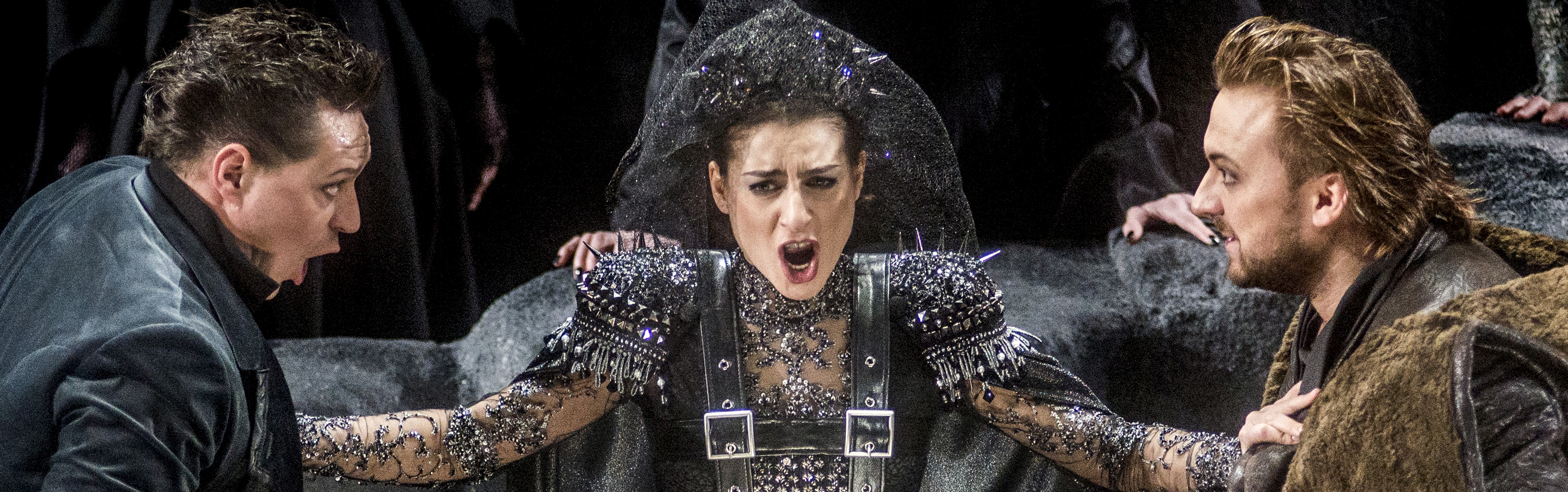
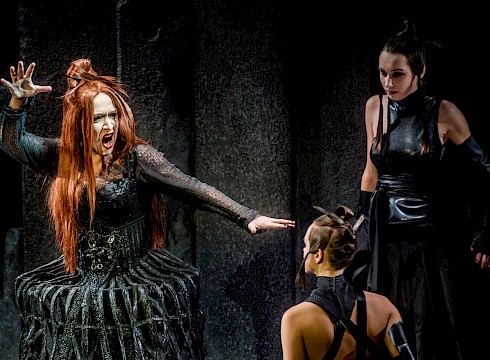
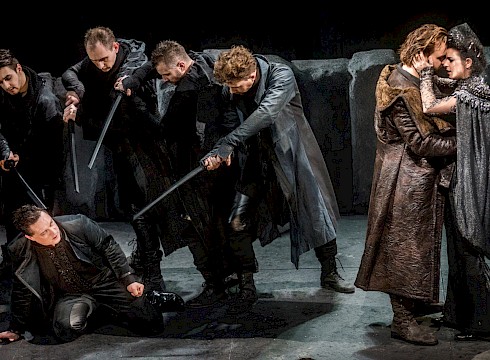
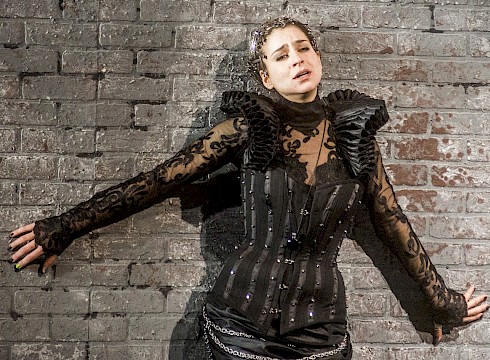
This season, after presenting their first production for young audiences - Hansel and Gretel - the creators at VCO stated that when speaking to children in theater, it’s not about adapting to their reality, but creating a new time and space together. A similar principle applies to this first Verdi staging by the original “bohemians.” Marijus Jacovskis’ set design, evoking the incredible visuals of Icelandic nature, echoes the continuity typical of Gothic style - the striving upward, the ascent toward the heavens. Jon Morrell’s costumes blend medieval history with contemporary fashion. Dark colors, large silhouettes, metal armor details, and Japanese stylistic influences all merge the atmosphere of different eras and the influence of “discovered lands.”
On stage, we see what appears to be a fairy-tale or fantasy world. But there are no kind fairies here - only darkness, in which Leonora shines like a final ray of light. The story is marked with blood by well-matched opponents Azucena and di Luna, and at the center of all conflicting interests stands Manrico - the Troubadour. Then, and now, and... always? Or perhaps this isn’t a fantasy world at all, but rather - us, today?
THE PLOT OF “IL TROVATORE”: SENSELESS VIOLENCE OR THEATRICAL TRADITION?
In all of Verdi’s operas, we encounter not only enchanting and emotionally powerful melodies, lyrical arias, and grand voices, but also equally striking characters and their dramatic lives. Looking more deeply, Il trovatore stands out with a multitude of themes that remain relevant today, such as self-sacrifice, retribution, and tolerance. Its powerful music tells grand stories driven by the collision of fundamentally different values. In such circumstances, the use of power and force - often physical - is inevitable. Killings, persecutions, mothers and children burned at the stake… One can’t help but ask: why so much violence?
Today, many are outraged by the flood of violent imagery in everyday life. While television pretends to protect viewers by labeling content with age restrictions, and online platforms claim to block graphic visuals from younger users, the theatre stage often becomes a scapegoat for criticism. It’s as if theatre - considered a space of artistic expression removed from reality - must abide by different rules, always remain aesthetically pleasing, and inspire admiration through external beauty. But where does this notion come from? And what does theatre history tell us?
Let’s briefly return to ancient Greece. Even if you think of that era as a time of majestic columns, masterful sculptures, and grapevines, opening any Greek drama reveals a wealth of brutality. Take, for example, the tragedy of Oedipus, who gouges out his own eyes, or Medea, who murders her children. True, the Greeks forbade the depiction of death on stage, so such events were vividly described by the chorus, after which the audience would see only the corpse. We see a similar device in opera: past tragic events are often recounted in detail by characters, becoming central arias or thundering choruses.
Now let’s jump to another pivotal moment in theatre history: the works of William Shakespeare. There’s no need to explain that in the plays of this dramatist - still regarded as one of the greatest in history - suicides, violence, and murder are inextricable parts of the narratives. Even today in Britain (as in other theatre-loving countries), a superstition persists that Macbeth - with its high body count - brings bad luck to those who stage it. Merely uttering the play’s name is said to invoke disaster, which is why it’s often referred to as “The Scottish Tragedy.”
We might also recall the double suicide in Romeo and Juliet, the ghost of Hamlet’s father urging revenge, the stories of Richard II and III as blood-soaked ascents to power. And Titus Andronicus? That one could be showcased as a collection of perversions: rape, mutilation, cannibalism, murder... One might argue these deaths are metaphors, chosen imagery. Perhaps - but that only affirms the point: any form can be chosen to tell a compelling story.
The many deaths in Shakespeare’s and other playwrights’ works even created a unique criterion for evaluating acting. Even today, we still hear curious compliments after a performance: “What a beautiful death scene!” So, on one hand, audiences accept violent endings, but on the other, still assess them aesthetically. Meanwhile, in horror or action films, people praise the “realistic gore” with comments like, “It looked so real.” Everything on screen remains in a “safe zone” - separated by material, screen, glass, goggles - barriers the theatre doesn’t have.
Today, many are unafraid to watch violent videos online, play games where the goal is to kill opponents. They’re brave - until it happens in real life. That’s always been the essence of theatre. To return to Shakespeare: “Theatre is the mirror of life.” But who truly enjoys looking in the mirror and seeing everything, not just the parts they like?
We now live in a world of self-made illusions, where we can choose a comfortable reality. We believe we can remain detached, live without seeing or accepting what’s around us. We convince ourselves that what we see on screen is happening somewhere far away, while we can safely exist in our own little bubble. But that’s never been true. And out of fear, we begin to deny and justify: “This shouldn’t be shown. How much more of this can we take?”
From Aristotle in ancient Greece to Sigmund Freud, many have asserted that avoidance, silence, and isolation are far worse ways of confronting problems than open confrontation. Each, in their field, promoted direct engagement with discomfort. This tradition lives on today. It’s no coincidence that a significant portion of contemporary theatre is accepted as a kind of therapy.
Let’s flip the question: why are works created more than a century ago still relevant today? It turns out that many of the pieces saturated with violence and death imagery are actually speaking about fundamental human values. These are the same values we find in religion. After all, can we honestly say that the crucifixion of Christ is not a scene of violence? And how many sweet and innocent stories from the past have truly endured and left a lasting impression on our lives?
In this light, revisiting the story of Il trovatore, we must ask: don’t we still face issues of intolerance toward Roma people and foreigners? Don’t we still hear tragic stories of disturbed mothers harming or even killing their children? Or crimes committed in blind pursuit of revenge? Perhaps it’s time to stop avoiding what has always been right beside us.
Related news
Bohemians Turn 20: Anniversary Season to Culminate in Norma with Asmik Grigorian

Sustainability in opera: how Juozas Statkevičius’s costumes were given new life a decade later

When everything hangs in the balance on stage: the invisible heroines of Dalia Ibelhauptaitė’s productions reveal the secrets behind the scenes

How Bohemians’ advertising took to the streets and changed perceptions of opera