e-CARMEN
Marijus Adomaitis (Ten Walls)
Conductor:
Ričardas Šumila
Director:
Dalia Ibelhauptaitė

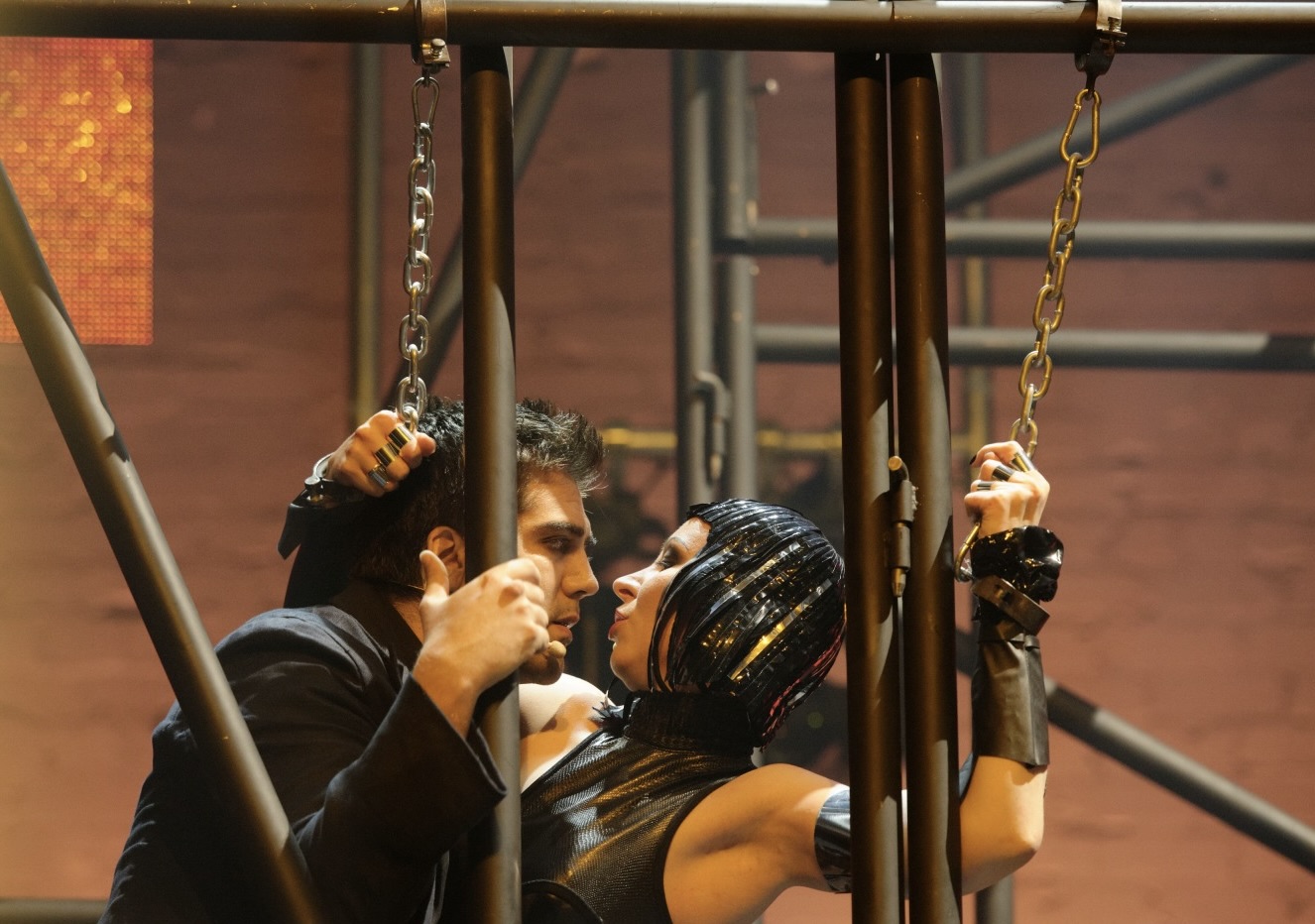
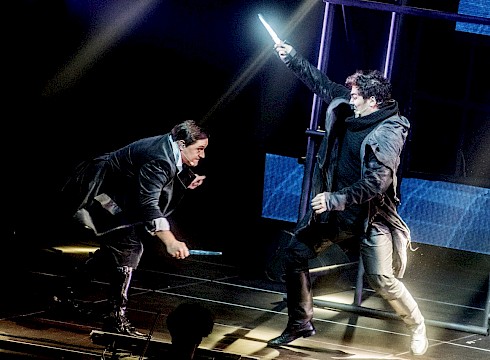
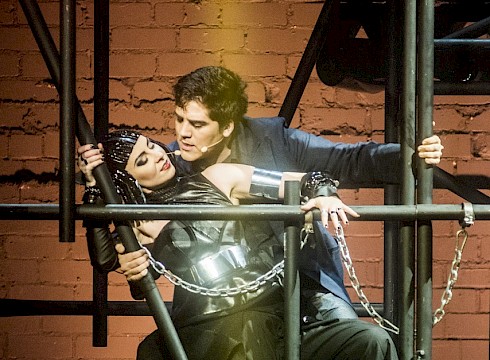
VCO’s biggest musical experiment “e-Carmen” is not some jumble of reworked arias, but a full-length 2-hour electronic opera based on G. Bizet’s music and traditional storyline. After the success of the “XYZ” project, the composer and virtuoso of electronic music Marius Adomaitis (Ten Walls) undertook an extremely bold creative task. Adomaitis, who has a classical musical education, became the main candidate for realizing an old dream of D. Ibelhauptaitė. The director had always wanted to direct “Carmen” but presenting the world’s most popular opera in a new modern way was a truly challenging task. The best way out was to completely rewrite the whole music.
“It’s difficult to comprehend how Marijus managed to fuse the multitude of styles of electronic music into an organic and tasteful whole and, moreover, to embody the wise, subtle modern narrator. During the performance electronic music seemed to create a certain effect of detachment which helped to keep the audience in line with the narrator, telling Carmen's story in another dimension”, wrote critics after the premiere.
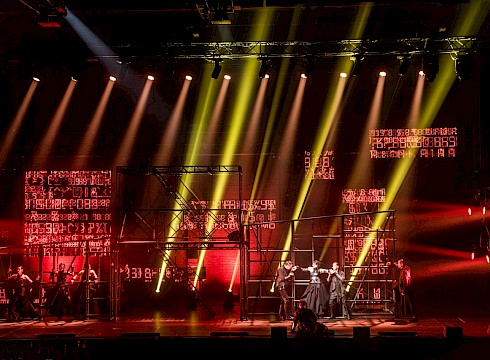
The impressive musical performance features not only exceptional costumes and set design, but also the work of lighting designer Eugenijus Sabaliauskas. His huge experience in various theatre, fashion and music shows helped the creator to unravel their extraordinary talents during the performance of “e-Carmen”. In his detailed lighting score, meticulously aligned with music, E. Sabaliauskas managed to fuse the theatric nature of Carmen and the chilly strokes of electronic music.
Creators


Sound director
Aivaras Stankevičius


Performers


Frasquita
Monika Kučinska
Mercedes
Dovilė Kazonaitė

Participating in performance
Toma Banzaitytė, Ana Kasperovič, Lora Kmieliauskaitė, Asta Lukošiutė, Arnas Kmieliauskas, Arūnas Kučinskas, Simonas Laučka, Raimundas Neverovas, Evaldas Petkus
String orchestra
Karolina Glinskaitė, Petra Zahumenska, Laimonas Bendaravičius, Erikas Klincevičius.
Vilnius City Opera ensemble
Premiere: 2016 September 17

SEXUALITY AND POWER: THE METAMORPHOSIS OF QUEEN CARMEN
Marijus Adomaitis (Ten Walls)'s electronic musical interpretation raised a few questions: “Is this a sin against the classic?”. However, what we often forget is the fact that even the greatest classical works were not initially accepted by their contemporaries. Carmen is no exception. Today, it’s one of the most frequently performed operas in the world; it received a range of reactions and later numerous original interpretations.
The story of Carmen has always fascinated with its dualities - the collision of man and woman, the understanding of moral and immoral, the temptation of freedom and strong beliefs, the right to choose and take responsibility for one's actions… The name “Carmen” itself bears two roots: the Hebrew karmel (the Lord’s vineyard) and the Latin carmen (song, poem). So it is for us today - melodic and intoxicating.
FROM THE LIPS OF THE COUNTESS…
Prosper Mérimée first saw her as melodic and intoxicating in 1830 while listening to the Countess of Montijo’s story during a visit to Spain. The writer, playwright, historian, and archaeologist fell under the spell of the tale about a rogue from Málaga who killed his lover - a woman who had devoted herself to the public. Clearly, the Frenchman was also passionate about anthropologicial studies. At the time, he was interested in the Romani people and chose George Borrow’s and Aleksandr Pushkin’s books for his study. Mérimée turned his heroine into a Romani woman and gave her the name Carmen.
He decided to tell this story as a form of “real experience.” In the first two chapters, he forms a friendship with Don José Navarro (Don José Navaro) and meets Carmen. He helps him escape from justice, and during their meeting, he lose his watch. The third chapter becomes the center of the story - the friends meet the day before José’s execution, and he recounts his life story. There’s also a fourth chapter, added to the complete publication in 1846 (the first publication was in 1845), which exclusively covers Romani culture.
…TO THE COMPOSER’S EARS…
While temporarily staying in Rome (1858–60), composer George Bizet added Mérimée to his reading list - it’s likely then he first read Carmen. After the Franco–Prussian War and with Paris’s artistic scene reviving, in 1872 Bizet, following a less-than-favorable experience at the Opéra-Comique, was offered a chance to create a “full-scale” opera - Carmen fell into its place.
Together with renowned librettists Henri Meilhac and Ludovic Halévy, the composer began work in 1873. From the start, their main task was to ease the rawness of Mérimée’s story and its character portrayals to make them more acceptable to the opera’s community, for the way Mérimée depicted them, they would seem monstrous. The team faced strong resistance. The theatre’s administration (with the exception of Adolphe de Leuven) found the main couple to be disreputable, while the pure Micaela (José’s fiancée, not present in the novel) seemed much more appropriate. Furthermore, there were plans to portray Romani people in a comic light, while the tragedy of Carmen’s death would be overshadowed by a triumphal finale…
The structure of the opera was constructed in keeping with opéra comique conventions, with musical numbers separated by dialogue. The majority of secondary roles follow this style - practically everyone except for the main couple, José and Carmen. The most unacceptable aspect was that the story revolving around the proletariat. The music Bizet composed for them is now recognized as a masterpiece - a vivid expression of their emotions and fates, marked by rich musical color, harmony, and character. Today, when describing its sound, it’s clear that it resonates closely with the style of verismo, later fully developed by G. Puccini.
“CARMEN” - CONDEMNED TO INTERPRETATION
Bizet did not leave a definitive or finalized version of Carmen. In France, it’s performed with dialogue, while elsewhere, it’s typically presented with recitative. Until its 1875 premiere, there were at least 3 different versions. To this day, musicologists debate which is most faithful to the composer’s intent. We can say that from its very creation, Carmen was “condemned” to variation and interpretation - yet nobody could have predicted just how many there would be.
Interestingly, it’s José who evolves most and resonates most strongly with the audience - he transforms from a dutiful soldier into a criminal, even a murderer - while Carmen is a completely different, new kind of heroine - a woman whose love is not pure but much more vital and dangerous. The power that a woman holds within herself can become threatening. It’s not a coincidence we talk today about Carmen in the context of feminism and women’s rights. This was something the 19th-century public may have disliked - yet it kept creative artists engaged in depicting a different kind of woman. The role of Carmen demands not only vocal prowess but also dramatic expression - even Maria Callas performed it in concerts, but not in a full production.
The Paris premiere was met with a somewhat chilly reception. Few critics and composers recognized its forward-thinking genius. It was not until 1883 that the opera was warmly received in its hometown. What happened in the meantime? Carmen successfully toured nearly all major European opera houses and even crossed the ocean, although its Metropolitan Opera premiere was not until 1884. During this time, Carmen received immense support not only from composers like Richard Wagner and Johannes Brahms but also from state leaders, Otto von Bismarck, and even from the philosopher Friedrich Nietzsche.
THE MOST POPULAR OPERA AND BOLD DIRECTORS
While Bizet died without experiencing Carmen’s eventual fame, by 1888 it had been performed over 300 times; by 1938 - over 2000; and by 2011, the Metropolitan Opera alone had performed it more than 1000 times. Performances, whether in principal or secondary roles, became a mark of prestige and professionalism for opera singers. The first recordings were made in the 1890s with the first recording equipment - phonographs - and their number has grown ever since. Currently, DVD recordings by David McVicar (2002) and Francesca Zambello (2007, 2010) are especially valued.
Carmen is not a piece where a director can completely detach its setting or drastically redefine its character relationships. As many a critic says: “Bizet always wins.” His score contains not only motifs from Spain, Cuba, and Romani culture but also character psychology and dramatic reactions. This is precisely what makes these two productions - more or less traditional - feel profoundly alive - just the way we know them from many recordings or photographs.
Perhaps the most radical production today is by the scandalous Calixto Bieito, who stripped Carmen down to its raw essence and placed it in a contemporary context. Nevertheless, even his production cannot become as scandalous as he might wish, because all he does is bring back the first, raw understanding of the piece - adding a heavy dose of dirt and passion. We can say this might be precisely what Bizet would have done if he had the opportunity in 1875 - growing less distant from Mérimée’s sharp view of the story.
DANCING CARMEN
But that's just the opera stage. It was a long wait and many attempts until Carmen appeared in a full ballet form with Bizet’s complete score. In 1949, renowned French choreographer Roland Petit created his Carmen. His story was based on Mérimée’s novel, with orchestration by Tommy Desserre. Petit performed José in the first productions, while Carmen was danced by his wife, Zizi Jeanmaire. In the 50 years following its London debut, this ballet was performed nearly 5,000 times.
Yet the most striking adaptation for ballet is the 1967 Carmen Suite. At the initiative of the legendary ballerina Maya Plisetskaya, her husband, composer Rodion Shchedrin, created a remarkable arrangement for strings and percussion. According to the composer, this allowed him to move much further away from Bizet’s orchestration while fully utilizing the Moscow Bolshoi Theatre’s orchestra. The main melodies remained recognizable, but their context was rendered more dramatic and unconventional.
This ballet, with its Cuban choreographer Alberto Alonso, triggered a scandal in the Soviet Union - Culture Minister Ekaterina Furtseva banned it after its first performance, stating it was a complete failure, filled with nothing but eroticism and a violation of Bizet’s work. Obviously, today it’s hard to comprehend these judgments.
This incident somewhat replayed the Paris premiere’s controversy, as the ballet fell victim to disputes and censorship while European and Canadian companies already eagerly wanted to perform it. Naturally, it didn’t take long for Carmen Suite to return to the stage - by 1968 it was a favorite both in Soviet and international theaters. Although Shchedrin remained close to Bizet’s score, Alonso’s choreography stayed much closer to Mérimée’s structure, retaining only the main character relationships, presented against a conceptual and modernist set by Boris Messerer - placing them in a bullring.
Using Shchedrin’s piece and with the help of composer Terry Davies, another new Carmen was subsequently brought to life by Matthew Bourne in his unconventional ballet The Car Man. Although the choreographer admits he didn’t delve much into Carmen’s story, choosing instead James M. Cain’s cult novel The Postman Always Rings Twice (1934) and its 1946 and 1981 film adaptations as a basis, this artistic transformation brings us much closer to Mérimée’s view. The 2000 ballet sets the action in a retro Italian-American community - mechanics, their garages, their women, and a chance newcomer. While Bourne’s adaptation strays far from the 1934 novel, much of its spirit resonates with Carmen: retaining its thematic flavor, its raw passions, its character relationships - all without fully capturing that “one and only Carmen.”
BLACK CARMEN AND CINEMA
It’s fair to say that just as much as Carmen resonates with the image of a woman, it resonates with a community of outsiders - ordinary workers - a view taken up by musical theatre as well. The 1943 Carmen Jones stands out as a strong example - a musical performed by an exclusively Black troupe, with a score adapted by Robert R. Bennett and lyrics by Oscar Hammerstein II. This musical was a smash hit, repeatedly restaged, won Laurence Olivier Awards, and in 1954 was made into a film. The more recent Carmen: A Hip Hopera (2001) brings a new twist, featuring pop icon Beyoncé Knowles - today recognized as a leading representative of feminism and the fight for Black rights - boldly employing sexuality as a form of expression. Another remarkable and original film - winner of the Golden Bear at the 2005 Berlin Film Festival - is U-Carmen eKhayelitsha. This South Africa–set cinematic adaptation, directed by Mark Dornford-May, merges Bizet’s score with traditional African musical elements.
When it comes to cinema, we would need a separate article just to list all the film adaptations related to Carmen. Among them are Jacques Feyder’s silent Carmen (1926), Herbert Maisch’s Nights in Andalusia (1938), Carmen with Jean Marais(1944), the team-up of cinema legends Rita Hayworth and Glenn Ford in The Loves of Carmen (1948), the spaghetti western Man, Pride and Vengeance (1967; a.k.a. With Django Comes Death), Jean-Luc Godard’s Prénom Carmen (1983), and Carmen Kiss (2011), which turned the main heroine into a sex slave from Romania…
In addition to the fact that Bizet’s bold choice has preserved and brought to the audience a work about ordinary, imperfect, sinful, yet profoundly passionate, real, and therefore inspiring people, perhaps Charlie Chaplin was also correct when he created A Burlesque on Carmen in 1916, offering us a chance to look at everything a bit more simply...
Meanwhile, the VCO creators, as the first to undertake a fully electronic arrangement, hope that today’s sound will bring us once again closer to this passionate story that once fell from the Countess’s lips.
Related news
Bohemians Turn 20: Anniversary Season to Culminate in Norma with Asmik Grigorian

Sustainability in opera: how Juozas Statkevičius’s costumes were given new life a decade later

When everything hangs in the balance on stage: the invisible heroines of Dalia Ibelhauptaitė’s productions reveal the secrets behind the scenes

How Bohemians’ advertising took to the streets and changed perceptions of opera