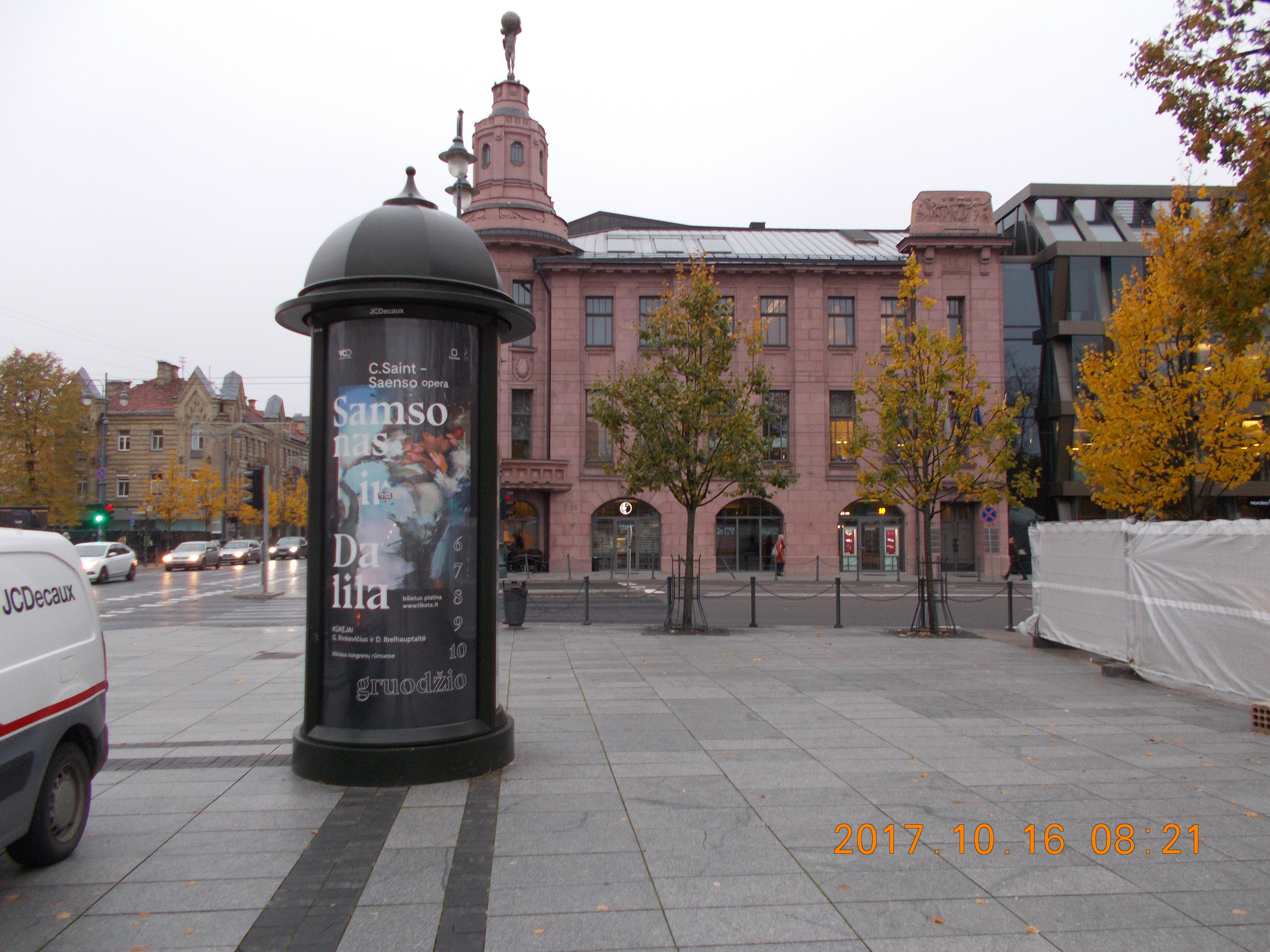
SAMSON ET DALILA
Camille Saint-Saëns
Conductor:
Gintaras Rinkevičius
Director:
Dalia Ibelhauptaitė

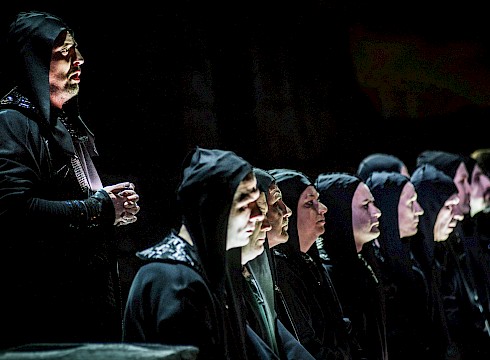
The world constantly experiences conflicts arising due to intolerance of other beliefs and people. The fact that not everything is just black and white is often forgotten. The passions in “Samson and Delilah” are fueled by the battles for religious beliefs, and the fight uses the same old methods: manipulation of people, their minds, knowledge and faith, thus turning them into tools of war. In continuation of the “Gourmet Opera” series, VCO undertook the production of this French opera that had not been staged in Lithuania since 1934.
The image of Samson brings out a very important storyline of a national hero. Who is that man, possessing special powers? “Very often we have tendency to deify our leaders. Although in the opera Samson is different from the superhero depicted in the Bible, but he still is the best, the most influential, the bravest, the most elemental... and possessing a single weakness - the inability to resist the temptations and sensuality of a woman. For this woman he betrays and destroys his nation. A banal and primitive personal desire brings doom to thousands of people... Maybe Samson does not die but rather is symbolically blinded in order to become able to see truth in his pain and, after regaining sight for the last time, to find strength within himself to defeat those who destroyed his nation”, contemplates D. Ibelhauptaitė.
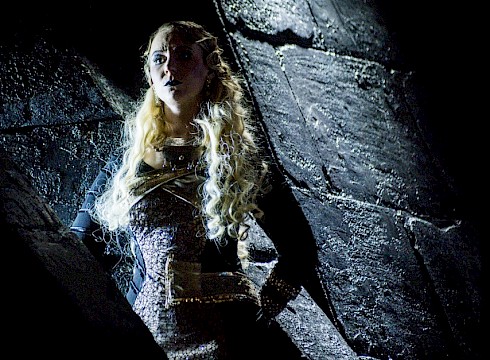
However, the opera focuses on Delilah, whose story seems much more relevant. Delilah is not a victim, she understands perfectly what is going on. Does she love Samson? Definitely not. She is propelled by vengeance and that is exactly what turns her into a modern woman fighter.
The creators do not romanticize the story shrouded in the Biblical legend, but instead choose to study the raw emotion, the aggressive and brutal force manipulating people’s emotions and to look how it has been used throughout the history of mankind. There is no sentiment here; everyone clearly knows what they are doing, there are no heroes and no single winner.

Creators


Performers


Samson
Derek Taylor (USA)


Participating in performance
Kaunas State Choir
Leader Petras Bingelis
Premiere: 2017 December 06

KRISTINA SABALIAUSKAITĖ: SAMSON AND DELILAH IN ART
Why has the story of Samson and Delilah captivated artists' imaginations for centuries? Cranach, Rembrandt, Rubens, Romantics, Symbolists, Italians, Dutch, Germans, Austrians – frequency of occurrence of this motif in painting is astonishing. The story is very simple: he is a hero of the Israelites, famed for his strength – thought to be partly borrowed from the Sumerian Enkidu and perhaps from the Greek Heracles. So strong that in his spare time he rips lions’ jaws apart and slaughters entire Philistine armies with a donkey’s jawbone. A leader, a strongman – but one who represents a primitive idea of power, strength, and masculinity (“if you have brawn, you don’t need brains”), bearing little resemblance to true strength; rather, a stereotypical brute.
No wonder that his name is now used in marketing to target a certain group of men – simple meat products and beer bear his name. Reading the Old Testament, Samson’s emotional story offers little reason to admire him as a character: having fallen for a woman from Timnah in Philistia, he insists on marrying her, to the dismay of both his own parents and hers – marrying foreigners, especially enemy Philistines, was forbidden. Her father secretly marries her off to a former charioteer; enraged, Samson takes revenge not only on the bride’s family but on all Philistines – he ties 300 foxes tail-to-tail, sets them on fire, and releases them into the grain fields to destroy the harvest. You wrong me – I’ll get back at you even worse!
True to macho form, he takes every woman he encounters, especially drawn to forbidden Philistine women – after the beauty from Timnah came a prostitute from Gaza, and finally the fatal Delilah. He comes, takes her without asking, but his Philistine enemies bribe her with 1,100 pieces of silver to uncover the source of his supernatural strength so they can finally defeat him. Coaxing him after sex, Delilah interrogates. He lies, first claiming he must be bound with bowstrings. The Philistines tie him while he sleeps. Naturally, he breaks them like straw. Still, he keeps returning to Delilah; no alarm bells ring in his long-haired head – brawn over brains. She coaxes again, he lies again: new ropes this time. The ropes snap. Then, he claims his hair must be woven into a loom. He breaks the loom too. The fourth time, he tells the truth: his strength lies in his hair. Presumably, at this point, he’s simply addicted to Delilah’s physical charms – in a post-orgasmic moment of vulnerability, the truth slips from his lips. The next time, after sex, he falls asleep with his head in her lap. A servant sneaks in and cuts his hair. The Philistines capture him, gouge out his eyes, drag him to Gaza, and make him grind grain like a beast of burden. Yet even blind, Samson eventually takes revenge – in a Philistine temple, he brings down the columns and kills himself along with the assembled crowd.
The story of the strongman Samson and the beautiful Delilah is fascinating in art and culture because it inflames the imagination so powerfully that each interpreter sees it differently, projecting their subconscious fears, desires, and demons onto it. Often, the sacred text is forgotten or heavily altered. Let's begin with the fact that Samson would be unable to taste his namesake sausages or beer today – his strength lay in being a Nazirite, someone dedicated to purity for God by parental vows from birth: no razor was to touch his hair, no alcohol, strict adherence to biblical rules of bodily purity, diet, and avoidance of impurity – no graves, carcasses, or filth. So, no beer and no non-kosher pork sausages. Ironically, even though tattoos contradict biblical purity laws, Samson – the lion-slayer and column-destroyer – is a popular tattoo figure, especially in prison culture. But in professional art... Ah, here the psychoanalytic richness of this tale begins.
From the earliest depictions, Delilah becomes a symbol of female deceit: she is synonymous with betrayal, a cynical embodiment of evil, using sex as a weapon to deceive, dominate, and destroy men. Although, as we’ve seen, Samson never tried very hard to earn her affection. Used to relying on brute force – he came, took her, used her like an object, returning each night to satisfy himself by right of strength. It’s hard to see how Delilah was supposed to develop deep love, passion, or loyalty toward a man who raped her repeatedly and was her people’s enemy. As for betrayal – let’s not forget she was a Philistine and simply helped her own. As for cunning... well, let’s not forget that Samson’s greatest trait was strength, not intelligence... And the hair – it wasn’t even she who cut it, but a servant.
Yet all the blame, all the misogyny, is heaped upon Delilah. In art, it is usually she, not the servant, cutting the hair. She’s guilty, just because – she was born a woman, and women are evil, not to be trusted. To Jews, she is a cautionary tale of what happens when Jewish men consort with non-Jewish women. To Christians – a traitor, a monster, likened to Judas who betrayed Jesus (even though the Old Testament says she never loved Samson, so she didn’t truly “betray” anyone – a fact curiously overlooked). Thankfully, artists, when tackling this theme, often reveal not misogyny but hidden desires and fears. That’s why every painting of Samson and Delilah is essentially a psychoanalytic self-portrait of the artist.
Take Rembrandt’s “thriller” – Delilah plays a secondary role, fleeing with hair in hand and scissors, looking back in surprise at what she’s done. The main focus is on the Philistine soldiers, many against one, gouging out Samson’s eyes so he’ll never see light again. Remembering Rembrandt’s own struggles with authority and the bourgeois community trying to confine him, this painting is a clear expression of fear – of being overpowered, of losing the ability to see the light, of losing the power to create and becoming an artistic eunuch working on Philistine commissions.
Or Caravaggio – erotically masochistic, as he typically strips sacred stories to raw personal truth. His Delilah, finger to lips, urges silence, not to wake him. With a falsely innocent Madonna-like face and provocatively exposed breasts, which Samson had just caressed, she holds not scissors but a razor. She hasn’t just cut his hair – she’s shaved him bald. It’s likely that Samson, as in most of Caravaggio’s works, is a self-portrait: he is the one betrayed by a woman, shaved, emasculated, just after embracing those breasts.
Early 20th-century German painter Max Liebermann’s work could illustrate a psychoanalysis textbook chapter on castration anxiety: no soldiers, no servants – just Samson and Delilah after sex. He’s collapsed, covering his genitals, while she triumphantly lifts his severed “scalp.” All these paintings carry the same masculine message: never fully trust a woman, or you’ll be conquered and deceived. Never love entirely, or you’ll be helpless and castrated.
Perhaps that’s why, looking at art history, the most interesting “Samson and Delilah” painting to me is the one by Artemisia Gentileschi (1593–1656). A member of the generation influenced by and working after Caravaggio, she achieved what was nearly impossible for a woman of her time: not only gaining recognition among her male peers (she became the first female member of the Florentine Academy of Art), but also passing the test of time and securing a place in art history. Sadly, neither talent nor intellectual family background protected the 17-year-old Artemisia – she was raped in her own home by her tutor, hired by her father. The abuse continued repeatedly, and when the truth came out, the only “solution” offered by society was to marry her off to her rapist to make her an “honorable woman.” Luckily, the wedding didn’t happen – the rapist backed out, and her family took him to court. Artemisia had to testify. This trauma remained a recurring theme in her work: Judith beheading Holofernes, Lucretia raped by Tarquin, Susanna harassed by elders – all became central motifs. Her portrayals of helplessness, violence, and trauma were clearly a form of creative self-therapy: a means of processing, understanding, distancing, and immortalizing her suffering. In this emotional authenticity, this raw personal interpretation of biblical scenes, she undoubtedly stands alongside Caravaggio.
And so, her Samson and Delilah: no drama, no thriller, no armed soldiers. Just Delilah, her dignified profile emerging from the shadows into light – not a seductress, not a harlot, just a woman. Beside her – a loyal maid, receiving the cut hair; the gesture is like a supportive, sisterly squeeze of the hand: “I witnessed everything you endured, and I understand and justify what you’re doing.” Nearby lies the sleeping Samson, his head in her lap – as repulsive as only an unloved, sleeping man can be – a drool seems moments away from sliding down his lips. And in Delilah’s hand, the compositional climax – a pair of small, shiny, almost manicure-sized scissors. The message is crystal clear: justice is done. Fortunately, even the worst strongmen are often fools. So don’t rape, don’t use your phallus as a sword, and you won’t need to fear castration. It can be delivered even by the manicure scissors of a weak victim. Such is Artemisia Gentileschi’sperspective – finally, not Samson’s, but Delilah’s story.
© Kristina Sabaliauskaitė, 2017
DONATAS PUSLYS: “NOTHING CAN BE DONE?” ARE YOU SURE?
VICTIMS AND NUMBERS
“He killed more people in his death than he had killed in his life” - this is how the story of Samson and Delilah ends. Captured by the Philistines, tortured, and blinded, Samson in his final breath brought down a temple, killing himself and, as the Old Testament says, thousands of men and women. He had already slain many before, fighting the Philistines - the very oppressors God had handed the Israelites over to because of their sins. But all of these victims remain nameless - just statistics in the whirlwind of brutal conflict. We know Samson’s name, and we know Delilah’s - the woman who seduced him, coaxed out his secret, and handed him over to the Philistines who killed him.
Yet we never learn the names of the victims. Perhaps, you might say, that’s how it should be, because they were the oppressors and brought this terrible fate upon themselves. But is it really that simple? Does justice increase in proportion to the number of dead? Doesn’t reducing all the dead to numbers just help us ignore that among the thousands were also innocent, blameless people? And if so, then the fight becomes less sacred and more like the very tyranny it sought to resist - an endless cycle of vengeance that risks turning into the same kind of evil.
Turning people into numbers functions like a sedative for the conscience. We often hear such numbers in reports from the world’s hottest conflict zones - Afghanistan, Iraq, Somalia. Perhaps this just helps us, the viewers and listeners, digest it more easily. Alongside economic indicators and sports stats, war victims are also reduced to mere digits.
THE MORALITY OF BILLY PILGRIM...
But the story of Samson and Delilah tells us more than that. It warns that one person can be both a victim and a perpetrator. Such is Samson. A victim who retaliates “an eye for an eye, a tooth for a tooth.” But that only leads deeper into a sea of violence, where every act of revenge provokes a more brutal response. In this swamp of blood, the question remains: who will dare to stop the orgy of killing - not with another attack, but by speaking of truth and justice amid hatred and rage?
“So it goes,” often said Billy Pilgrim, the protagonist of Kurt Vonnegut’s anti-war novel Slaughterhouse-Five, set against the bombing of Dresden in WWII. Billy believed that past, present, and future were unchangeable - so why write an anti-war novel? That, he said, would be like writing an anti-glacier book, since wars are unstoppable - like glaciers. “And even if wars did stop like glaciers retreat, no one escapes death.” So why bother, when the story of Samson and Delilah keeps repeating in modern times - in WWII, the Balkan wars, the Israeli–Palestinian conflict, or the war in Ukraine? The list goes on. But can we actually change anything? If it’s beyond our control, is it worth worrying about?
...AND RESISTANCE TO IT
“I speak to you as someone who, fifty years and nine days ago, had no name, no hope, no future, and was known only as A-70713,” said Elie Wiesel on January 27, 1995, addressing those gathered at Auschwitz to commemorate the camp’s liberation. He was one of the lucky few who regained a name, hope, and future. Millions did not. Today, at best, we follow road signs leading to the sites of their murders. On that day, Wiesel spoke not only for himself but for the fading memory of others.
On July 21, 2008, Serbian police arrested a man in Belgrade carrying ID in the name of Dragan David Dabić. But that name was fake. Behind it hid Radovan Karadžić - the so-called Butcher of the Balkans. “Karadžić is a killer sitting calmly atop a pile of corpses, worrying only about survival,” wrote journalist Dubravka Ugrešić. “He was aided by a vast human mechanism - the same one that long protected Slobodan Milošević: aides, accomplices, fans, politicians, criminals, clergy, and ordinary people - some mad, some perfectly sane.” Everyone talked about Karadžić, but how many remembered the names of his victims - those robbed of names, hope, and futures? Who remembered their relatives, still living with unhealed wounds? Ugrešić bravely condemned not just Karadžić, but all who trampled justice - those who sided with butchers over victims, who valued tribal loyalty or chauvinism over universal moral principles.
TWO FACES OF WAR - GOYA AND LICHTENSTEIN
Can we truly say, like Billy Pilgrim, “nothing can be done”? I look at two paintings. In Francisco Goya’s The Third of May, 1808, we see Napoleon’s soldiers executing Spanish rebels. The soldiers face away from us - evil is faceless, dehumanized, reducing soldiers to instruments of command. But we see the faces of the victims, frozen just before death. Goya preserves their memory - those whom the victors would rather reduce to statistics and forget. His painting is not just a recreation of history, but a moral imperative: to take the side of the persecuted, to refuse to forget, and to fight for justice. Peace is not just the absence of war; it is impossible without justice.
In Roy Lichtenstein’s painting Whaam!, we see a war scene drawn like a comic strip. The image is borrowed from comic artist Irv Novick of DC Comics. Lichtenstein speaks to how modern war and technology further dehumanize killing. Goya’s soldiers had to face their victims. Today’s pilot just presses a button. On a monitor, humans become black dots, mere targets.
Lichtenstein’s work also critiques how we consume war as entertainment. Do we empathize with the victims, or are we voyeurs seeking the thrill of danger from a safe distance? The overexposure to such images dulls us - war ends for us when we switch off the TV. But for those living through it, even when attention shifts, their “Samsons and Delilahs” remain.
WHAT CAN WE DO?
We can change how we talk about conflict. When discourse is dominated by geopolitics, tactics, and tech, we must insist on humanism. When revenge rhetoric takes over, we must remain clear-headed and uphold justice and law. That’s what people like Sir Henry Campbell-Bannerman, Bishop George Bell, and writer David Grossman did.
In 1901, during the Boer War, Campbell-Bannerman dared to be called a traitor for condemning British methods in South Africa - calling the use of concentration camps barbaric. “We are not fighting a foreign enemy. These people are our neighbors - no, our fellow citizens,” he said.
In 1944, Bishop Bell spoke in the House of Lords against the bombing of German cities that targeted civilians. Had his plea been heard, Vonnegut might never have needed to write Slaughterhouse-Five. Bell was never made Archbishop of Canterbury. “Does the government understand the dangers of bombing cities? The moral implications and the harvest it sows for European nations?” he asked.
This echoes what writer Miljenko Jergović observed during the Balkan wars. Watching the burning Sarajevo library, his narrator wonders: “All these fires, accidental or deliberate, are giving birth to a new kind of person - one who’d watch the Louvre burn without even reaching for a glass of water.” Why stop the flames if human indifference already destroyed the meaning?
“Just once, look at them not through a gun sight or from behind a checkpoint. Then you’ll see people who suffer no less than we do,” said David Grossman in Tel Aviv in 2006, addressing his government. His son Uri had just died in the Lebanon War. Still, he did not seek revenge. Instead, he pleaded with society and leadership to see the humanity in those on the other side - not just enemies or targets, but people.
That’s what we must do, too. Grossman’s friend, writer Amos Oz, argued that even well-meaning European liberals reduce conflicts to a binary: who are the good guys, and who are the bad? Sometimes that’s easy to answer. But often, it’s not. And once we answer, we turn into fans at a sports match - rooting for Samson or Delilah. But even on the “bad” side are people who don’t deserve only vengeance and humiliation - they deserve justice. Humanism triumphs only when we demand rights and justice not only for ourselves, but also for our so-called enemies. Samson and Delilah never realized this - and that was their downfall.
WHERE IS ABRAHAM?
In the Book of Judges, the Philistines rejoice that their god delivered Samson into their hands - the man who had devastated their land and killed so many. We also read Samson’s final prayer: “O Lord God, please remember me! Strengthen me just once more, so that with this one blow of revenge I may pay back the Philistines for my two eyes.” But can God stand with those who seek revenge instead of justice? Can God be unjust?
This is the question Abraham asked God: “Will you really destroy the righteous along with the wicked? If there are fifty righteous people in the city, will you still destroy it?” Abraham negotiates the number down to ten. His position is a rebellion against collective punishment - where the innocent are punished with the guilty just for being of the same nation, race, or religion.
The world always needs people like Abraham - especially when voices cry out for vengeance. Abraham is the one who sides not with power, but with the victim; who stands not for revenge, but for justice.
Unfortunately, today the tomb of Abraham and his wife Sarah in the city of Hebron is divided between Jews and Muslims. That in itself is not the problem - after all, Abraham is the forefather of Jews, Christians, and Muslims alike. The problem is that to get from the synagogue to the mosque, or vice versa, one must pass through extremely strict security checks, which reflect the underlying tension and mistrust. Abraham spoke of justice, yet his descendants today fail to properly uphold this legacy. While striving to be physically as close as possible to the patriarch, they are, spiritually, light-years away from him.
The city of Hebron itself is divided between Palestinians and Jewish settlers, and the only thing maintaining order between the communities is the presence of armed soldiers. This situation becomes a symbol of how, tragically, the vengeful Samsons and Delilahs of today often triumph over Abraham’s pursuit of justice. Still, Abraham’s example prevents us from repeating the words of Billy Pilgrim: “So it goes.” The people previously quoted show that although we may not change the world - or even our own countries - we can at least strive, by our own example, to uphold and preserve the moral norms that the encroaching darkness seeks to extinguish. If we succeed in doing even this, it will already be a victory - a sign that, even as cities burned, not everyone was indifferent or unwilling to lift a finger to offer a glass of water.
SAMSON AND DELILAH IN THE CONTEXT OF HOLY SCRIPTURE
In the Holy Scriptures, among the so-called books of the Old Testament - most of which are equally respected by both Jews and Christians - we find the Book of Judges. This text describes a difficult period around the 11th century BCE when the people of Israel suffered under Philistine domination in the Holy Land. At the end of this era, a particularly striking figure arises: Samson.
He is born to a barren couple after the Lord, through an angelic revelation, announces the miraculous birth of Samson as a gift to the people of Israel. From childhood, he was to be consecrated to God, a nazir, meaning he was never to cut his hair, consume alcohol, or touch anything dead. All of this was intended to ensure ritual purity and prepare him to be another of Israel’s “Judges” - liberators from foreign oppression. To fulfill this mission, the Lord grants Samson extraordinary strength and power, on the condition that he faithfully adheres to the nazir lifestyle. Physical strength becomes Samson’s unmistakable hallmark: he can slay dozens of enemies at once, and even kill a lion with his bare hands.
But Samson’s story is riddled with intrigue from the start. His first wife, a Philistine, betrays him under pressure from her relatives and extracts from Samson the answer to a riddle he posed to wedding guests. As a result, the marriage collapses, and military conflicts between the Israelites and the Philistines escalate. Soon after, even the Israelites “betray” Samson: fearing Philistine threats, they decide to bind him and hand him over to their oppressors. Yet Samson’s strength enables him to break free and defeat his enemies once again.
Toward the end of his life, Samson falls prey to yet another betrayal: he falls in love with a woman named Delilah (the text does not definitively confirm if she is a Philistine, though the context strongly suggests it). She is lured by the promise of money from Philistine leaders in exchange for discovering the secret of Samson’s strength. Delilah begins questioning Samson. After three false answers, she resorts to tears and reproaches: “You say you love me, yet you don’t trust me with your secret.” Eventually, worn down by her persistence, Samson tells her the truth about his strength. From there, the road to tragedy is short: Delilah summons the Philistines while Samson sleeps. They cut off his seven locks of hair and finally manage to subdue their most fearsome enemy. Samson’s eyes are gouged out, and Israel’s hero ends his days in Philistine captivity as an object of mockery and entertainment... However, God does not abandon him: during a festival, after his hair has begun to grow back, Samson finds the strength to collapse the Philistine temple, killing a great number of his enemies - though he dies in the act.
From a believer’s perspective, the Holy Scriptures are God-inspired texts, given to enlighten humanity. As in some other parts of the Old Testament (which varies widely within itself and even more so compared to the New Testament), stories are sometimes conveyed in a legendary or symbolic style. Thus, as readers of Scripture, we ask not only: “Is the story of Samson and Delilah a literal historical event, or more of a moral parable, similar to those Jesus often used - full of symbols and instructive meaning?” But more importantly, we ask: “What does this passage teach me?”
Perhaps we’ll never uncover all the answers to that question, but certain truths do emerge. First and foremost, Samson’s image represents God’s promise that His seeking people will never be abandoned: even when they are lost and have strayed from their path, God will continue to send strong and courageous leaders. However, these leaders must also remain vigilant. Just as Cain killed his brother Abel out of jealousy, and Judas Iscariot betrayed Jesus for thirty pieces of silver, so too does Delilah value promised wealth more than Samson’s safety. Perhaps she doesn’t fully grasp the consequences of her actions - perhaps her judgment is clouded by greed. The Philistines’ words - “Try to find out the source of Samson’s strength so that we can bind him and be rid of him” - might not have struck her as especially ominous. Still, the text reveals one undeniable truth: Samson may be physically strong, but his spiritual shortsightedness is just as legendary. He chooses partners based more on physical attraction than on character, and he naively yields to manipulation without recognizing the trap.
If this Old Testament story highlights Delilah’s greed and spiritual infidelity, it also casts Samson’s carelessness in sharp relief - something with profound relevance to our modern era. God calls us to mutual relationships grounded in integrity and respect. If we yield to injustice and deception on either side, we all ultimately suffer. In contrast, discernment and self-restraint lead us much further.
Theol. Dr. Msgr. Visvaldas Kulbokas
Related news
Bohemians Turn 20: Anniversary Season to Culminate in Norma with Asmik Grigorian

Sustainability in opera: how Juozas Statkevičius’s costumes were given new life a decade later

When everything hangs in the balance on stage: the invisible heroines of Dalia Ibelhauptaitė’s productions reveal the secrets behind the scenes

How Bohemians’ advertising took to the streets and changed perceptions of opera