SWEENEY TODD – THE DEMON BARBER OF FLEET STREET
Stephen Sondheim
Conductor:
Gintaras Rinkevičius
Director:
Dalia Ibelhauptaitė

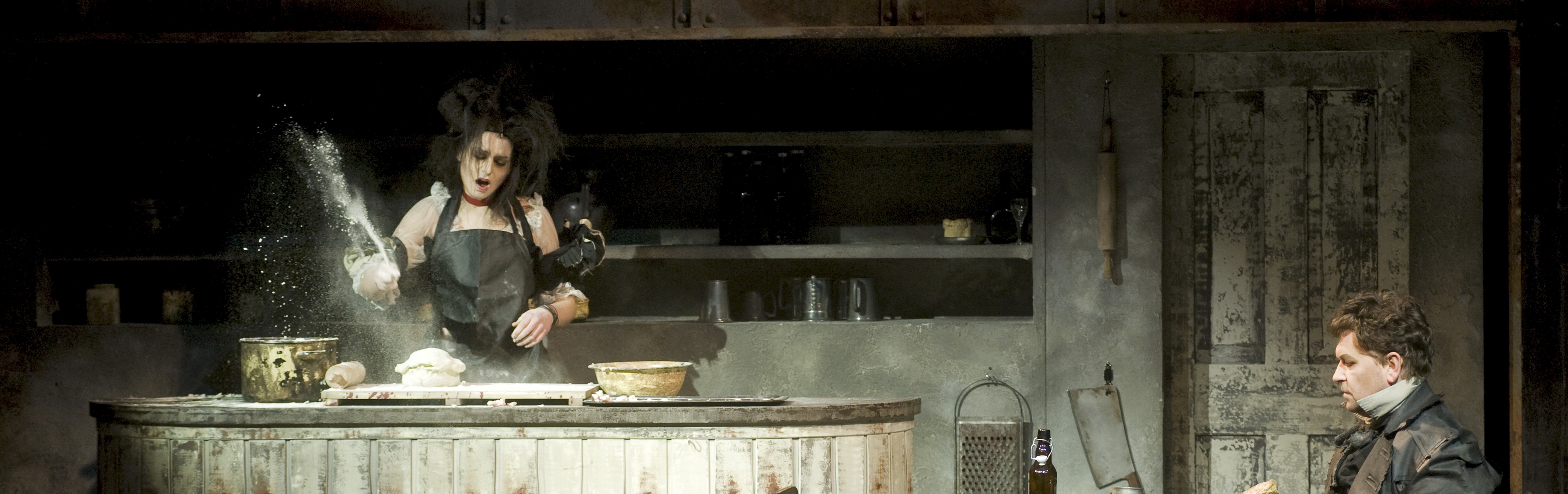
The first staging of the famous S. Sondheim’s musical in Lithuania became exceptional not only for the troupe, but for the audience as well. The reason for this was not only the brand new musical piece in VCO’s repertoire or its extremely complicated stage performance and original costumes, but, first of all, the fact that it attracted a large crowd of young people to the world of opera into which they return too, to this day.
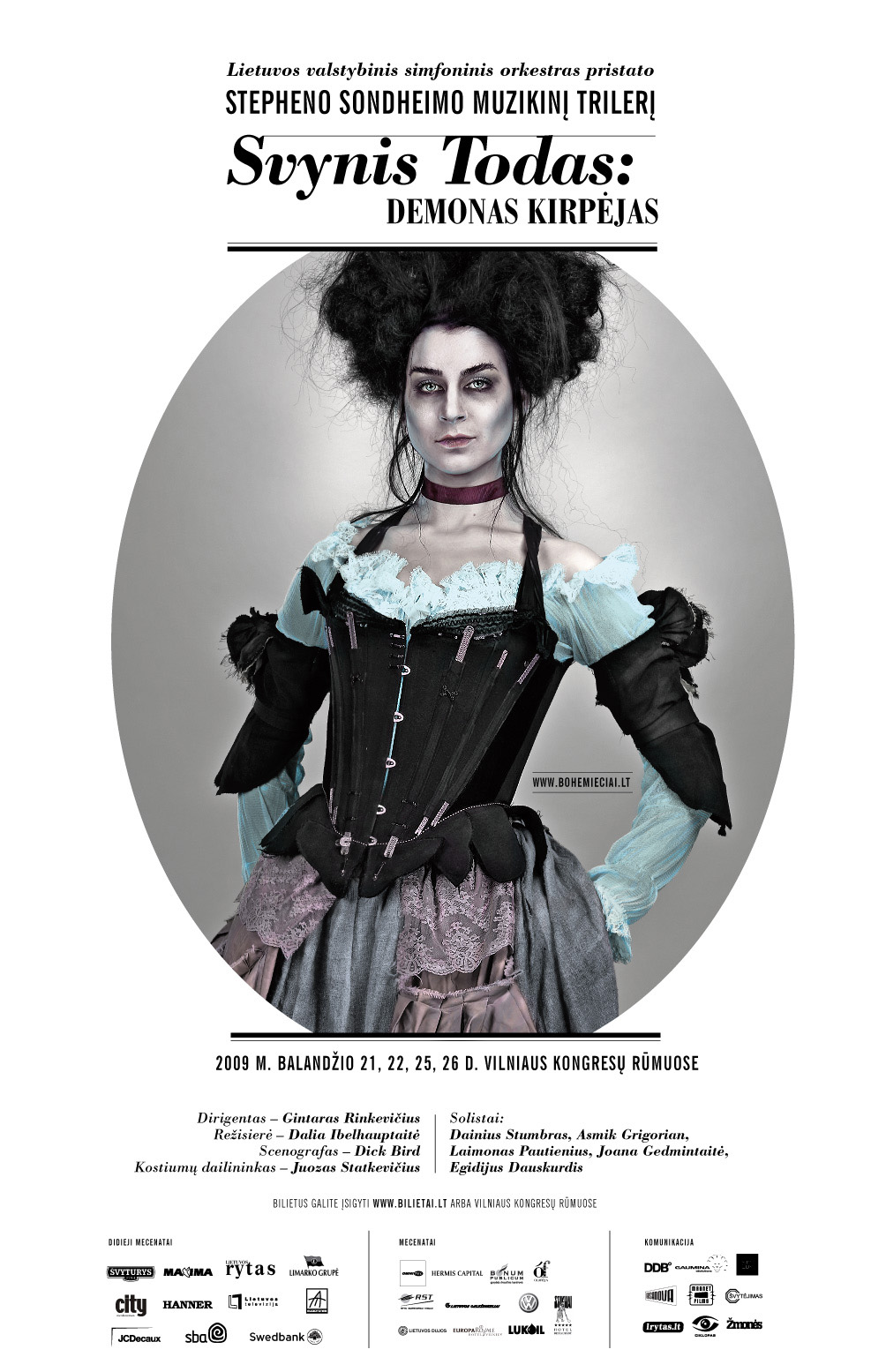
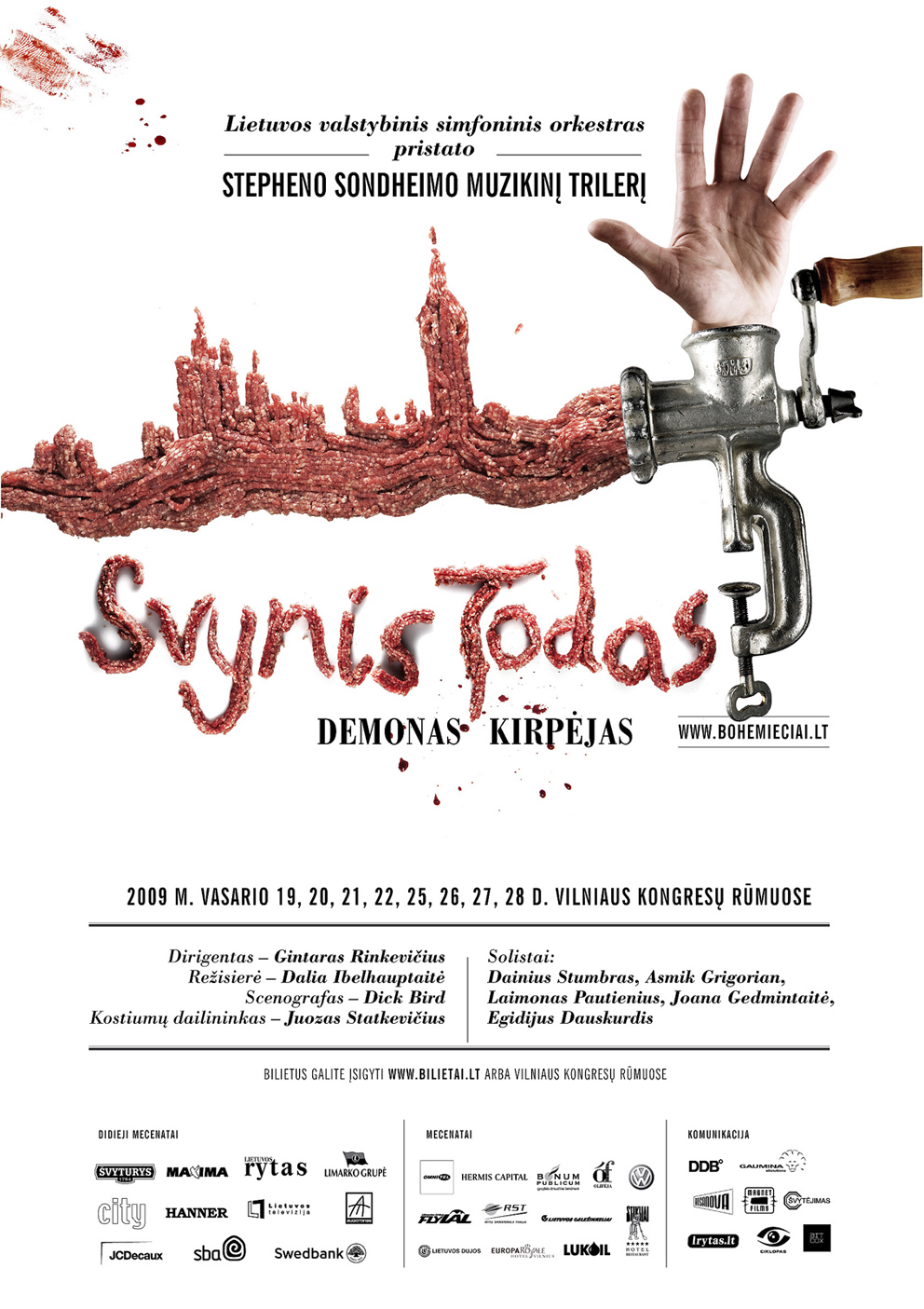
In 2009, the advertising campaign of the premiere was met with resistance and accusations of propagating violence, it was censored both on television and on outdoor display stands, which resulted in legal disputes in the courts lasting for the next couple of years. Nevertheless, VCO not only proved the relevance and expedience of the chosen piece, but also did it with triumph. Without attempting to change the period or to obviously actualize the details, “Bohemians” managed to grasp the essence of the musical: it is a performance that requires the highest quality, accompanied by a sincere love for the work. That was and still is the main principle that the whole troupe has followed in order to turn the Congress Hall into a Broadway stage for “Sweeney Todd” performance evenings.
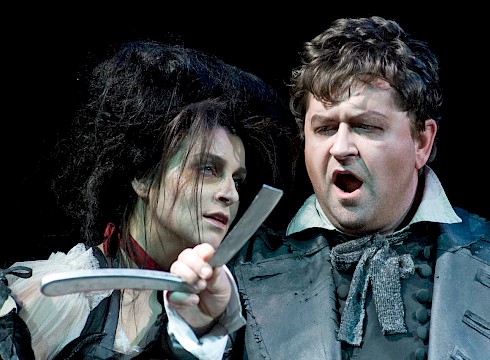
“Sweeney Todd” is considered to be one of the most complex musicals and a hard egg to crack for performers. Its score could be likened to an intricate cobweb of melodies. S. Sondheim was also extremely meticulous in specifying even the smallest actions of the characters such as when the barber has to raise and when to lower the razor and when Mrs. Lovett kills the cockroach!
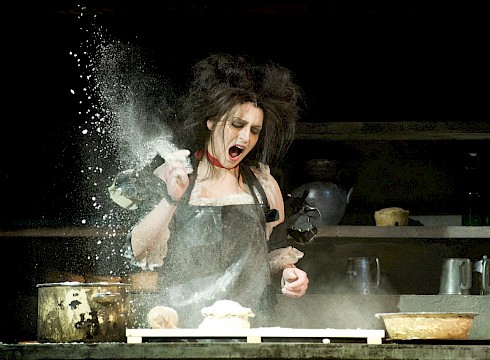
Dainius Stumbras and Asmik Grigorian spent as many as 5 months learning their parts. Asmik who had to learn tongue-twisting English patter even suffered from swollen lips, as before that she did not speak English at all. In the end, however, the soloist perfected even the typical Cockney accent.
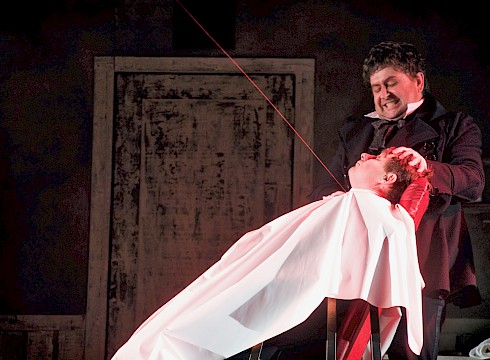
The scenographer Dick Bird outdid himself by creating the most complex stage set the Congress Hall stage has ever seen with dozens of music-sensitive modifications which had to be controlled with the help of over 10 technicians and stage managers. The vast amounts of free-flowing fake blood were ordered in tens of liters from Germany, whereas the real pies that had been eaten on the stage were baked by the restaurant “Bohema” based on a special recipe and historical British design.
Juozas Statkevičius’ costumes, as always, were intrinsically detailed. Juozas himself cut out the “moth holes” in jackets and used tea to dye the seemingly urine-stained underskirts of the Beggar woman character.
In 2010, Asmik Grigorian was awarded the Golden Stage Cross in the operetta category for her role as Mrs. Lovett.
Creators


Music preparation, conductor
James Holmes (UK)
Sound designer
Collin Pink (UK)


Performers

Sweeney Todd
David Arnsperger (Germany)


Participating in performance
LNOBT choir
Leader Česlovas Radžiūnas
Premiere: 2009 February 19

CHARACTER: SWEENEY TODD
In English society, stories of the demonic barber Sweeney Todd have circulated for more than two centuries. Today, he is considered the archetypal serial killer in all of history. Yet debates persist about whether this terrifying man and the crimes of the late 18th century were actually real. The controversy surrounding Sweeney Todd is similar to that of Jack the Ripper, who appeared a century later - but both characters have become legendary prototypes, classic figures in urban legends about maniacal murderers.
In 1973, Christopher Bond wrote a play about the London serial killer Sweeney Todd, which inspired Stephen Sondheim to create his musical. The musical recounts the story of the murderous barber, another variation among countless 19th and 20th-century genre interpretations - novels, dramas, and films. What makes Bond’s play different is that he raises questions completely foreign to previous versions. Instead of focusing on the crime itself and its details, Bond explores how and why such eruptions of brutality occur in society. The psychological-social aspect of the play sets it apart from other versions, which tend to revel in the act of murder itself without attempting to understand its causes. But what was the evolution of the Sweeney Todd character up to Bond’s version?
In literature, the character first appeared in 1846, serialized in 18 issues of the London weekly The People’s Periodical in a sensational yet wildly popular short novel titled The String of Pearls. It is believed to have been written by Thomas Peckett Prest. This was one of those tales that captivated London audiences and reflected the 19th-century public’s “bloodthirsty appetite,” which was regularly stoked by grisly news in the London Times. It is reasonably assumed that these cheaply printed weekly tales were often based on real crimes, with authors eagerly following any criminal news for inspiration. Thus, the genre of stories printed in weekly papers known as penny dreadfuls (literally: “one-penny horrors”) became wildly popular in the 19th century. Because there was such a demand for grisly stories, publishers sought to print them as often and as cheaply as possible. Printing was expensive in those days, and books were outrageously priced. To appeal to the masses, publishers used cheap paper, devoted 6–8 pages to serialized horror stories, and included gruesome illustrations. These weeklies were sold for just one penny, and society devoured them ravenously.
Another side of this story suggests that Sweeney Todd may have been a real person. The Daily Courant, London’s first daily newspaper, reported a murder on April 14, 1785, resembling Todd’s modus operandi. A witness claimed to have seen a barber near Fleet Street pull out a razor and slit the throat of a countryman, then vanish into the fog. That newspaper note may have become the prototype for countless later retellings. Soon after, tales spread of a murderous chair (used by Todd to rob and kill wealthy clients - he would seat them, tilt the chair, sending their bodies crashing headfirst into the cellar, breaking their necks or skulls; those who survived were finished off with a razor). There was also talk of a pie-maker, Margery Lovet - Todd’s lover and accomplice - whose bakery was connected to the barber shop by an underground tunnel through which the bodies were transported.
Today, criminologist Peter Haining, who dedicated 25 years to studying the maniac and described his research in Sweeney Todd: The Real Story of the Demon Barber of Fleet Street (1993), claims the real Sweeney Todd was born on October 26, 1756, into a poor, gin-soaked family in London’s East End. His childhood ended quickly - he was orphaned at twelve and taken in by a cruel uncle, a cutler who specialized in razors. At fourteen, he was imprisoned in Newgate for five years after being falsely accused of stealing a pocket watch. In prison, he met an old barber named Elmer Plummer, jailed for fraud. The old man taught Todd not only the basics of shaving and haircutting, but also how to pick clients’ pockets. Upon release, Todd opened a barber shop with a sign reading “Quick shaves for one penny – cheaper you won’t find” on Fleet Street, near the Royal Courts of Justice. It’s easy to see why he chose this location - he emerged from prison a bitter and cruel young man, ready to take revenge on judges or wealthy passersby. Todd murdered and robbed affluent customers. Eventually, the mysterious disappearance of a sailor named Francis Thornhill led investigators to his barbershop. Mrs. Lovet confessed everything, and Todd was tried for killing the sailor, from whom he had stolen a pearl necklace worth sixteen thousand pounds. But the ensuing investigation shocked even the blood-hungry public of the time. Nearly 160 sets of clothing were found on the premises. On January 25, 1802, Todd was hanged at Newgate, and the night before, thousands had gathered outside the prison to witness the execution. Mrs. Lovet, too, met her fate - she was found poisoned in her cell. From that point, Todd was dubbed the King of Serial Killers in English history, and his story became a subject of fascination.
Christopher Bond’s play, released at the end of the 20th century, fundamentally transformed the original portrayal. The English writer set the story in a later time - mid-to-late 19th-century London - whose brutal social environment becomes an essential argument in understanding Todd’s actions. In Bond’s version, the London atmosphere becomes a socio-cultural lens through which personal tragedy and the roots of brutality - not just maniacal greed - are explored.
The era Bond chose - Victorian England (1837–1901) - was one of the most paradoxical. On the one hand, it was a time of architectural revival and upward cultural momentum, with reforms aimed at social welfare and improving the middle class’s conditions. It was during this century that it was decided every child up to age 10 should have the right to free education. Darwin’s Origin of Species was published in 1859, the first World Exhibition was held in London in 1851, photography emerged, and the Crystal Palace - a modular steel-and-glass structure considered a prototype of modern architecture - was unveiled.
On the other hand, sweeping political shifts and explosive economic growth pushed human dignity and rights to the margins. Despite its modern ideas, London was also a city where morality and human rights were often neglected. The Industrial Revolution triggered a massive population boom (from 16.8 million in 1851 to 30.5 million in 1901) and rapid urbanization. Influxes of people created chaotic, overcrowded slums and hastily erected housing. Many urban poor, especially laborers in London’s working-class neighborhoods, lived in squalid, cramped, filthy conditions. Dark alleyways, narrow winding streets, and buildings shrouded in shadow made perfect hideouts for criminals.
Many newcomers were disillusioned by the English capital, finding themselves in the grimy streets of a noisy, overcrowded metropolis. The stench of horses filled the air; dirty runoff mixed with coal soot flowed not only through sewers but also openly in the streets, while speeding carriages splashed mud onto pedestrians. Sanitation was nonexistent - clean water was a luxury only the wealthy could afford. Everyone else not only used but drank the murky Thames water, whose filtration was only considered in the mid-19th century. Meanwhile, gin flowed in astounding quantities - Londoners quenched their thirst with gin rather than water. The city had more than 8,000 establishments openly selling the spirit.
The economic boom devoured the lives of factory workers. A typical workday lasted 16 hours - not just for adults but for children as well.
It was precisely the Victorian era that became forever immortalized by the exploitation of children - as early as three years old, they were sent to factories; children slaving away in coal mines from the age of five rarely lived to see their 25th birthday; more agile boys worked as chimney sweeps, messengers, or shoeshiners in London. In 1840, as many as 20 percent of London’s children were completely illiterate, and by 1860, statistical data showed that only half of children aged 5 to 15 attended school. However, the greatest and most incomprehensible horror of that time was the flourishing prostitution, called the “social plague,” as girls as young as thirteen were involved in it, with the main age range of prostitutes being from 15 to 22 years. In the mid-19th century alone, there were nearly ten thousand prostitutes in London, most concentrated in the East End district. These prostitutes were also associated with the horrific crimes of Jack the Ripper, which shocked the entire nation and even more clearly revealed a terrifying portrait of a society plunging into complete depravity.
It is clear why Christopher Bond chose this time period. He encourages reflection on the brutal situation in the metropolis, the deep social divide that emerged when people were replaced in production by new technologies and steam engines, when the creation and expansion of factories triggered a migration boom into cities, leading to the incomprehensible growth of London’s territory and the gathering of all sorts of people in one place. The play is set in a time when economic growth devalued the human being - man became less important than the industrial machine, which forces us to look at Sweeney Todd’s story from a completely different angle - as a portrayal of the spiritual poverty of the people of that time.
On one hand, Bond’s play, with its complex plot twists, is a crime thriller. On the other, the English author radically transforms character traits and introduces characters that did not appear in earlier versions of this story. Perhaps this was done in an attempt to present his version as a mirror of both 19th-century and modern society. For example, Beadle Bamford is portrayed as a corrupt scoundrel, and Sweeney Todd’s rival, Adolfo Pirelli, as a typical blackmailer and racketeer. However, the most shocking move by Bond is the creation of Judge Turpin’s character. The judge’s scene in the first act - when he satisfies his lust while watching a young girl through a keyhole - places readers face-to-face with a real societal tragedy, one we lack the will and courage to acknowledge or speak of aloud.
This late 20th-century play emphasizes aspects of personal tragedy and psychological drama, which were entirely absent in The String of Pearls. For instance, the girl Johanna, who had nothing to do with Sweeney Todd in earlier versions, is presented by Bond as Sweeney’s long-lost daughter. This plot element further darkens the already grim fate of the barber’s family, providing Sweeney with a solid moral justification for his desire for revenge - the corrupt Judge Turpin raped his wife, sent him to five years of penal servitude without reason, and now plans to marry and rape Sweeney’s daughter, who is not even sixteen yet.
The author clearly reinterprets Mrs. Lovett’s character - from the secondary, meek, unfortunate woman in The String of Pearls, who was only helping the killer out of fear and focused on her meat pie business - to a true embodiment of evil, an equal partner in cruel deeds, seeking solace in a glass of brandy in moments of weakness. In Bond’s 20th-century work, it is Mrs. Lovett who comes up with the profitable "business plan"; it is she who deceives the barber, claiming that his wife had poisoned herself, as she dreams of becoming Sweeney’s lover. In Bond’s play, Sweeney’s negative traits - greed and cold-bloodedness - are deliberately transferred to Mrs. Lovett. In this way, the author radically modifies the traditional image of Sweeney - from a typical mad killer to a suffering hero enduring personal trauma, from a superhuman monster whose actions are questionable, to a man driven to despair, shaped by a society that had long since trampled its morality and humanity. This aspect was not present in any previous version of the story - only Bond begins to explore why heartless psychopaths like Sweeney arise among people, or what made Judge Turpin descend to the level of a child molester. Christopher Bond openly writes about issues that most people wouldn’t dare whisper about. This is where the differing perspectives on the Sweeney Todd story become clear - while some versions talk plainly about crime as a sensational fact that excited the vivid imagination of 19th-century society, others, like Bond’s play, analyze an individual’s downfall as a consequence of societal tragedy.
Paradoxically, horror stories continue to capture people’s imagination more than anything else - not only in the 19th century but even today. The kind of long lines we see for action-thriller movie premieres in theaters are unlikely to form for screenings of films by, say, Andrei Tarkovsky or Federico Fellini. And in most television schedules, a firmly entrenched formula has long been in place: start the evening with a crime drama or action thriller, and end the night with a cheap horror movie. These films fail to raise the kind of questions Bond poses, trying to draw attention to a society rotting from the inside. Composer Stephen Sondheim takes the same “unfashionable” path, shaking up the traditional musical genre by choosing this very version of the Sweeney story for his work. Sondheim’s Sweeney Todd is entirely different from typical Broadway musicals - not sentimental, not cheerful or witty, but a painfully distorted reflection of reality.
GENRE – MUSICAL
As it steps into the Lithuanian musical scene, Stephen Sondheim’s Sweeney Todd: The Demon Barber brings an entirely new perspective to the genre. In Lithuania, musical theatre culture consists of isolated instances, fading into the broader panorama of entertainment events. For most people, the only familiar name in this genre is the composer Andrew Lloyd Webber. Just a few examples of Lithuanian musicals exist - such as the first original Lithuanian musical Ugnies medžioklė su varovais (Fire Hunt with Beaters), Love and Death in Verona, and the popular productions Notre-Dame de Paris and The Phantom of the Opera. These musicals often represent a hybrid of genres, leaning toward rock opera. Other musicals tend to veer toward entertainment, musical comedy, or fairy tale formats.
However, in the main centers of the genre - London’s West End and New York’s Broadway - the life of the musical is vibrant, multifaceted, and varied. It ranges from simple entertainment to masterpieces of the highest caliber, works that can rival academic classical music in their artistic value. Although the term "musical" in Western culture originally denoted light, popular music involving singing, dancing, dramatic elements, and a light storyline, over time the scope of subjects expanded significantly. Musicals branched into show-musicals, fairy-tale musicals, folk musicals, musical films, socially themed musicals, and mega-musicals known for their complex and innovative scenography.
In the second half of the 20th century, the musical began to transcend its own boundaries. Plots became more diverse, musical language more varied, and the musical itself began to approach the genre of opera. This trend is especially visible in socially themed musicals. One of the earliest examples is Jerome Kern’s Show Boat (1927), which dared to address societal issues and wounds. In the context of 1920s America, this subgenre of musical emerged naturally as a reflection of societal depression, class struggles, racial conflict, war trauma, and broken destinies. Such works include George Gershwin’s Porgy and Bess (1935), Frank Loesser’s The Most Happy Fella (1956), and the works of Kurt Weill, which stand out for their psychological depth and historical perspective - closer to opera than traditional musicals. Notably, Leonard Bernstein’s West Side Story (1957), for which Sondheim wrote the lyrics, is a unique and poignant score portraying racial tensions and violent gang realities. However, in Lithuania, we often know it more for its upbeat West Side dances and the catchy tune I Want to Be in America, without realizing that Bernstein embedded in that very song the paradoxes of life in America - the immigrant’s excitement and expectations upon arrival, and the cruel reality that awaits them.
Stephen Sondheim’s Sweeney Todd naturally continues the lineage of socially themed musicals. How might we describe Sondheim’s work in the context of Lithuanian cultural life? First, this is music of a completely different genre than what we’re used to hearing on Lithuanian stages - especially academic ones. On the one hand, Sondheim’s musical feels like a breath from another world or an unknown land, as it is vastly different from the type of musical typically associated with the genre. Socially themed musicals are virtually unknown in Lithuania. On the other hand, Sweeney Todd is a bombshell even within the realm of socially themed musicals, as Sondheim tackles a bold and controversial subject. He addresses the decline of morality, questioning how society has deteriorated to such a state, why figures like Sweeney Todd, Mrs. Lovett, or Judge Turpin - festering boils of brutalized relationships - exist at all. Sondheim dares to plunge his artistic ambitions into the mire of contemporary society, and thus his music pulses with the pain of 20th-century tragedy. It’s impossible to remain indifferent upon hearing it. This is not a simple tale about Sweeney Todd but a work that vividly reveals our own downfall.
In Lithuania, the full version of the musical is performed. On global stages, including Broadway, Judge Turpin’s aria from the first act is often cut. This explicit sexual scene depicts the judge voyeuristically pleasuring himself while watching a young girl through a keyhole. Even jaded American audiences have been shocked by this scene, and it is often omitted due to age restrictions, which could affect the production’s commercial success. But the truth is, the commercial world often takes the easy way out - turning a blind eye to the catastrophic, twisted relationships between adults and children, or parents and minors. It's unpleasant to acknowledge such societal shame, let alone speak of it publicly. By removing this scene, directors often veer toward a shallow interpretation of the musical, reducing it to a penny dreadful story that merely satisfies a thirst for gore. But Christopher Bond included this scene for a reason: it is a vital part of the artistic whole, particularly for its moral implications. Sondheim likewise refused to omit it, because he ignored commercial censorship in favor of artistic integrity. He created an unvarnished, raw, and unpolished - but real - musical, reflecting the distorted portrait of today’s society. Lithuanian performers followed suit: they avoided pandering to censorship and dared to pose the same questions as the original creators - both playwright and composer.
Here lies the layered meaning of the musical, which uses a centuries-old bloody story as mere camouflage. Sondheim’s musical boldly and provocatively challenges the listener, testing whether they have enough dark humor and sanity to understand its subtext and allegorical language. Earlier versions of the Sweeney Todd story portrayed the main character as a cold-blooded killing machine. But in the Bond/Sondheim version, Sweeney is utterly convinced of his mission and its justification. His actions are a crusade - a way to save the world from a rotten elite, from corrupt officials and sycophants cloaked in respectability and power. The musical aims to show that today’s high moral values are just another cheap commodity - pursued only if they serve a vested interest or yield profit. Sweeney is another ideological "equalizer of the world," like Tadas Blinda or Robin Hood. He does not target the common folk, but priests, judges, and bureaucrats who have lost all humanity and are metaphorically served as meat pies to the poor: “How delightful to know that the upper crust will finally serve the lower!”
One of the most philosophically profound moments - the cornerstone of the entire musical - is the penultimate number of Act I, Epiphany. Here, Sweeney clearly states his mission: after Judge Turpin escapes, he swears vengeance on all judges and pledges to cleanse society of its filth. Sondheim uses a powerful theatrical device - Sweeney turns directly to the audience, making them part of the action, erasing the boundary between stage and seats. This makes the viewer reflect not just on the stage action or the fictional plot - but perhaps on themselves, their neighbor, their decaying environment.
The meat pies in this musical are not mere details of a bloody crime, but symbols of Sweeney’s mission. The duet A Little Priest at the end of Act I, where Sweeney and Mrs. Lovett sing about the pies, is the key to Sweeney’s motivation. The barber never considers using ordinary people like actors, poets, or simpletons: “Have you got a poet or someone like that? No, the trouble with poets is - how do you know when they’re dead?” or “This one might be a bit stringy, but of course - it’s a violinist!” Their ironic dialogue about the pies is a direct condemnation of the fallen elite: “This is a priest. Try the priest. Is he good? Oh, sir, he’s too good, if you catch my drift!” “A lawyer’s not bad - goes for a lot of money,” “Fancy a nice clerical bite?” “Try a banker who climbed the heights of glory! No, he gives off a bad smell,” “The magistrate smells decent - well-greased, you know,” “Here’s a politician - so slippery, he’s best served on a napkin.”
Symbolically, the only survivors at the end are the young characters still untouched by life’s corruption - Sweeney’s daughter Johanna, her love Anthony, and the orphan boy Tobias. This next generation, perhaps cleaner and already horrified by the chaos we’ve created, may represent our last hope. In the final scene, Sweeney himself dies under the razor’s blade - Sondheim thus closes the narrative circle. The composer does not justify the killer. He shows clearly that no matter how much pain life has caused, no matter the injustice, revenge and hatred are not the path toward the light.
Related news
Bohemians Turn 20: Anniversary Season to Culminate in Norma with Asmik Grigorian

Sustainability in opera: how Juozas Statkevičius’s costumes were given new life a decade later

When everything hangs in the balance on stage: the invisible heroines of Dalia Ibelhauptaitė’s productions reveal the secrets behind the scenes

How Bohemians’ advertising took to the streets and changed perceptions of opera