ONEGIN
Pyotr Tchaikovsky
Conductor:
Gintaras Rinkevičius
Director:
Dalia Ibelhauptaitė
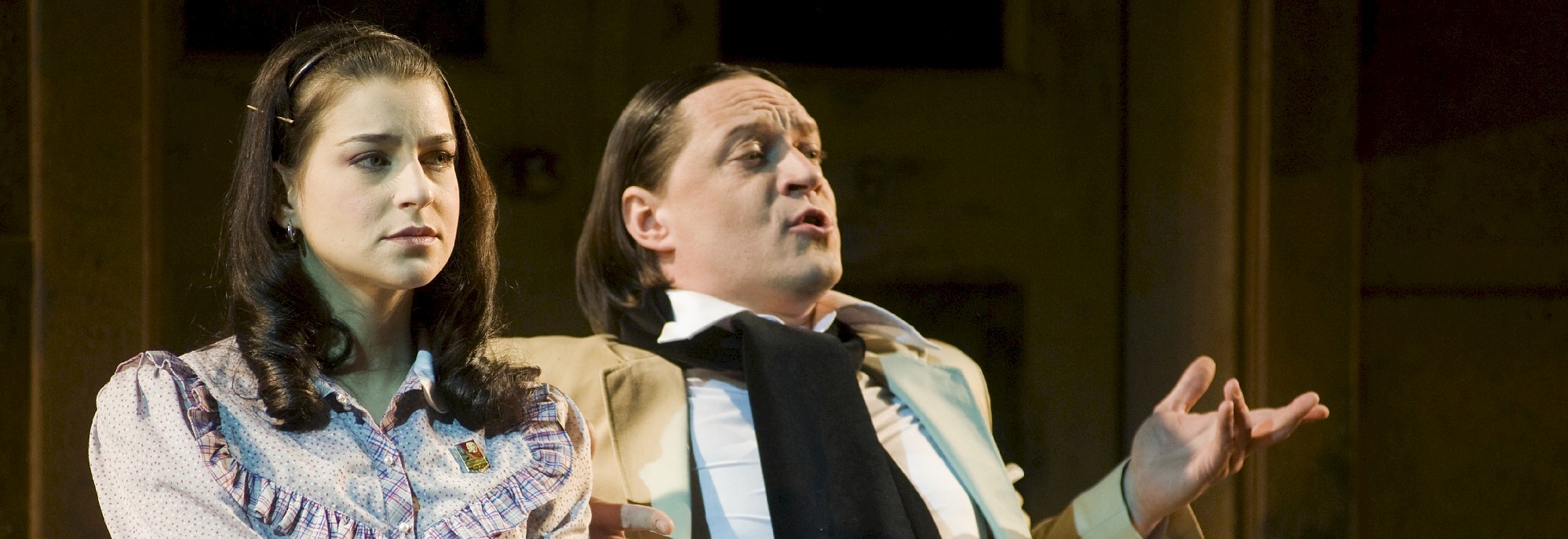
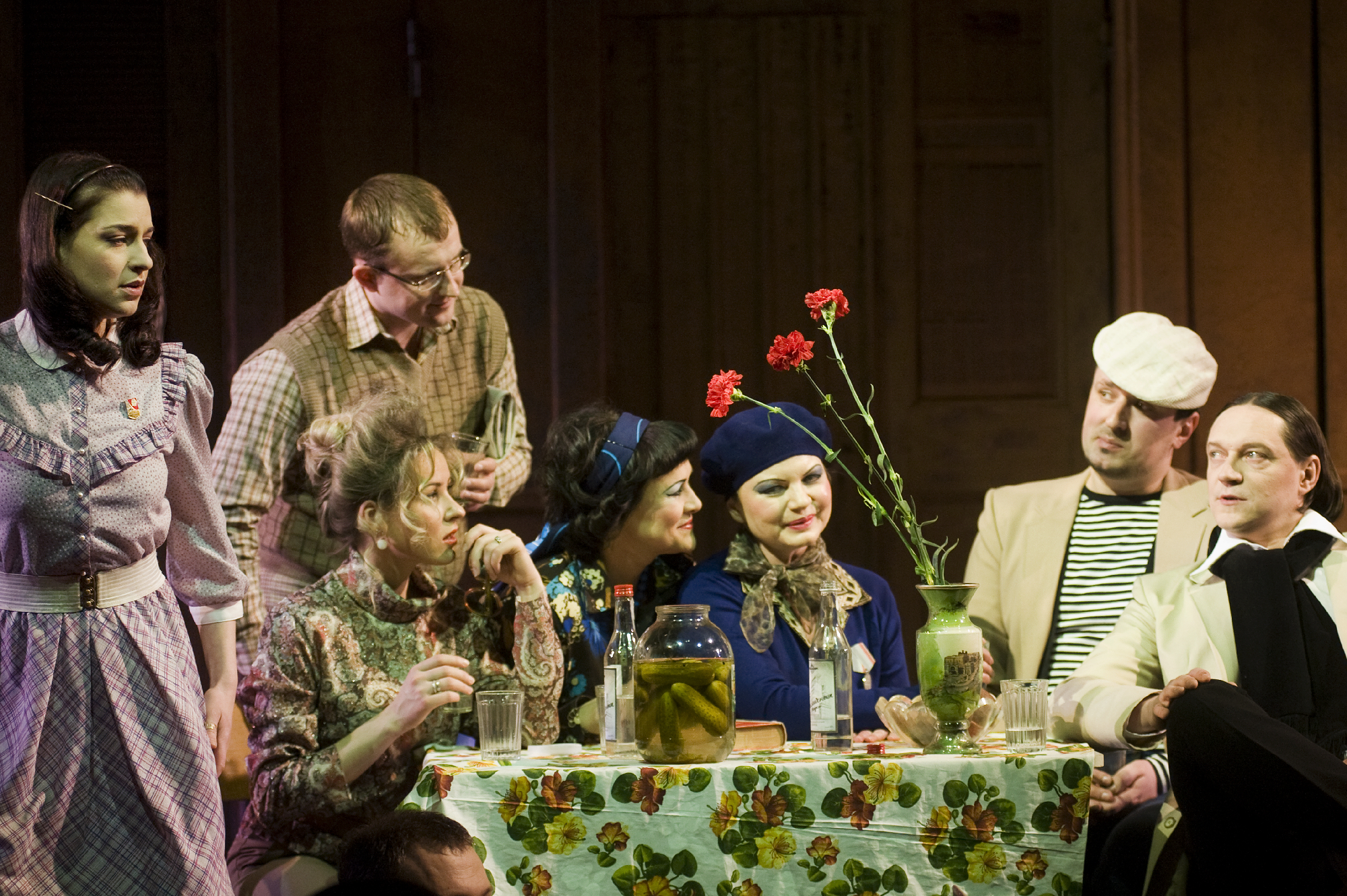
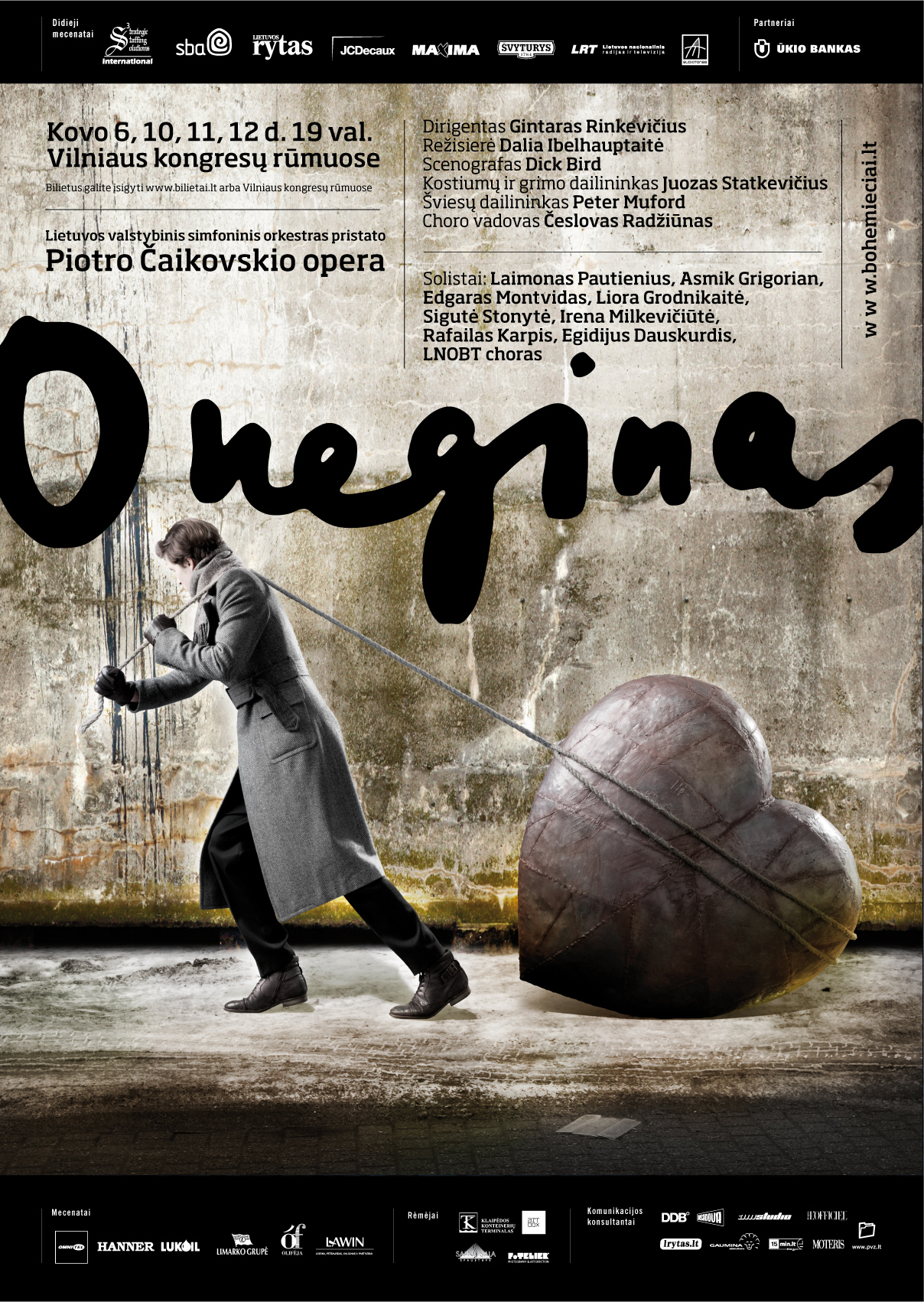
Production of “Onegin”, based on the masterpieces by Alexander Pushkin and Pyotr Tchaikovsky, is one of the most striking interpretations by VCO. Here the action is moved from the beginning of the 19th century to the final decades of the last century - the Soviet-era Russia province of 1970s and the modern world of New York in 1980s. In Lithuania, the atmosphere and concept of the so-called “kommunalki”, or communal apartments, are still well remembered and understood. It is more than just a memory: during the production, in search of props and costumes the scenographer’s assistants collected huge amounts of authentic items from all around Lithuania, while an announcement of the need to find authentic clothes resulted in sacks of Soviet-era basketball shorts, tank-tops, crimplene dresses and other garments, brought in by Vilnius residents.
Another authentic aspect of life in “kommunalka” was not only shared household items, but also shared smells from the communal kitchen. During the celebration of Tatyana’s name day in Act II, the VCO stage turns into a real feast with platefuls of real, fragrant food: from fried onions and boiled potatoes with sausages to a specially made cake and an enormous roast turkey.
3 liters of pickled tomatoes, 3 liters of pickled beets, 3 liters of pickled cucumbers, 3 liters of sauerkraut, as many as 5 jars of canned peas, 6 large “Doktorskaya” sausages, 2 loaves of bread and 8 packs of gingerbreads and “sushki” are used for every performance. And that’s only for starters! The stage also flows with drinks - only vodka is replaced with water, and wine and whiskey with juice and tea. When in Act III the action moves to New York, the role of fancy champagne is played by 6 liters of lemonade.
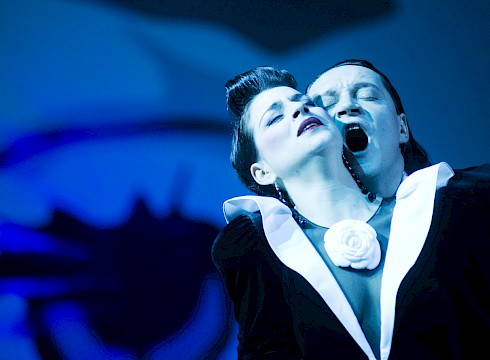
“It is a masterpiece full of lyricism, intimacy, and emotional depth. When one knows a piece really well, a certain creative freedom comes which fuels brave decisions. For this staging I really wanted to find a period in which “Onegin” would sound modern and relevant”, said Dalia Ibelhauptaitė before the premiere. This decision worked out. The roaring applause was followed up by numerous commentary and discussions of the extremely convincing recreation of “kommunalka” world by set designer Dick Bird and costume designer Juozas Statkevičius and of the impressive appearance of both the chorus and the orchestra. Critics also spared no praise, especially for the Act III of the opera: “The sudden leap from the bleak life of “kommunalka” into the cold and sterile elegance of New York left even the biggest critics speechless. P. Tchaikovsky’s polonaise seemed to perfectly fit the fashion show at the beginning of this act. The Congress Hall was turned into a modern art museum of New York, while the audience became participants of a fashion show, as in this performance Tatyana marries not a wealthy Russian, but a millionaire and patron of the arts from New York.”
In 2012, Laimonas Pautienius was awarded the Golden Stage Cross in the category of “Soloist of the Year” for his roles of Onegin (VCO “Onegin”) and Enrico (KVMT “Lucia di Lammermoor”).


Creators


Performers


Lensky
Emilio Pons (Mexico)


Participating in performance
LNOBT choir
Leader Česlovas Radžiūnas
Premiere: 2011 March 06

“KOMUNALKAS” - SPLENDOR AND POVERTY
It would be difficult to find another phenomenon that encapsulates the Soviet way of life as accurately as the komunalka. This Bolshevik invention was perfectly designed for the ambitious project of creating a “new kind of person” - someone who organizes their daily routines and their very being according to the principles of collectivity and equality. How else could several families live together under a single roof, forced to share a communal kitchen, bath, toilet, corridor, or phone? After all, a single apartment could accommodate a remarkable assortment of people - of different education, ages, perspectives, ethnicities, and habits.
STUCK FOR DECADES
In the 1960s, the majority of Soviet families lived in komunalkas. This was because the government encouraged people to move from villages into the cities and distributed rooms in nationalized apartments free of charge. Often, new tenants stayed there for decades - a desirable flat was a privilege for the select few. If each person had only about four and a half square meters of space, their family was not eligible for a better home. The residents of komunalkas used their imagination to protect their autonomy, manage their routines in shared spaces, fairly split expenses, and keep a vigilant eye on their neighbors.
CONFLICTS OF EQUALITY
One citizen’s complaint to state institutions is a case in point - after a divorce, his ex-wife forbade him from partitioning a corner of their communal room. Such comic disputes were a constant feature in komunalkas. Often, there were arguments over communal bills. The neighbor whose phone “code” was composed of several rings, for instance, used more electricity than the rest - just like the one with an electric iron. Should there be a quota for ironing? The komunalka’s activists solved these problems - not for the money, but for the principle of fairness, to make sure nobody lived at someone else's expense.
Meanwhile, utility payments were mere kopecks. The state covered komunalka expenses and was responsible for its upkeep. So when the ceiling fell in, komunalka’s tenants would grit their teeth instead of dipping into their savings for repairs. Leaking taps, rotting pipes, peeling wallpaper, worn floors - these were typical sights in a komunalka. All its occupants belonged to a team that kept it clean, and a cleaning schedule was always displayed in the most busy room - the kitchen.
A LIFE WITHOUT SECRETS
Not a thing escaped the komunalka’s watchful community - not a word about their collective duties, not a bit about who was buying what, what they were cooking, who was visiting, where someone had gone, or whether they'd come back. Even their laundry was not a secret! One komunalka resident admits that after moving in from a private flat, at first, she was ashamed to hang her laundry openly - but not for long. A delicate two-layer method to conceal intimate details was soon met by a chorus of neighbors’ advice to hang laundry more efficiently in order for it to dry faster.
Transplanting komunalka life to another context would be nearly impossible. Where else at night would you bump into a half-dressed neighbor in the corridor, or a woman coloring her hair in the kitchen? Here, people casually walked around in bathrobes or sweats, with towels on their heads, without cosmetics or a care for their appearance. If someone stayed in the bath or restroom for too long, they’d soon hear a knock; if someone lingered on the phone, a neighbor would appear. Sexual relationships were a matter for the community, too - a couple could be together only with their relatives’ permission, while the rest kept track of the minutes in the kitchen or “killed time” with their neighbors.
RAPIDLY EFFICIENT TELEPHONE OF GOSSIP
A komunalka’s resident is a silent detective just outside your door, relayed through their extensive social network. A typical story from a komunalka: a longstanding tenant asked a neighbor to speak to her ex-daughter-in-law’s boss about securing a driver’s job for her son. The elderly woman knew, for instance, that the ex-daughter-in-law was on very good terms with her supervisor! Soviet reality forced people to care not only about their nearest neighbors, but also their relatives’ and friends’ professional and family situations, preferences, and routines - social capital was a perfect substitute for cash. Anything you needed could be gotten through a network of relationships. There was no free market for goods or services. The builders of communism scorned bourgeois comforts and luxury.
ISLANDS OF THE PAST
Today, islands of communal living still remain in stylish districts of Russian cities - resisting generous offers from real estate developers. Some pensioners and solitary individuals even appreciate life there. Here, not only duties but also leisure, birthday parties, and other celebrations are shared. The crumbling walls, worn floors, rotting pipes, and debris-littered hallways do not undermine the komunalka’s residents’ ability to appreciate their buildings’ architectural value and desirable city location.
Related news
Bohemians Turn 20: Anniversary Season to Culminate in Norma with Asmik Grigorian

Sustainability in opera: how Juozas Statkevičius’s costumes were given new life a decade later

When everything hangs in the balance on stage: the invisible heroines of Dalia Ibelhauptaitė’s productions reveal the secrets behind the scenes

How Bohemians’ advertising took to the streets and changed perceptions of opera